

Protecting your business from construction liens in California starts with knowing who may claim lien rights. Under Civil Code § 8400, direct contractors, subcontractors, material suppliers, laborers, equipment lessors, and design professionals may have rights for authorized project work; under Business and Professions Code § 7031, an unlicensed contractor cannot file a valid mechanics lien or sue for compensation for unlicensed work. A recorded lien can affect the property’s title and may interfere with refinancing or borrowing against it.
Paying your general contractor does not necessarily settle every project bill. Subcontractors and suppliers may also have lien rights. This guide explains who may file a lien, how preliminary and completion notices affect deadlines, and how contractor licensing relates to your protections. It also covers practical ways to track payments and releases, and what to consider if a lien is recorded against your property.
Key Takeaways
- Track project payments and collect the appropriate lien releases as payments are made to reduce the risk of unpaid subcontractor claims.
- Understand how preliminary notices and a recorded Notice of Completion can affect lien deadlines, and keep project completion records organized.
- Check whether a lien claimant’s work and licensing status affect their ability to claim or enforce lien rights.
- If a lien is recorded, note the foreclosure deadline and assess whether the lien’s filing and service requirements have been met.
Mechanics Liens in California: Part II: How Can Property Owners Protect Their Properties from Mechanics Liens?
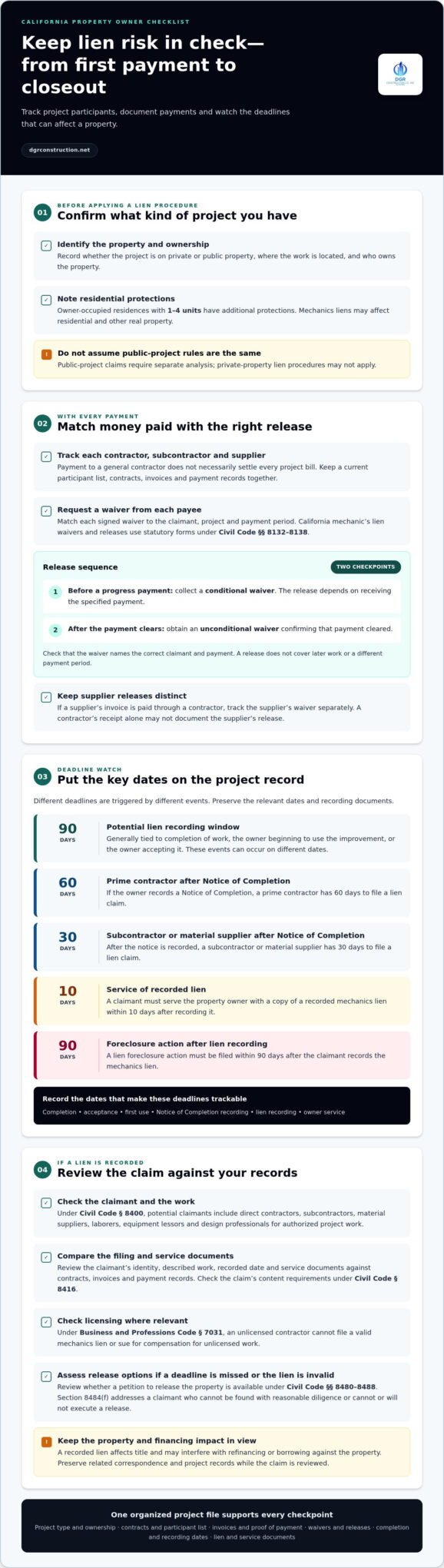
Before applying a lien procedure, identify the project type and ownership. California provides additional protections for owner-occupied residences with 1-4 units, and mechanics liens can affect residential and other real property. Public-project claims require separate analysis; don’t assume private-property lien procedures apply. An invalid lien may be challenged, and an owner who prevails in a release petition may recover reasonable attorney’s fees under Civil Code section 8488.
-
Compare Project Lien Rules
Start by identifying whether the project involves private property, public property, or an owner-occupied residence. Mechanics liens may affect residential and other real property, while owner-occupied residences with 1-4 units have additional protections. Don’t apply private-property procedures automatically to a public project; confirm which claim process fits the property and contract. Record the project type, ownership, and work location with the payment documents so each claim can be assessed against the right project facts.
-
Obtain Lien Waivers
Request a waiver from each contractor or supplier as payments are made, then match it to the payee, project, and payment period. California mechanic’s lien waivers and releases use statutory forms under Civil Code §§ 8132-8138. Keep the signed documents with invoices and proof of payment. For example, if a supplier’s invoice is paid through a contractor, track the supplier’s waiver separately; a contractor’s receipt alone may not document the supplier’s release.
-
Use Conditional and Unconditional Releases
Collect a conditional waiver before making a progress payment, then obtain an unconditional waiver after the payment clears. The conditional waiver makes the release depend on receiving the specified payment; the unconditional waiver confirms that payment cleared. Check that each waiver names the correct claimant and payment. A conditional release does not prove that funds cleared, and an unconditional release does not cover later work or a different payment period.
-
Consider Options After a Missed Deadline
Calendar the enforcement deadline as soon as a claimant records a lien. According to California Legislative Information, a lien foreclosure action must be filed within 90 days after the claimant records the mechanics lien. If the deadline passes, review whether a petition to release the property is available under Civil Code sections 8480-8488. Section 8484(f) addresses a claimant who cannot be found with reasonable diligence or cannot or will not execute a release.
- Resolve a disputed lien by comparing the recorded claim with invoices, contracts, payment records, and required service documents. Check whether the claim meets Civil Code section 8416’s content requirements and whether the owner received the required lien notice. If a court grants a petition to release an invalid lien, Civil Code section 8488 allows reasonable attorney’s fees when the owner used an attorney and prevailed. Preserve each record for that review.
How mechanics liens affect property owners
- Track work completion, acceptance, and first use of each improvement. According to California Legislative Information, a potential lien claimant generally must record a mechanics lien within 90 days of completion of work, the owner beginning to use the improvement, or the owner accepting the improvement. These events can occur on different dates, so preserve completion records, inspection documents, and evidence showing when the property began operating. A dated project log helps identify which event may affect the recording deadline.
- Record a Notice of Completion when appropriate, then calendar the shortened filing periods. According to California Legislative Information, if a property owner records a Notice of Completion, a prime contractor has 60 days to file a lien claim. After that notice is recorded, a subcontractor or material supplier has 30 days to file a lien claim. Keep the county recording date with the project closeout documents, since the deadline depends on when the notice is recorded.
- Identify who performed or supplied authorized project work. Under California Civil Code § 8400, direct contractors, subcontractors, material suppliers, laborers, equipment lessors, and design professionals may have mechanics lien rights. A subcontractor’s unpaid invoice, for example, may create a property claim even when the owner paid the direct contractor. Keep contracts, invoices, payment records, and a current list of project participants together to trace each claim to its source.
- Consider how a recorded lien could affect the property’s title and financing. A mechanics lien creates a claim against the property and may complicate refinancing or obtaining a loan secured by it. If you plan to refinance, a recorded claim can affect a lender’s review until the dispute is resolved or the lien is released. Treat the recorded document as a property matter, not just an invoice disagreement, and keep related correspondence.
- Review each lien notice promptly and compare it with project records. A claimant must serve the property owner with a copy of a recorded mechanics lien within 10 days after recording it. Check the claimant’s identity, the work described, the recorded date, and the service documents against contracts and invoices. If work remains disputed, separate the contested items from completed payments in your records. For a commercial tenant improvement, orderly scopes and project records can support clearer administration; explore commercial tenant improvement work.
Who Can File a Mechanic’s Lien?
- Map every participant to the work they performed or supplied. Under California Civil Code § 8400, direct contractors, subcontractors, material suppliers, laborers, equipment lessors, and design professionals may have lien rights for authorized project work. A supplier delivering materials and a design professional providing project services fit different claimant categories. Use contracts, purchase orders, invoices, and work records to identify each party and its role.
- Separate the direct contractor from lower-tier participants in your payment ledger. The direct contractor has a contract with the owner, while subcontractors and suppliers may receive payment through that contractor. List each subcontractor, supplier, laborer, equipment lessor, and design professional involved in the work. Match each participant to their scope and invoices. This record helps you identify who may still be unpaid when a payment request arrives.
- Consider a joint check when paying a contractor for work performed by an identified subcontractor. Make the check payable to both the general contractor and subcontractor, so both named parties are included in the payment. For California property owners, this can help manage subcontractor lien risk. A disciplined payment process is one practical step in protecting your business from construction liens in California.
- Match each joint check to a specific invoice before issuing payment. Confirm the payees’ names, the subcontractor’s scope, and the amount allocated to that work. Keep a copy of the check and supporting invoice with the payment record. If one payment covers separate trades or suppliers, document each allocation. This makes it easier to trace who was paid and which invoices remain outstanding.
- Reconcile payment records against the project participant list after each payment cycle. Compare the direct contractor’s request with subcontractor and supplier invoices, then record any remaining balances. A joint check addresses payment to the identified subcontractor, but it does not document payment to every participant. Tracking each claimant and retaining payment records helps protect your business from construction liens in California.
Preliminary notice requirements and deadlines
- Create a notice log when subcontractors begin work or suppliers deliver materials. In California, subcontractors and material suppliers generally have 20 days after beginning work or delivering materials to serve a Preliminary Notice on a homeowner. Record the date received, sender, project address, described work, and hiring party. For example, log a materials supplier’s notice separately from the subcontractor installing those materials. This gives the owner a clear record of who is involved and when their notice arrived.
- Compare the notice date with the claimant’s first work or delivery date. A late Preliminary Notice limits lien rights to work performed or materials delivered during the 20 days before the notice and afterward. It doesn’t cover earlier work or deliveries under that rule. For example, if a supplier’s notice arrives after deliveries began, match each delivery record to its date. Keep the notice and delivery tickets together so the affected period can be identified.
- Distinguish laborers from subcontractors and suppliers when reviewing notices. Laborers are not required to give homeowners a Preliminary Notice to preserve lien rights, so the absence of a laborer’s notice does not establish that no lien claim can arise. A prime contractor must provide a Preliminary Notice to the construction lender when a contracted project is financed by a loan. Record the lender and financing status in the project file, and track the prime contractor’s notice separately.
- If you receive a Preliminary Notice or intent-to-lien notice, request a current list of subcontractors, suppliers, and people working on the property. Compare it with the contracts, invoices, and payment records on file. If the notice names a supplier missing from the project ledger, identify the contractor who engaged that supplier and record the relationship. This can reveal payment channels that may not appear on the prime contractor’s invoices.
- Use each notice to update payment oversight, not as proof that the claimant has filed a lien. Match the claimant to its scope, hiring party, and invoices, then note whether its work or deliveries appear in the current payment request. For example, a supplier’s notice can prompt you to review its unpaid invoices before releasing funds. Keep the notice, correspondence, payment records, and any updated participant list together for later review.
Contractor licensing and lien rights
- Separate a claimant’s trade role from its licensing status. A contractor may perform work that could otherwise support a lien claim, but California licensing rules can limit that right. Under Business and Professions Code § 7031, an unlicensed contractor cannot file a valid mechanics lien or sue for compensation for unlicensed work. Review the agreement, invoices, and project records together; a company name on an invoice alone doesn’t establish who performed the work or under what license.
- Compare the contractor named in the agreement with the party that performed the work. Match names across the contract, invoices, payment applications, and correspondence, and record any differences. If one business signed the agreement but another appears on a claim, identify each entity’s role before treating the claim as established. Licensing and the claimant’s connection to the work both matter, so do not rely on a payment record alone.
- Keep licensing documents in the project file from the start. Record the contractor’s name and license details as shown in project documents, then compare them with the names on payment requests and lien notices. If the records identify different entities, note the discrepancy and connect it to the relevant scope and dates. This creates a clear trail for assessing whether the claimant is the contractor responsible for the work described.
- Distinguish filing a lien from enforcing one through foreclosure. In California, a non-licensed individual cannot foreclose on a mechanics lien for work valued at more than $500. This restriction is separate from Business and Professions Code § 7031, which addresses an unlicensed contractor’s ability to file a valid lien or sue for compensation for unlicensed work. Review the claimant’s licensing status and the specific work before assessing the legal effect of a recorded claim.
- Organize the contract, scope, invoices, license information, and payment records before a dispute develops. If a claim identifies unlicensed work, preserve the documents showing who performed it and what compensation is sought. Licensing status doesn’t replace review of the claimant’s role or project records. For a commercial build, clearly defined scopes and coordinated project documentation support orderly administration. Plan your commercial construction project with those records in view.
DGR Construction: Aerospace Construction
DGR Construction Co. is a natural next step when your business is planning an aerospace facility or another complex commercial project. Its Aerospace Construction, Data Center Construction, Industrial Construction, and Tenant Improvement work is supported by design-build construction management, coordinating architectural design, engineering, and on-site building. For owners, clear coordination among project participants helps keep scopes, responsibilities, and payment records organized, key details when managing lien exposure. Bring DGR into the conversation as you shape project requirements and delivery, so the construction process has a coordinated point of accountability. Contact DGR Construction Co. to discuss your commercial project.
Set Project Controls Before Work Begins
Make lien-risk management part of project setup, not just closeout. Before construction starts, assign responsibility for maintaining contracts, payment records, notices, and release documents. Set a consistent process for updating these records as scopes and participants change. This gives your team a clear reference when a payment question or claim arises, rather than leaving key details scattered across emails and individual files.
A practical next step in protecting your business from construction liens in California is to incorporate documentation and payment coordination into the project’s regular management routine. If you’re planning a commercial construction project, DGR Construction can discuss how its construction work fits your requirements. Contact DGR Construction to discuss your project, and move forward with a clearer plan for managing project responsibilities.
Frequently Asked Questions
What are California construction liens and who can file one?
A California mechanics lien is a recorded claim against property tied to unpaid authorized project work. Under Civil Code § 8400, direct contractors, subcontractors, material suppliers, laborers, equipment lessors, and design professionals may have lien rights. For example, a materials supplier may assert a claim if its project invoice remains unpaid. A recorded lien affects the property’s title, so identify the claimant and the work connected to its claim.
What are the deadlines for serving and recording a California mechanics lien?
Subcontractors and material suppliers generally have 20 days after starting work or delivering materials to serve a Preliminary Notice. A potential lien claimant generally must record a lien within 90 days of work completion, the owner’s first use, or acceptance of the improvement, according to California Legislative Information. Make sure the property owner receives a copy of any recorded lien. A recorded Notice of Completion changes some claimants’ filing periods.
How can a California property owner verify contractor and subcontractor licenses?
Use the California Contractors State License Board’s public license information to compare a contractor’s license record with the name on its agreement and payment documents. Check subcontractors separately, since the business named on an invoice may differ from the entity performing the work. Save the relevant record with the contract and scope documents. If names or roles do not align, document the discrepancy before processing related payment requests.
What preliminary notices must contractors and suppliers send in California?
Subcontractors and material suppliers generally serve a Preliminary Notice within 20 days after beginning work or delivering materials. A late notice limits lien rights to work performed or materials delivered during the 20 days before notice and afterward. Laborers aren’t required to provide homeowners a Preliminary Notice to preserve lien rights. For loan-financed projects, the prime contractor must provide a Preliminary Notice to the construction lender.
How can a business owner require lien releases before making progress or final payments?
Build release documentation into payment administration: identify each payee, link the release to the payment and work period, and keep it with the payment record. California property owners may withhold the next payment until they receive unconditional releases for the previous payment. However, an owner cannot withhold a contractor’s entitled payment solely because the owner is dissatisfied with the work. Keep payment disputes separate from release records.
What are California conditional and unconditional lien waivers, and when should each be used?
A conditional release is used before payment and ties the release to receiving the specified funds. An unconditional release is used after payment clears. California’s statutory lien waiver and release forms appear in Civil Code §§ 8132-8138. Match each document to the claimant and payment covered; don’t treat a conditional release as proof that funds cleared or assume a release for one payment covers later work.
How can a California business protect itself with joint checks, payment bonds, or escrow?
When paying a contractor for an identified subcontractor’s work, consider issuing a joint check payable to both parties. Match the check to the subcontractor’s invoice and scope, then retain the payment record. If you are considering a payment bond or escrow arrangement, define the covered claims, payment conditions, and release process in the project documents. Align those terms with the project’s payment workflow and participant records.
What are the deadlines and steps for enforcing or removing a California mechanics lien?
A claimant must file a foreclosure action within 90 days after recording its mechanics lien, according to California Legislative Information. For a recorded claim, preserve the lien document, service papers, contract, and payment records. To challenge an invalid lien, an owner may petition for release under Civil Code sections 8480-8488. Section 8488 allows reasonable attorney’s fees when an owner uses an attorney and prevails in that petition.