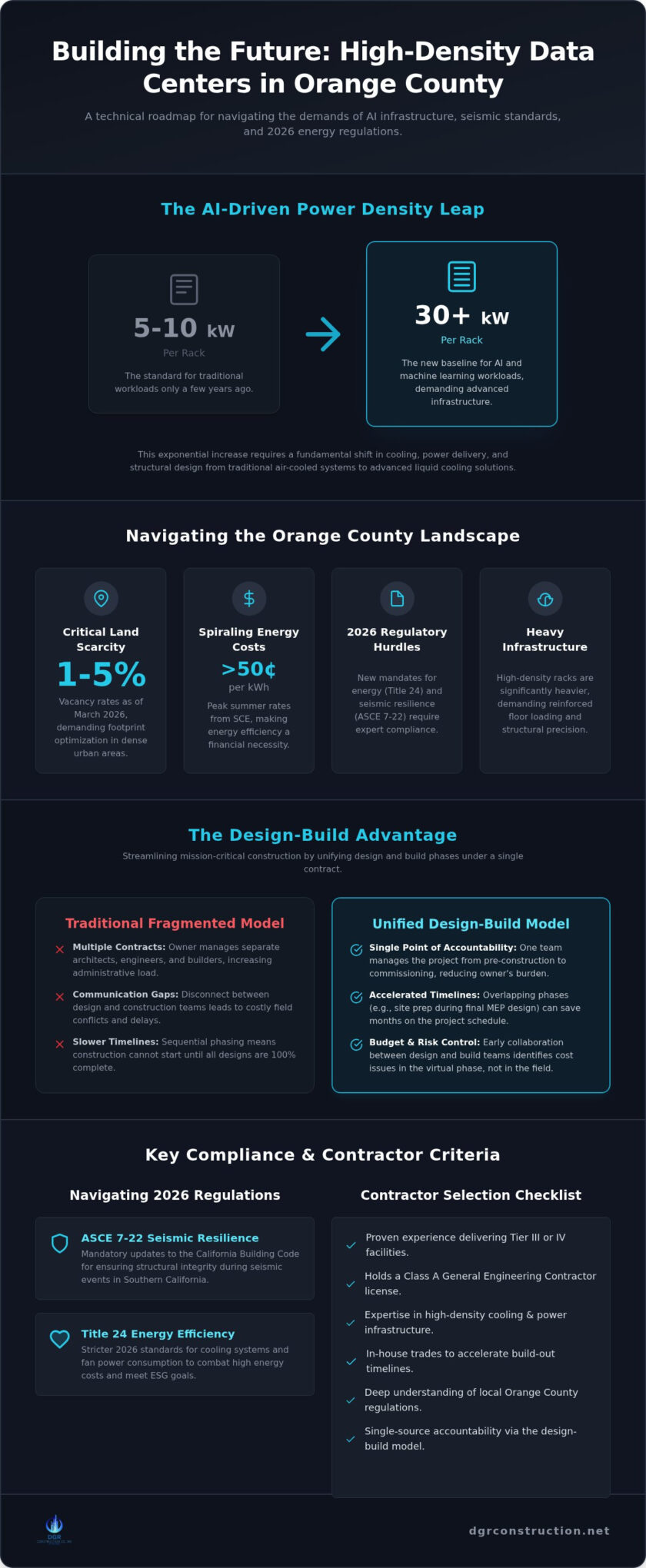
AI and machine learning workloads now demand 30 kilowatts or more per rack, representing a significant leap from the 5 to 10 kilowatts that defined the industry only a few years ago. You likely recognize that building a facility to handle this density in Southern California is no longer a standard commercial endeavor. Successfully managing data center construction in Orange County requires a precise alignment of high-density cooling, power availability, and the strict 2026 Title 24 energy standards. It requires a partner who treats technical compliance as a baseline rather than a hurdle.
We understand the stress caused by specialized MEP requirements and the administrative weight of coordinating fragmented teams. This guide provides a technical roadmap for 2026, offering expert insights on how to integrate ASCE 7-22 seismic resilience with hyper-efficient infrastructure under a single contract. You’ll learn how the design-build model reduces administrative burdens and ensures your project meets Tier III or IV standards. We’ll explore the critical updates to the California Building Code and show you how a streamlined approach keeps your mission-critical build on schedule and within budget.
Key Takeaways
- Understand why AI-driven workloads are pushing power densities to 30kW per rack and how this shifts infrastructure needs in Southern California.
- Learn how the design-build model for data center construction Orange County eliminates administrative friction by providing a single point of accountability from pre-construction to commissioning.
- Navigate the 2026 regulatory landscape, including the new ASCE 7-22 seismic design standards and Title 24 energy efficiency mandates for cooling systems.
- Discover how leveraging in-house union trades and real-time project monitoring can accelerate build-out timelines while preventing costly MEP overruns.
- Identify the critical technical criteria for selecting a Class A licensed general contractor capable of delivering Tier III or IV mission-critical facilities.
The Evolution of Data Center Construction in Orange County
Orange County has transitioned from a secondary storage market into a high-stakes environment for edge computing and AI infrastructure. With vacancy rates sitting between 1% and 5% as of March 2026, the pressure on data center construction Orange County to deliver high-performance facilities has never been higher. Building a modern data center in an urban Southern California setting presents unique challenges, particularly regarding footprint optimization and noise mitigation in densely populated areas. DGR Construction Co. serves as the critical bridge between complex IT requirements and the physical realities of Class A commercial builds. We ensure that technical specifications translate into functional, scalable structures that remain stable under heavy operational loads.
Meeting AI and High-Density Power Demands
The hardware landscape has shifted rapidly. AI workloads now demand 30 kilowatts or more per rack, which is a massive increase from the 5 to 10 kilowatt averages seen just a few years ago. Traditional air-cooled systems often fail under these loads, necessitating a move toward liquid cooling. We focus on preparing the building envelope for these advanced systems while reinforcing floor loading capacities. High-density racks are significantly heavier than standard equipment; therefore, structural precision is mandatory to prevent settling or structural fatigue. DGR manages these technical nuances by coordinating with specialized MEP engineers during the earliest design phases to ensure the facility can support 2026-era hardware.
The Shift Toward Sustainable Data Facilities
Energy efficiency is now a financial necessity rather than an elective feature. With Southern California Edison (SCE) system-wide rates averaging 34.4 cents per kWh, and peak summer rates exceeding 50 cents, operational costs can spiral without aggressive efficiency strategies. The 2025 Building Energy Efficiency Standards (Title 24, Part 6), effective January 1, 2026, mandate stricter cooling system performance and fan power consumption limits. Modern corporate tenants view sustainability as a prerequisite for leasing. We integrate renewable energy sources and backup battery storage into the facility design to meet these ESG goals while maintaining mission-critical uptime. By addressing power constraints and seismic codes early, DGR ensures your facility remains compliant and competitive in the local market.
The Design-Build Advantage for Mission-Critical Facilities
Mission-critical facilities don’t tolerate the friction of traditional construction methods. By consolidating design and construction under one contract, DGR Construction Co. eliminates the typical disconnect between architects and technical builders. This single-source accountability means that the team responsible for the final physical product is the same team overseeing the initial blueprints. It’s a method that prioritizes precision and reduces the administrative burden on the owner. For data center construction Orange County, this model is the most effective way to manage the technical compliance required by complex state regulations.
The primary advantage of this approach is speed. We often begin structural work and site preparation while the final MEP details are still being refined. This overlap can save months on the project timeline, which is vital when power reservations and hardware delivery schedules are fixed. Early collaboration with MEP engineers allows us to identify potential conflicts in the virtual design phase rather than in the field. This proactive management protects the budget from hidden costs and ensures that the facility meets the rigorous standards for Seismic Resilience and Compliance mandated by the 2026 California Building Code.
Phase 1: Pre-Construction and Technical Design
Transitioning from design to build-out is seamless when the trades are managed in-house. DGR utilizes our own union drywall and T-bar teams to accelerate structural work, maintaining total control over quality and scheduling. We manage every phase through Procore, providing owners with real-time transparency into project milestones and field reports. This level of oversight extends through the integration of server racks and supporting infrastructure. If you are planning a high-performance facility, our design-build expertise ensures your project moves from concept to commissioning without the usual logistical hurdles.
Seismic Resilience and Compliance in Southern California
The 2025 California Building Standards Code, which becomes effective on January 1, 2026, introduces a more rigorous basis for seismic design by adopting the ASCE 7-22 standard. For any team managing data center construction Orange County, this regulatory shift impacts every stage of structural engineering, from continuous solid foundations to braced wall panels in high seismic design categories. Precision is non-negotiable. Building owners must ensure their facilities can withstand significant lateral forces without compromising the integrity of mission-critical hardware. Many contractors are leveraging a Design-Build Advantage to navigate these evolving technical standards while maintaining aggressive delivery schedules.
Energy compliance is equally demanding. The 2025 Building Energy Efficiency Standards (Title 24, Part 6) mandate specific cooling system efficiencies and containment strategies that directly influence the construction budget. Beyond energy, Orange County zoning laws often impose strict limitations on facility height and density, particularly in areas transitioning from light industrial to tech-heavy use. Managing these complexities requires a comprehensive Environmental Impact Report (EIR) and a deep understanding of the California Environmental Quality Act (CEQA). DGR Construction Co. handles these administrative and technical hurdles by integrating compliance checks into the earliest design phases, preventing costly mid-project corrections.
Seismic Retrofitting for Existing Structures
Converting an existing industrial warehouse into a high-tier data center is a common strategy in the land-constrained Orange County market. However, these structures rarely possess the floor loading capacity required for modern server deployments. We specialize in structural reinforcement techniques, such as adding steel bracing and carbon fiber wraps to existing columns. These enhancements support heavy equipment platforms and ensure the facility meets Tier III or IV standards. DGR has successfully managed complex structural renovations across Southern California, applying decades of experience to make older buildings viable for 2026-era technology.
Thermal Management and T-Bar Ceiling Systems
Effective thermal management relies heavily on the precision of the building’s physical seals. We utilize our in-house union drywall and T-bar teams to ensure airtight hot and cold aisle containment, which is essential for maintaining the pressure differentials required by high-density cooling systems. Specialized T-bar ceilings do more than provide a finished look; they serve as a critical component of the airflow management strategy. Our teams also address acoustic attenuation requirements. Large-scale cooling plants generate significant noise, and we implement specialized wall assemblies to ensure the facility remains a responsible neighbor within the local community.
Choosing the Right Data Center General Contractor
Selecting a partner for data center construction Orange County requires a move beyond general commercial experience. While many firms can manage a standard office build, mission-critical facilities demand a Class A licensed contractor who understands the intersection of heavy structural requirements and high-density MEP systems. The complexity of these projects leaves no room for the learning curves often associated with non-specialized builders. A qualified contractor must provide a track record of reliability and a management style that prioritizes transparency through every phase of the project life cycle.
Precision in this sector is often a direct result of the labor force utilized. Union labor provides a level of training and technical proficiency that is essential for the high-stakes environment of a data center. These tradespeople are accustomed to the rigorous standards of industrial and aerospace construction, ensuring that every seal is airtight and every structural component meets exact tolerances. DGR Construction Co. leverages this expertise to provide owners with a stable, predictable building experience that minimizes the risks of technical failure or project delays.
The Value of Self-Perform Capabilities
One of the most significant risks in complex construction is the reliance on a fragmented chain of third-party subcontractors. We mitigate this risk by maintaining in-house union drywall and T-bar teams. By self-performing these critical trades, we maintain total control over the quality and schedule of the building envelope. This capability is particularly vital during the final build-out phase, where specialized ceiling systems and containment walls must be installed with absolute precision to support thermal management. Direct management of these trades can save weeks on the final delivery timeline, ensuring the facility is ready for server integration on schedule.
Safety and Quality Management Systems
Operational excellence is measured by more than just the final structure; it is defined by the safety and transparency of the process. A zero workplace accident record is a primary metric of a disciplined organization. We reinforce this culture of safety with daily “look-ahead” schedules and real-time project visibility through Procore. This software integration allows stakeholders to monitor field reports, photos, and submittals from any location. This level of oversight fosters long-term relationships built on trust and performance. If you are ready to discuss the technical requirements of your next project, our team provides the data center construction expertise necessary to deliver a high-performance facility.
DGR Construction: Your OC Data Center Partner
Building a facility that meets 2026 technical standards requires more than just engineering knowledge; it requires a partner who manages the entire experience with professional discipline. For over 25 years, DGR Construction Co. has defined the standards for data center construction Orange County by delivering high-profile commercial and industrial projects that prioritize stability and reassurance. Our mission is to provide a clean and seamless construction process where client stress is removed through meticulous planning and a single point of accountability. We don’t rely on hyperbole; we rely on a proven track record of delivering mission-critical environments on time and under budget.
The complexity of Southern California’s regulatory environment demands a contractor who is deeply rooted in the local market. DGR projects a quiet expert persona, focusing on the precision required for Tier III and IV facilities while ensuring every structural element complies with the latest seismic and energy codes. By maintaining a Class A license and a 0 workplace accident record, we offer the reliability necessary for high-stakes builds. Our role as a premier partner for data center construction Orange County involves more than just structural work. It is about managing the relationship between technical needs and physical execution to ensure a frictionless experience for every stakeholder.
From Design to Occupancy
Successful project delivery begins long before the first slab is poured. DGR manages the entire lifecycle of the build, from navigating the intricate permit processes of Orange County to the final coordination of server racks and specialized furniture. We understand how to bridge the gap between initial blueprints and operational reality, ensuring that long-lead items like generators and liquid cooling systems are integrated without delaying the schedule. For those evaluating their options, we have outlined how regional expertise compares to larger firms in our guide to the top data center construction companies for 2026.
Start Your Mission-Critical Project
We invite you to request a tailored consultation to discuss the specific power, cooling, and seismic requirements of your next facility. Every project we manage utilizes Procore integration, providing you with real-time tracking, daily field reports, and total transparency from any location. This level of oversight is a standard feature of our management philosophy. The technical precision we apply to data facilities often overlaps with our work in other high-performance sectors, such as Aerospace Facility Construction, where compliance and quality are non-negotiable. Contact DGR Construction Co. today to begin planning a facility that is built for the demands of the future.
Securing Your Mission-Critical Infrastructure in 2026
The shift toward high-density AI hardware and stricter 2026 standards has redefined success in Southern California. Delivering a Tier III or IV facility depends on a design-build approach that integrates seismic resilience with hyper-efficient cooling from the start. By consolidating accountability, you eliminate the friction that leads to MEP cost overruns and permitting delays. This methodology ensures technical requirements drive the build rather than complicating it, resulting in a facility that’s both compliant and operationally superior.
DGR Construction Co. brings the authority of a Class A Commercial Contractor and a Certified Minority Contractor to every project. With over 25 years of experience, we understand the nuances of managing data center construction Orange County to prioritize technical excellence and client peace of mind. Our self-perform capabilities and Procore-driven transparency ensure your facility is delivered with the craftsmanship your operations demand. We manage the complexity so your team can remain focused on long-term growth.
If you’re ready to navigate 2026 hardware requirements and state compliance, our team is prepared to lead the way. Contact DGR Construction for a Data Center Consultation to discuss your facility’s specific needs. We look forward to building a stable, high-performance foundation for your digital future.
Frequently Asked Questions
What is the average timeline for data center construction in Orange County?
Timelines for mission-critical facilities vary based on scale and power availability, though most projects range from 12 to 24 months. Our design-build model accelerates this schedule by starting structural work while final MEP designs are still being refined. This overlap can save several weeks on the project lifecycle. Factors such as Southern California Edison infrastructure delivery and local permit processing also influence the final occupancy date.
Do I need a specialized contractor for data center seismic retrofitting?
Yes, mission-critical facilities require a contractor who understands the structural demands of high-density hardware and updated 2026 codes. Retrofitting involves reinforcing foundations and adding steel bracing to support heavy server platforms. DGR has extensive experience in complex structural renovations, ensuring existing buildings meet the ASCE 7-22 seismic standards. A specialized approach prevents structural fatigue and protects your hardware investment during seismic events common in Southern California.
How does the design-build model reduce costs for technical facilities?
The design-build model reduces costs by providing a single point of responsibility, which minimizes expensive change orders and administrative friction. By coordinating architects, engineers, and builders under one contract, we identify MEP conflicts before construction begins. Our self-perform capabilities for drywall and T-bar work eliminate third-party markups and ensure quality control. This integrated approach allows us to deliver high-performance data center construction Orange County projects under budget.
What are the California Title 24 requirements for data center cooling?
The 2025 Title 24 Part 6 standards mandate specific energy efficiency ratios for cooling systems and require airtight hot or cold aisle containment. These regulations focus on fan power consumption and economizer performance to reduce the environmental footprint of data facilities. We utilize our in-house teams to install precision T-bar ceilings and containment walls that meet these mandates. Compliance ensures lower operational costs and alignment with California’s aggressive sustainability goals.
Why is union labor preferred for data center build-outs?
Union labor is preferred because it guarantees a high level of technical training and precision for complex builds. Signatory to the Carpenters Union, DGR employs tradespeople who are skilled in meeting the exact tolerances required for mission-critical facilities. This expertise is vital for installing sound-attenuated walls and specialized platforms. Reliable labor reduces the risk of rework, ensuring the facility meets Tier III or IV standards without schedule slippage.
Can DGR Construction handle both new builds and tenant improvements?
DGR Construction Co. handles both ground-up new builds and specialized tenant improvements for commercial clients. Whether you are constructing a new facility or converting an industrial warehouse into a modern data center, we manage the entire lifecycle from permits to furniture coordination. Our experience with high-profile clients demonstrates our ability to deliver tailored environments that meet specific technical and aesthetic requirements in urban Southern California settings.
How do you manage noise and environmental concerns in urban OC locations?
We manage urban constraints through sophisticated acoustic attenuation and rigorous adherence to the California Environmental Quality Act (CEQA). Cooling plants generate significant noise, so we install STC-rated wall assemblies to protect the surrounding community. Our team also handles the complexities of environmental impact reports for large-scale projects. By addressing these concerns during the design phase, we ensure the facility remains a responsible neighbor while meeting density goals.
What project management software does DGR use for client transparency?
We utilize Procore to provide complete transparency and real-time project monitoring for our clients. This platform centralizes RFIs, submittals, daily reports, and project photos in one accessible location. Clients can check the daily report tab to stay informed about progress and upcoming milestones. This digital integration ensures that communication remains constant and that every stakeholder has the data needed to make informed decisions throughout the build.