In 2026, the success of a data center project isn’t measured by the total square footage of the builder, but by their ability to navigate a power grid reaching its absolute limit. Selecting from the top data center construction companies requires more than just looking at a portfolio of past successes. It demands a partner who understands the immediate implications of California’s 2025 Title 24 energy standards and the rigid requirements of Senate Bills 886 and 887. You’re likely feeling the weight of these new regulations, especially when the fear of schedule slippage in a high-demand market can result in millions of dollars in lost opportunity.
We recognize that managing multiple subcontractors for cooling and power redundancy, while simultaneously clearing Southern California’s permitting hurdles, is a daunting task. This article compares the leading national data center builders with specialized regional partners to help you find the right fit for your 2026 infrastructure project. You’ll gain a shortlist of qualified builders, a clear understanding of when to choose a national firm versus a local expert, and a proven framework for selecting a design-build partner that prioritizes speed, precision, and local compliance.
Key Takeaways
- Understand how AI-driven demand and the 2026 power availability crisis are reshaping infrastructure requirements for mission-critical facilities.
- Learn how to evaluate the top data center construction companies by weighing the global scale of national giants against the speed and local compliance of regional experts.
- Identify critical selection criteria for 2026, including the importance of zero-accident safety records and the quality control benefits of in-house union labor.
- Navigate the specific complexities of the Southern California market, from seismic engineering requirements to the latest Title 24 energy standards.
- Discover how the design-build model streamlines the transition from initial shell construction to final occupancy for faster project delivery.
Evaluating the Landscape of Data Center Construction in 2026
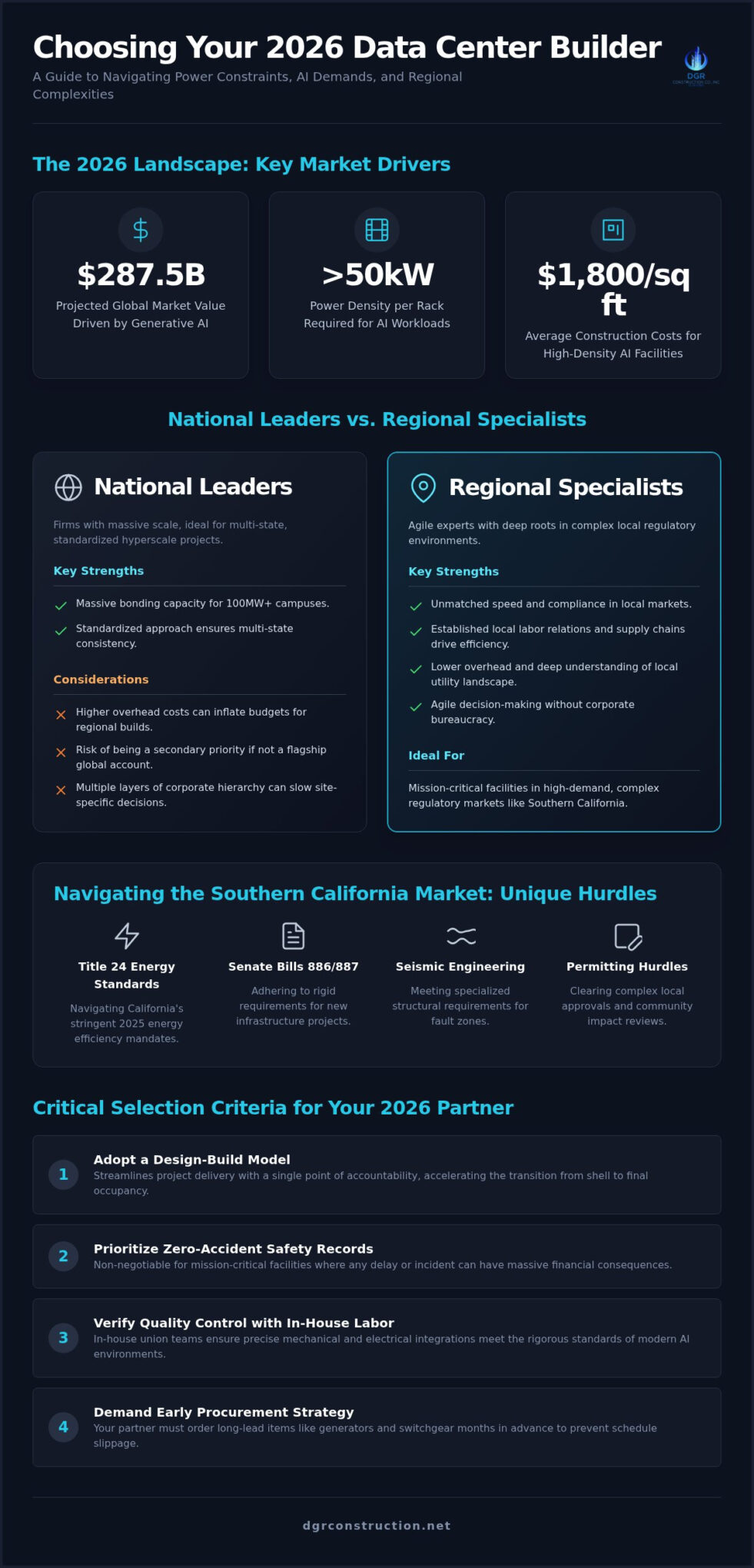
The data center boom has shifted from simple storage to high-intensity processing. In 2026, the global market value is projected at $287.5 billion, driven primarily by generative AI requirements. Providing a comprehensive Data Center Overview for these projects reveals that traditional construction methods no longer suffice. Power availability has replaced location as the primary constraint. Developers now prioritize partners who can secure grid connections and manage extreme power densities while adhering to strict environmental safeguards.
Mission-critical construction in this era means zero downtime is the baseline, not the goal. The top data center construction companies distinguish themselves by their ability to integrate complex electrical and mechanical systems during the earliest design phases. It’s a shift from the old stick-build approach toward integrated delivery. This methodology ensures that cooling and power redundancy aren’t just added features but are built into the structural DNA of the facility. The general contractor acts as the central point of accountability, managing the delicate balance between rapid deployment and long-term operational stability.
The AI Impact on Infrastructure Requirements
High-density computing is forcing a radical redesign of the data center floor. AI workloads often require racks exceeding 50kW. This significantly increases floor load requirements and heat output. Traditional HVAC systems are giving way to liquid cooling solutions, such as rear-door heat exchangers or direct-to-chip cooling. These systems require specialized plumbing and structural reinforcements to handle the added weight of liquid and high-density server hardware. DGR Construction utilizes in-house union teams to ensure these precise mechanical integrations meet the rigorous standards of modern AI environments.
Speed to Market: The Competitive Edge
Delays in 2026 are exceptionally costly. With average construction costs for AI facilities reaching $1,200 to $1,800 per square foot, every day of vacancy represents a massive loss in potential revenue. The industry is moving away from the fragmented Design-Bid-Build model in favor of Design-Build at DGR Construction. This approach streamlines the process by creating a single point of accountability. Early procurement is also essential. General contractors must now order long-lead items like backup generators and specialized switchgear months before the first shovel hits the ground to avoid schedule slippage in a high-demand market.
National Leaders vs. Regional Specialists: A Comparative Breakdown
Selecting the right partner from the list of top data center construction companies depends largely on the scale and geographic scope of your 2026 project. While national conglomerates offer immense resources, they often carry substantial overhead costs that can inflate budgets for regional builds. In high-demand markets like Southern California, the “regional advantage” isn’t just about proximity; it’s about having established roots in a complex regulatory environment. Local specialists frequently outperform national giants on speed and compliance because they don’t have to navigate several layers of corporate hierarchy to make a site-specific decision.
The cost structure of a project often reveals the true difference between these two tiers. National firms must account for the logistics of traveling teams and multi-state administrative burdens. Conversely, regional experts leverage local labor relations and existing supply chains to drive efficiency. This local focus is especially critical when managing the Key Considerations for Data Center Development, such as community impact and power usage, which require a nuanced understanding of the local utility landscape.
Tier 1 National Contractors: Scale and Reach
Firms like DPR, HITT, and Turner provide massive bonding capacity and a standardized approach that appeals to hyperscale developers building 100MW+ campuses. Their primary strength lies in multi-state consistency. If you’re building identical facilities in three different time zones, a national giant ensures a uniform result. However, for projects that fall below the “mega-campus” threshold, there’s a risk of being assigned to a secondary project team. These firms often prioritize their largest global accounts, which can lead to staffing inconsistencies for smaller, more specialized data center projects.
Regional Design-Build Specialists: Agility and Expertise
Regional specialists excel in environments where agility is the primary currency. These firms offer direct principal involvement, meaning the people making the decisions are often the ones walking the job site. This hands-on approach is ideal for edge data centers, colocation retrofits, and complex tenant improvements. Because they maintain deep ties to the local community and labor unions, these builders can often bypass the scheduling delays that plague out-of-state contractors. For projects in Los Angeles or Orange County, partnering with DGR Construction provides the stability of 26 years of local experience combined with the streamlined efficiency of a design-build model.
Critical Selection Criteria for Mission-Critical Facilities
Identifying the top data center construction companies requires a rigorous evaluation of operational standards that extend beyond simple revenue rankings. A builder’s safety record serves as the most reliable indicator of project discipline. For mission-critical environments, a zero-accident milestone is a non-negotiable requirement. Financial stability is equally vital; a $3M liability insurance standard ensures the contractor can manage the high stakes of 2026 infrastructure builds. To maintain transparency, modern firms utilize integrated project management software like Procore, allowing stakeholders to monitor real-time progress and budget health from any location.
The design-build model has emerged as the definitive solution for AI-driven rapid deployment. By merging the design and construction phases into a single contract, this approach eliminates the friction often found in traditional delivery methods. It allows for the simultaneous engineering of cooling systems and structural reinforcements, which is essential for meeting the aggressive timelines of the current market. This streamlined methodology at DGR Construction ensures that technical requirements are locked in early, preventing the costly mid-project changes that often derail high-density server projects.
The Importance of Self-Perform Capabilities
Relying heavily on a fragmented network of subcontractors often leads to communication breakdowns and schedule slippage. The most reliable builders maintain in-house union drywall and T-bar teams to control the project’s critical path. This direct labor management significantly reduces RFI delays because the project leads have immediate oversight of the installation process. When the general contractor self-performs these critical architectural elements, they can guarantee a level of precision and quality control that third-party vendors simply cannot match. This integrated approach ensures that ceiling infrastructure and acoustic partitions are installed correctly the first time, protecting sensitive hardware from dust and vibration.
Navigating Modern Technical Standards
Compliance with the 2025 Building Energy Efficiency Standards (Title 24), effective January 1, 2026, is a primary concern for California developers. These mandates require specific configurations for economizers, fan power consumption, and containment strategies. Beyond energy, builders must address the acoustic requirements of high-density facilities. This involves constructing STC-rated walls that mitigate the noise from massive cooling arrays. Finally, maintaining clean room standards during the final stages of construction is essential. A partner like DGR Construction Company Inc. understands these nuances, ensuring that the environment is pristine and fully compliant before any server racks are commissioned.
Navigating the Southern California Data Center Market
Southern California serves as a critical hub for the 2026 data center expansion. Los Angeles and Orange County have become the epicenter for edge computing due to their high population density and proximity to established tech corridors. With an installed capacity of 778.6 MW as of late 2026, the region demands builders who can manage high-stakes infrastructure within a constrained urban environment. The top data center construction companies operating here must look beyond standard blueprints to address the specific geographical and legislative pressures of the California market. Successfully delivering a facility in this region requires a deep integration into the local utility and permitting landscape.
LA and Orange County Regulatory Hurdles
Building in Downtown Los Angeles or dense Orange County corridors presents unique MEP coordination challenges. Retrofitting high-rises or industrial shells for data center use involves complex mechanical and electrical routing through existing structures. Seismic requirements are also more stringent here than in almost any other domestic market. Every server rack, cooling unit, and backup generator must feature specialized seismic bracing to ensure operational continuity during a tectonic event. Additionally, legislation like SB 886 and SB 887 requires data centers to cover the costs of necessary transmission infrastructure upgrades. DGR Construction manages these hurdles by coordinating early with local utilities and municipal departments to prevent permitting bottlenecks that could otherwise stall a project for months.
The Union Advantage in California
The reliance on highly skilled tradespeople is a defining characteristic of successful California builds. As a signatory to the Carpenters Union, DGR Construction Company Inc. provides access to a workforce that’s trained in the latest safety protocols and technical standards. This union membership isn’t just about labor; it’s a commitment to quality and compliance with state prevailing wage requirements. Using in-house union teams for critical phases like drywall and ceiling infrastructure ensures that the project remains on schedule and meets our zero workplace accident standard. This level of oversight is vital for maintaining the structural integrity and acoustic performance required by modern AI facilities. When you partner with top data center construction companies that prioritize union labor, you’re investing in a project’s long-term reliability and community standing.
If you’re planning a mission-critical project in the LA or OC area, you need a partner who understands these local nuances. Contact DGR Construction to discuss your 2026 data center requirements.
Why DGR Construction is a Strategic Partner for LA Data Centers
DGR Construction Company Inc. has spent over 26 years establishing a reputation for reliability in the Southern California commercial market. While national giants often prioritize hyperscale campuses, our firm focuses on the intricate requirements of urban data centers and colocation facilities. Choosing a partner from the top data center construction companies should involve looking at local rootedness and a proven track record of regional compliance. We provide a stabilizing force for clients who need to navigate 2026’s complex regulatory environment without sacrificing speed or quality.
Our Design-Build model is central to this efficiency. Unlike fragmented project deliveries that separate design from execution, we manage the entire lifecycle from initial architectural planning to final furniture installation. This holistic approach ensures that technical requirements, such as acoustic standards and cooling infrastructure, are integrated from day one. Our in-house union drywall and T-bar teams provide a distinct advantage in quality control. Because we don’t rely on a rotating list of third-party subcontractors for these critical architectural finishes, we can guarantee a zero-accident safety record and a level of precision that protects your mission-critical hardware.
Seamless Project Delivery in Los Angeles
Executing high-profile builds in environments like DTLA and Beverly Hills requires more than just technical skill; it requires a deep understanding of local logistics and community impact. We utilize Procore to provide our clients with “Daily Peace of Mind” through real-time project transparency. Every update, RFI, and schedule adjustment is visible, ensuring that communication remains steady and logical throughout the build. As a certified minority contractor, we also help our partners meet their diversity and inclusion goals while delivering a product that exceeds the standards of top data center construction companies for operational excellence.
Getting Started with Your 2026 Infrastructure Project
The most successful 2026 projects will be those that prioritize Early Contractor Involvement (ECI). Engaging us during the site selection phase allows for a proactive assessment of power availability and seismic requirements before significant capital is committed. Because we utilize in-house union trades, we typically save our clients several weeks on project timelines by eliminating the mobilization delays common with external vendors. This streamlined approach allows you to move from groundbreaking to occupancy with minimal friction.
Partner with DGR Construction for your next data center build to ensure your infrastructure is ready for the demands of 2026 and beyond.
Building for the Future of Mission-Critical Infrastructure
The 2026 infrastructure landscape requires a shift from standard building practices to highly integrated, mission-critical delivery. Success in this market depends on your ability to balance the immense power requirements of AI with the rigid regulatory framework of Southern California. While the top data center construction companies offer varying levels of scale, the most resilient projects are those built on a foundation of local expertise and direct accountability. Choosing a partner who understands seismic bracing and Title 24 energy standards is no longer optional; it’s the baseline for operational continuity.
DGR Construction Company Inc. provides this stability through over 26 years of Los Angeles expertise and a steadfast zero workplace accidents safety record. We maintain an A+ BBB rating and remain in good standing with the CSLB, reflecting our serious commitment to professional excellence and project integrity. By leveraging our in-house union teams and a streamlined design-build model, we remove the friction from complex builds and ensure your facility is ready for the technical demands of the next decade.
Request a Consultation for Your Data Center Project to secure a partner who values your project’s precision as much as its timeline. We look forward to helping you build a more reliable digital future.
Frequently Asked Questions
What should I look for in a data center general contractor?
Prioritize contractors with a proven safety record and deep technical expertise in power redundancy. You need a partner who understands the integration of cooling systems and structural loads from the earliest design stages. Look for firms that maintain in-house union teams to control the critical path of construction. This direct oversight reduces RFI delays and ensures that high-density server environments meet the exact specifications required for operational stability in a high-demand market.
How much does it cost to build a data center per square foot in 2026?
Construction costs for data centers vary significantly depending on power density and cooling requirements. For developers seeking to benchmark these expenses across different regions, the Global Cost Estimator provides essential construction cost intelligence. AI-optimized facilities generally require a higher investment due to the specialized liquid cooling systems and structural reinforcements needed for high-rack densities. The most accurate estimates come from early contractor involvement during the site selection phase. This allows builders to account for local utility upgrades and seismic bracing before significant capital is committed to the infrastructure project.
A mission-critical specialist focuses on the complex integration of mechanical and electrical systems that ensure zero downtime. While a standard general contractor handles the physical shell, a specialist manages the delicate balance of power redundancy, cooling efficiency, and acoustic attenuation. This distinction is vital when evaluating the top data center construction companies. Specialists like DGR Construction Company Inc. prioritize the functional performance of the facility to protect sensitive hardware from environmental and structural risks.
Why is the design-build model preferred for data center construction?
The design-build model creates a single point of accountability that streamlines the transition from initial planning to tenant occupancy. By overlapping the design and construction phases, this model allows for early procurement of long-lead items like generators and switchgear. This is especially beneficial for data center projects where speed to market is a primary competitive advantage. It eliminates the friction between architects and builders, often saving weeks or months on the overall project timeline.
How do Southern California seismic codes affect data center construction?
Seismic codes in Southern California require every piece of mission-critical infrastructure to be secured with specialized bracing. This includes server racks, cooling arrays, and backup power systems. Builders must also account for the structural integrity of platforms and ramps to ensure they can withstand tectonic events without interrupting operations. DGR Construction utilizes its 26 years of experience in Los Angeles and Orange County to navigate these rigid engineering standards while maintaining project momentum.
What role does union labor play in California data center projects?
Union labor provides access to highly skilled tradespeople who are trained in the latest safety protocols and technical standards. Being a signatory to the Carpenters Union allows a contractor to guarantee a level of craftsmanship that non-union builders often struggle to match. This membership ensures compliance with California labor laws and prevailing wage requirements. It also supports a zero-accident workplace culture, which is essential for maintaining the high-stakes environment of a modern data center build.
Can DGR Construction handle high-density AI data center retrofits?
DGR Construction is fully equipped to manage high-density AI retrofits within existing commercial shells. Our team specializes in the structural reinforcements and MEP coordination required to support the extreme weights and cooling needs of AI server racks. As one of the top data center construction companies in the region, we understand how to integrate liquid cooling and high-capacity power systems into complex urban environments. Our in-house union teams ensure these technical upgrades are executed with surgical precision.
How does Procore improve data center construction management?
Procore centralizes all project documentation into a single, transparent platform that provides clients with real-time updates. It manages everything from RFIs and submittals to daily reports and high-resolution site photos. This technology integration removes the stress of project management by ensuring every stakeholder has access to the most current drawings and schedules. For data center builds, this level of transparency is critical for maintaining the tight coordination required between electrical, mechanical, and structural teams.
Pingback: 2026 Data Center Cooling Guide for High-Density AI
Pingback: Data Center Construction in Orange County: The 2026 Guide to High-Performance Builds