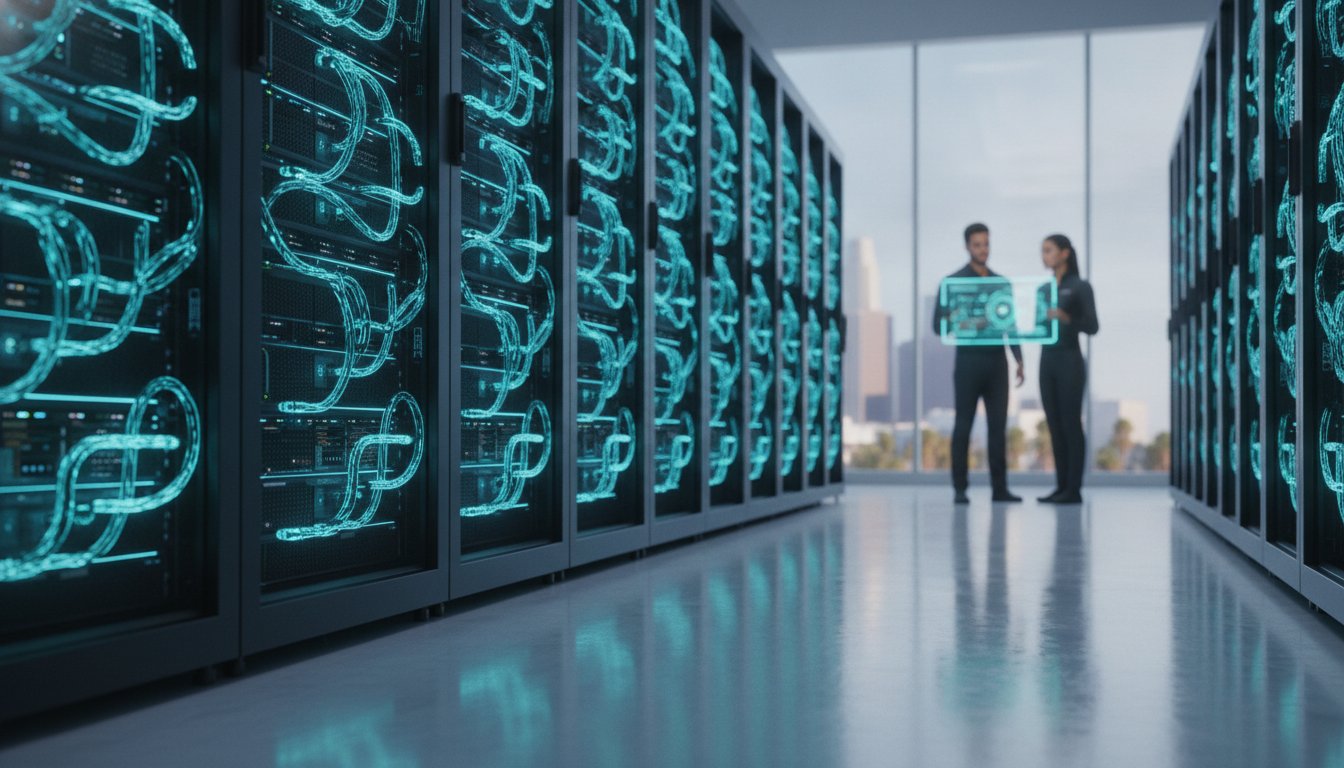
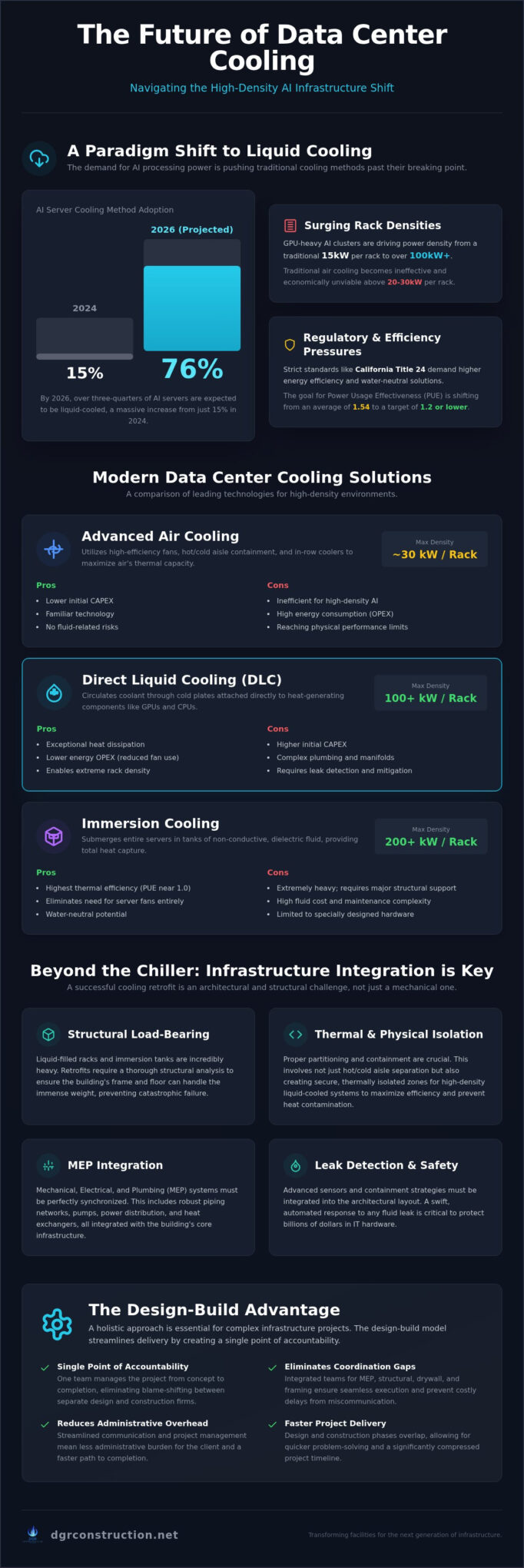
As of 2026, 76% of AI server deployments are expected to be liquid-cooled, a staggering increase from the 15% seen just two years ago. This shift isn’t just a trend; it’s a necessity as rack densities frequently exceed the 20 to 30 kW threshold where traditional air cooling loses its effectiveness. You’re likely facing the reality that legacy systems can’t keep pace with high-density GPU workloads, especially when navigating the rigorous energy standards of California Title 24. Implementing the right data center cooling solutions requires more than just a mechanical upgrade. It demands a holistic look at your facility’s structural integrity and power distribution.
This guide provides the technical and architectural framework you need to support next-generation infrastructure. You’ll gain a clear understanding of the trade-offs between advanced air and liquid cooling, along with the specific structural requirements for heavy liquid cooling retrofits. We’ll also outline a strategic framework for selecting a design-build partner who can manage the complexity of MEP integration. By the end of this article, you’ll have a roadmap to transform your facility into a high-density environment that’s both efficient and compliant.
Key Takeaways
- Understand the critical shift from 15kW to 100kW+ per rack and why traditional air cooling is reaching its physical and economic limits.
- Evaluate the trade-offs between Direct Liquid Cooling (DLC), immersion systems, and hybrid data center cooling solutions to determine the most efficient path for your specific AI workloads.
- Identify the structural load-bearing and thermal isolation requirements necessary to support heavy liquid cooling retrofits while maintaining California Title 24 compliance.
- Learn how integrating MEP coordination with self-perform capabilities in drywall and framing reduces administrative overhead and eliminates coordination gaps.
- Discover how the design-build model provides a single point of accountability to streamline the delivery of complex infrastructure projects.
Addressing the High-Density Heat Challenge in Modern Data Centers
The thermal landscape of the data hall has undergone a fundamental transformation. In 2026, rack densities have surged from the traditional 15kW average to 100kW or more per cabinet. This shift is driven by the deployment of massive GPU clusters dedicated to AI training and inference. High-density cooling in 2026 AI infrastructure refers to the thermal management systems capable of dissipating heat from rack configurations exceeding 30kW through advanced liquid-to-chip or immersion methodologies. As these densities climb, traditional air-based data center cooling solutions face a physical plateau. Air simply cannot move heat away fast enough at these scales without the cooling fans consuming a disproportionate amount of the facility’s total power.
Efficiency is measured by Power Usage Effectiveness (PUE), and the stakes for this metric have never been higher. While the global average PUE in 2026 remains around 1.54, enterprise-grade facilities now target 1.2 or lower to remain competitive. Achieving these numbers requires moving beyond room-level air circulation to more precise, rack-level interventions. This transition represents a significant mechanical and structural challenge that impacts the entire building envelope, requiring a precise integration of mechanical systems and physical partitions.
The Evolution of Rack Power Density
GPU-heavy AI clusters change the thermal profile of the data hall by creating concentrated heat zones that air cooling cannot penetrate effectively. This evolution has forced a move toward localized cooling strategies where the medium is brought directly to the heat source. From an architectural perspective, this shift increases the physical weight of the infrastructure. Liquid-cooled racks and the associated piping networks require a sophisticated understanding of floor loading and structural volume. At DGR Construction, we use a design-build approach to integrate these heavy mechanical requirements with the building’s structural frame, ensuring the facility can support the next generation of hardware without compromise.
Environmental and Regulatory Drivers in California
Operating in Los Angeles and Orange County requires strict adherence to California Title 24 energy efficiency standards. These regulations now push for water-neutral solutions, making traditional evaporative cooling towers less viable for new builds. Many operators are turning to immersion cooling technologies to maximize heat rejection while minimizing water consumption. Balancing high-performance AI demands with LEED and sustainability certifications is a complex task. Success depends on a streamlined partnership that manages MEP integration and structural partitioning with precision, ensuring that these advanced data center cooling solutions remain compliant without sacrificing operational capacity.
Comparing Liquid Cooling vs. Advanced Air-Based Building Solutions
Modern facility operators are increasingly transitioning from air cooling to liquid cooling to manage the intense thermal output of AI chips. While traditional air methods are reaching their limits, selecting the right data center cooling solutions involves a careful balance between performance and existing structural constraints. For 2026 builds, liquid cooling typically demands a higher initial CAPEX due to specialized plumbing and structural reinforcements, but it offers a much lower long-term OPEX by drastically cutting fan power and energy waste.
Liquid Cooling: DLC and Immersion Systems
Direct-to-chip (DLC) systems manage heat by circulating coolant through cold plates directly on the processors. This requires intricate plumbing within the IT rack and a robust network of pumps and manifolds. Immersion cooling takes this further by submerging entire servers in dielectric fluid. These systems are incredibly heavy; a single immersion tank can put immense stress on a standard data center floor. We focus on structural load-bearing analysis during the design-build phase to ensure the building can handle these fluid-filled tanks safely. Effective mitigation also requires advanced leak detection sensors integrated into the floor’s architectural layout, ensuring any fluid escape is addressed before it impacts operations.
Optimizing Airflow with Containment Solutions
For facilities that aren’t ready for full immersion, Rear Door Heat Exchangers (RDHx) serve as an effective middle-ground. These units replace the back door of the server rack with a liquid-cooled coil, neutralizing heat before it enters the room. However, even with RDHx, precision airflow management is vital to maintain data center cooling solutions that meet Title 24 standards. Hot-aisle and cold-aisle containment systems use specialized drywall partitions and T-bar ceiling configurations to prevent air mixing. Our in-house union teams handle these installations to ensure airtight seals and precise overhead cable distribution. If you’re planning a retrofit, a streamlined construction partner can integrate these mechanical and architectural components into a single, cohesive workflow that minimizes downtime and administrative stress.
Beyond the Chiller: Why Infrastructure Integration Matters Most
The success of modern data center cooling solutions relies on the seamless integration of physical infrastructure and mechanical systems. Integration is the backbone. When a facility transitions to high-density AI workloads, the complexity of MEP (Mechanical, Electrical, and Plumbing) coordination increases exponentially. A minor misalignment in piping or power distribution can lead to costly delays and operational risks. As a Commercial General Contractor in Los Angeles with over 26 years of experience, we’ve seen how a unified approach prevents these coordination gaps.
One of the most effective ways to reduce administrative overhead is through self-performing critical trades. By utilizing our in-house union drywall and T-bar ceiling teams, we maintain direct control over the schedule and quality of thermal partitions and airflow containment. This eliminates the “communication gap” often found when multiple subcontractors compete for space in crowded overhead plenums. This methodology ensures the physical building is perfectly synchronized with the cooling hardware it houses. Managing power redundancy alongside this cooling infrastructure is equally vital, as high-density clusters require a stable, high-capacity electrical backbone that doesn’t compromise the thermal environment.
The Critical Role of Precision Engineering
Achieving operational excellence begins in the design-build phase. We coordinate with architects and engineers early to address the specific needs of high-velocity cooling fans, such as floor-to-ceiling sound attenuation and vibration isolation. Using Procore for transparent, real-time MEP submittal management allows our team to track every component’s journey from the factory to the data hall. This level of oversight ensures that the data center cooling solutions you’ve invested in perform as intended without disrupting the surrounding office or industrial environment.
Seismic Considerations for Heavy Cooling Equipment
In Southern California, seismic safety isn’t optional; it’s a core structural requirement. High-density cooling often involves heavy chillers, pumps, and liquid tanks that require specialized bracing to meet local building codes. We prioritize the structural reinforcement of raised floors and overhead supports to ensure equipment remains stable during a seismic event. Our commitment to safety is reflected in our zero workplace accidents record, even during the most complex structural installs. This stability provides the reassurance that your high-stakes infrastructure is built to last in the unique environment of Los Angeles and Orange County.
Architectural and Structural Requirements for Modern Cooling Retrofits
Transitioning to advanced data center cooling solutions is as much about the building’s skeleton as it is about the mechanical hardware. In 2026, retrofitting an existing facility in Los Angeles or Orange County to support 100kW racks requires a systematic architectural approach. Most legacy structures were designed for much lighter loads and lower thermal intensities. A successful upgrade follows a clear, four step process to ensure the physical environment doesn’t become a bottleneck for your AI hardware.
- Step 1: Structural Load-Bearing Analysis: We assess the existing slab to determine if it can support the concentrated weight of liquid-to-chip manifolds or immersion tanks.
- Step 2: Partitioning for Thermal Isolation: Installing precision drywall barriers is essential to create airtight containment zones that prevent hot and cold air mixing.
- Step 3: T-Bar Ceiling Upgrades: Modern T-bar systems must be reinforced to manage the increased volume of overhead coolant piping and high-density cabling.
- Step 4: Compliance Testing: Final integration includes rigorous Title 24 energy testing to ensure the new cooling architecture meets California’s strict 2026 efficiency mandates.
Structural Reinforcement and Floor Loading
AI infrastructure is exceptionally heavy. Immersion cooling tanks and large-scale fluid distribution units can easily exceed the pounds-per-square-foot capacity of a standard data center floor. Our team conducts deep-dive slab evaluations and, where necessary, installs structural steel platforms or reinforced concrete pads. We also design and build custom ramps to ensure equipment access remains seamless. By utilizing our in-house union trades for these structural modifications, we maintain the precision required for high-stakes environments while upholding our zero-accident safety record. This self-perform capability ensures that structural reinforcements are completed on a timeline that keeps your project moving forward.
Ceiling and Partitioning Strategies
Effective airflow management relies on the integrity of your facility’s partitions. For high-density data halls, acoustic requirements are also a priority due to the noise generated by high-velocity cooling fans. We utilize specialized T-bar ceiling systems that offer the flexibility needed for overhead cooling distribution while providing superior sound attenuation. These systems are integrated with precision-built drywall containment walls to create a sealed thermal environment. If you are planning a facility upgrade, our expertise in Data Center Construction in Southern California ensures your architectural solutions are as advanced as your cooling hardware. To discuss the specific structural needs of your next retrofit, contact DGR Construction for a professional consultation on your MEP and structural integration.
The Design-Build Advantage for Data Center Infrastructure
The complexity of 2026-era data center cooling solutions requires a delivery method that prioritizes integration over silos. In a traditional design-bid-build model, the gap between the mechanical engineer’s specifications and the contractor’s execution often leads to change orders and schedule slips. The design-build approach eliminates this friction by unifying the design and construction phases under one roof. At DGR Construction, we serve as the single point of accountability, ensuring that the structural modifications and mechanical installs discussed in previous sections are synchronized from day one. This model doesn’t just reduce administrative overhead; it provides a stabilizing force in a high-stakes environment where precision is mandatory.
Speed to market is a critical competitive advantage for AI providers. The design-build model allows us to begin the build-out phase while the final design details are still being refined. For example, we can initiate structural slab reinforcement and partition framing while the specific liquid cooling manifolds are being fabricated. This overlapping schedule significantly compresses the project timeline. Our commitment to a clean, organized construction process ensures that even during heavy retrofits, the facility remains professional and manageable. We prioritize craftsmanship and technical standards, managing the entire experience so it feels frictionless for our clients.
Streamlining the Construction Process
Precision control is maintained through rigorous project management protocols. We utilize weekly “look-aheads” and detailed meeting minutes to prevent delays before they occur. This level of transparency is supported by Procore, which gives our clients 24/7 access to daily reports, project photos, and real-time submittal logs. Our 26+ years of local experience in Los Angeles and Orange County means we understand the nuances of Southern California’s building codes and environmental regulations. This deep rootedness allows us to navigate the permitting process for complex data center cooling solutions with a level of authority that newer firms cannot match. When evaluating your options, understanding how top data center construction companies compare on regional expertise and regulatory knowledge can help you make a more informed decision for your 2026 project.
Getting Started with Your Cooling Infrastructure Project
Early-stage consultation is the most effective way to ensure your facility is ready for the 100kW rack densities of 2026. We help you manage the transition from initial design concepts to full occupancy, focusing on the seamless execution of MEP and structural integration. Our team handles the heavy lifting of coordination, allowing your internal resources to focus on IT deployment. If you’re ready to upgrade your facility’s thermal capacity, contact DGR Construction for your Data Center Build-Out. We’ll provide a disciplined, results-driven framework to transform your infrastructure into a high-density AI environment.
Future-Proofing Your High-Density Infrastructure
Transitioning to 100kW+ rack densities requires more than just high-performance hardware; it demands a building that can support the physical and thermal weight of modern innovation. You’ve seen how integrating structural load-bearing analysis with precision partitioning creates a facility capable of handling the most demanding AI workloads. Mastering data center cooling solutions in 2026 means moving beyond the mechanical room and looking at the entire architectural envelope. By choosing a design-build partner, you ensure that every pipe, partition, and power line is synchronized to eliminate operational bottlenecks and administrative stress.
DGR Construction brings a grounded sense of authority to every project, backed by an A+ BBB rating and our status as a Certified Minority Contractor. As a signatory to the Carpenters Union with Procore-integrated project management, we provide the transparency and craftsmanship your infrastructure deserves. Partner with DGR Construction for Expert Data Center Infrastructure to secure a facility that’s efficient, compliant, and ready for the future. We look forward to helping you manage your next high-stakes project with precision and reliability.
Frequently Asked Questions
What is the most energy-efficient data center cooling solution for 2026?
Direct-to-chip and immersion methods are the most efficient data center cooling solutions for 2026. These technologies target a Power Usage Effectiveness (PUE) of 1.2 or lower by removing heat directly at the source. This reduces the energy wasted by high-velocity fans in traditional air systems. Implementing these solutions helps facilities meet modern energy standards while supporting the extreme heat generated by AI GPU clusters.
How does liquid cooling impact the structural requirements of a data center?
Liquid cooling significantly increases the physical weight of infrastructure due to fluid-filled tanks, manifolds, and piping. Most legacy slabs require a detailed structural load-bearing analysis to ensure they can support these concentrated loads. We often install reinforced structural platforms and access ramps to accommodate this equipment. Using our in-house union trades ensures these structural modifications are executed with the precision needed for high-stakes AI environments in Los Angeles.
What is PUE, and why is it critical for California data centers?
Power Usage Effectiveness (PUE) is a ratio that measures how efficiently a facility uses power specifically for IT equipment versus cooling and overhead. In California, achieving a low PUE is critical for Title 24 compliance, which mandates strict energy efficiency for commercial buildings. Facilities in Orange County and Los Angeles must optimize their infrastructure to stay within these regulatory limits while managing the increased power demands of modern AI hardware.
Can I retrofit an existing air-cooled data center for liquid cooling?
Retrofitting is possible but requires a comprehensive integration of mechanical, electrical, and plumbing (MEP) systems. You’ll need to assess if existing floor heights and structural slabs can handle the new liquid-based infrastructure. A design-build approach simplifies this process by coordinating the architectural modifications and technical installs under a single contract. This methodology prevents coordination gaps and ensures the retrofit meets current California energy and safety standards.
What are the seismic bracing requirements for data center equipment in Los Angeles?
Equipment in Los Angeles must adhere to rigorous seismic bracing standards to prevent movement or failure during an earthquake. Heavy chillers, pumps, and immersion tanks require specialized anchoring to the building’s structural frame or reinforced slabs. Our team manages these complex installs with a focus on local building codes and seismic safety. This oversight provides stability for your high-stakes infrastructure and maintains our zero workplace accidents record.
How does a design-build contractor save time on data center cooling upgrades?
A design-build contractor saves time by serving as a single point of accountability for the entire project. We can begin structural work and build-out while the final mechanical designs are still being refined. This overlapping schedule compresses the timeline, allowing you to move from design to occupancy weeks or months faster. By managing MEP integration internally, we eliminate the communication delays common with traditional multi-subcontractor models.
What role do T-bar ceilings play in data center airflow management?
T-bar ceilings are essential for managing overhead airflow and organizing the complex distribution of cooling pipes and cabling. When integrated with airtight partitions, these systems help create effective hot-aisle or cold-aisle containment zones. Our in-house union T-bar teams specialize in installing these high-capacity systems with precision. This ensures that your data center cooling solutions operate at peak efficiency by preventing thermal mixing within the data hall.
Are there specific Title 24 requirements for data center cooling in Orange County?
Orange County data centers must follow the 2026 Title 24 standards, which emphasize water-neutral cooling and high energy efficiency. These requirements often push operators toward closed-loop liquid systems that minimize water evaporation. Local enforcement in Southern California is strict, so your cooling architecture must be verified through rigorous testing. We ensure every project meets these mandates by integrating compliance checks into our design-build workflow from the start.
Pingback: Data Center Construction in Southern California: The 2026 Infrastructure Guide