The 2026 regulatory landscape in Los Angeles has reached a level of complexity where traditional “bid-and-build” methods almost guarantee project delays. With the 2025 California Building Standards Code now fully effective as of January 1, 2026, the margin for error in permitting and energy compliance has disappeared. Finding a commercial general contractor in los angeles who can bridge the gap between architectural intent and technical execution is no longer a luxury; it’s a requirement for project solvency.
You likely understand the frustration of watching a project stall because of poor communication between designers and subcontractors. We’ve designed this guide to help you bypass those common pitfalls by leveraging the design-build model. You’ll gain expert insights into navigating LADBS permit timelines, securing fixed-price certainty for specialized aerospace and medical facilities, and utilizing in-house union labor to maintain quality control. We’ll explore how a streamlined, integrated approach ensures your facility moves from design to occupancy without the typical friction of the LA County system.
Key Takeaways
- Understand how the 2026 California Building Standards Code updates impact your project timeline and permitting strategy within Los Angeles County.
- Discover why the design-build model creates a single point of accountability, effectively reducing costly change orders and communication gaps between architects and builders.
- Learn the technical requirements for high-stakes facilities, including the specialized infrastructure and security standards needed for aerospace and data center environments.
- Identify the critical criteria for selecting a commercial general contractor los angeles that prioritizes technical precision and operational excellence over low-bid shortcuts.
- See how utilizing in-house union drywall and T-bar teams provides superior quality control and ensures your project meets the most rigorous industry standards.
The Landscape of Commercial Construction in Los Angeles for 2026
The commercial landscape in Southern California has transitioned from a period of general expansion to one of high-precision specialization. In 2026, the role of a commercial general contractor los angeles involves more than just supervising a job site; it requires acting as a strategic partner who can manage the intersection of technical engineering and local economic shifts. We see a distinct rise in adaptive reuse projects where older industrial shells are transformed into sophisticated data centers or aerospace labs. This shift reflects a broader trend across LA County and Orange County, where land scarcity has made the intelligent repurposing of existing structures a primary driver of growth.
This evolution toward specialized adaptive reuse and high-standard renovation is not limited to Southern California. In major markets like the Greater Toronto Area, Octopus Renovation Group serves as a professional commercial construction and renovation firm that mirrors this commitment to technical excellence and strategic facility transformation.
Today’s sophisticated project owners are increasingly looking for a “quiet expert” persona. The era of high-hyperbole marketing in the construction sector is fading, replaced by a demand for firms that project stability and a track record of reliability. Whether a project is located in the tech hubs of Silicon Beach or the industrial corridors stretching through Irvine, the priority is seamless execution. A design-build methodology has become the preferred delivery system because it provides a single point of accountability, which is essential for managing the high-stakes requirements of 2026 projects.
Economic Drivers for LA Commercial Projects
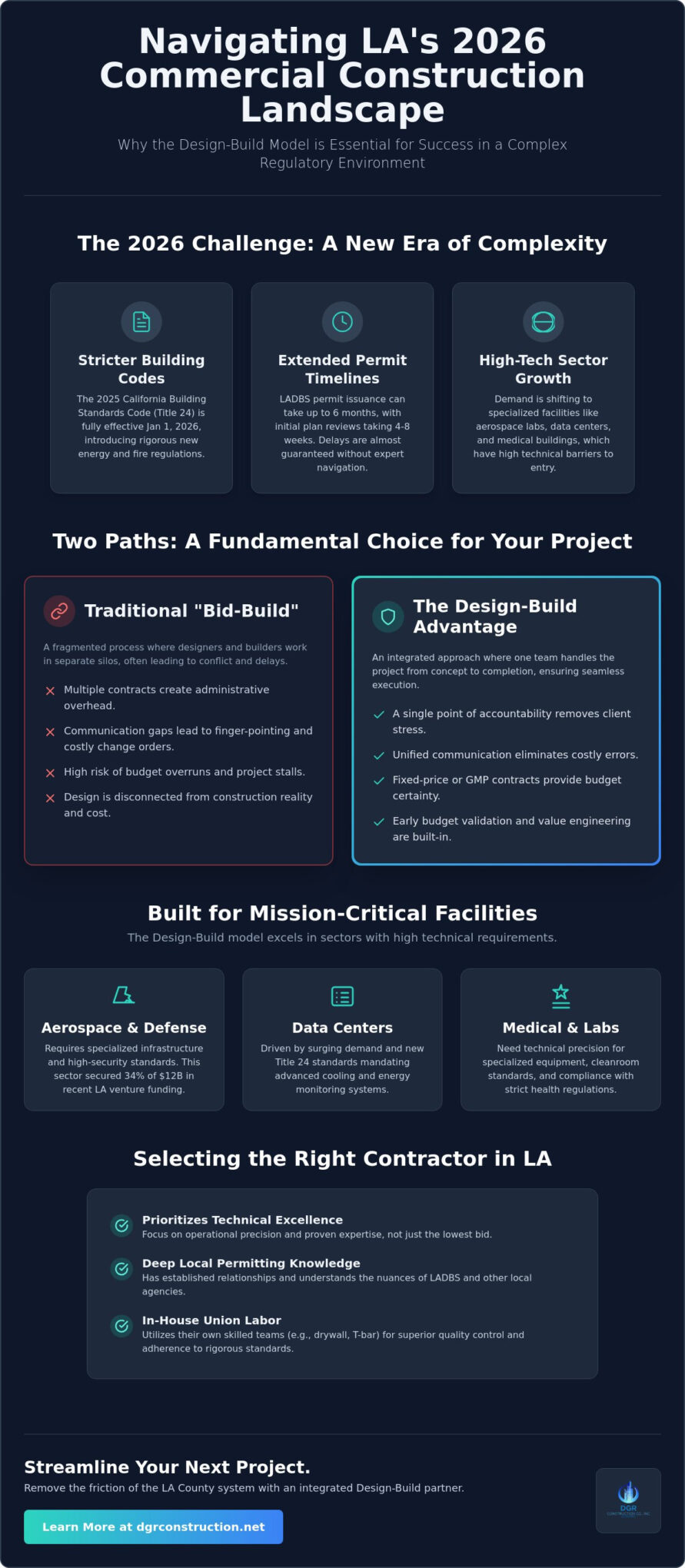
Regional developments have shifted commercial demand toward sectors with high technical barriers to entry. In 2025, aerospace and defense firms secured 34% of the $12 billion in venture funding within Los Angeles, creating a massive need for specialized facilities in El Segundo and Long Beach. Traditional retail is taking a backseat to high-density tenant improvements in West LA and Downtown, where businesses are optimizing floor plans for hybrid work models. Data center construction is also surging, driven by new Title 24 standards that mandate advanced cooling and energy monitoring systems starting in early 2026.
Navigating Local Regulatory Hurdles
Compliance is the most significant hurdle for any Southern California project. The 2025 California Building Standards Code (Title 24) became effective on January 1, 2026, introducing rigorous energy and fire regulations that affect every new permit application. A commercial general contractor los angeles with deep roots in local permitting offices is vital for avoiding “red tag” delays. With the Los Angeles Department of Building and Safety (LADBS) typically taking 4 to 8 weeks for an initial plan review, and up to 6 months for total permit issuance, having a team that understands local nuances is the only way to maintain a predictable timeline.
The Design-Build Advantage vs. Traditional Contracting
Traditional contracting often leads to a fragmented process where the architect and builder operate in separate silos. This fragmentation creates a gap where miscommunication occurs, often resulting in finger-pointing when costs exceed the initial budget. A commercial general contractor los angeles utilizing the design-build model closes this gap by acting as a single point of contact. This integrated approach ensures that the design is grounded in construction reality from the very first draft, removing the administrative overhead of managing multiple separate contracts.
Choosing the right contractual structure is critical for project solvency in the Southern California market. While cost-plus contracts offer flexibility for designs that may evolve, fixed-price contracts provide the certainty needed for specialized facilities. In the design-build model, a Guaranteed Maximum Price (GMP) structure is frequently used to align the interests of the builder and the owner. This creates a “Streamlined Partner” dynamic where our primary focus is the removal of client stress through unified, transparent communication.
Efficiency in the Pre-Construction Phase
The role of a commercial general contractor los angeles during pre-construction is to serve as the primary point of accountability. Pre-construction is where a project’s financial fate is decided. Through early budget validation, we identify potential cost overruns before they materialize on the job site. Value engineering plays a vital role here; it isn’t about cutting corners but finding more efficient ways to achieve the same high-quality result. By integrating engineering and architectural design early, we significantly reduce the likelihood of expensive change orders during the build phase.
Timeline Acceleration in Southern California
Speed is often as valuable as cost savings, especially when navigating the tight deadlines of the 2026 market. Traditional bidding processes can add months to a schedule. Design-build allows for overlapping phases, where site preparation or structural work begins while final interior details are still being refined. This concurrency is essential for high-stakes tenant improvements where occupancy dates are non-negotiable.
In sectors like aerospace, the logic of this model is clear. The ability to start foundation work while finalizing complex clean-room specifications can shave weeks off a delivery schedule. Adhering to California’s public works laws and rigorous local standards requires a partner who manages every technical detail. This streamlined oversight is why many firms choose to partner with a single-source contractor to ensure their most complex facilities are delivered with precision and professional confidence.
Specialized Construction: Aerospace, Data Centers, and Medical Facilities
Generic construction methods often collapse under the weight of specialized facility requirements. For clients in the aerospace, data center, and medical sectors, an “off-the-shelf” approach to building is a liability that leads to operational failure. A commercial general contractor los angeles must possess the technical literacy to coordinate with specialized engineers and navigate the rigorous safety standards inherent to these fields. Whether it is managing the vibration sensitivity of a clean room or the massive power demands of a server farm, precision is the only path to project success.
Precision Engineering for Aerospace Facilities
Aerospace construction in hubs like El Segundo and Long Beach demands more than just structural integrity; it requires precision engineering that aligns with specific mission requirements. Clean room installations and specialized structural supports for heavy assembly aren’t just secondary details. They’re the core of the facility. Our methodology involves a start-to-finish partnership with aerospace engineers to ensure that high-security, high-spec builds meet every technical threshold before the first piece of steel is placed. This disciplined approach ensures that the physical structure supports the advanced technology it houses without compromise.
Mission-Critical Data Center Construction
As highlighted in the 2026 construction forecast, data centers continue to lead market demand while presenting some of the most complex challenges in modern building. Achieving 99.999% uptime requires meticulous planning of power redundancy and cooling infrastructure. The integration of specialized T-bar ceilings and raised flooring systems is a functional necessity for efficient cable management and airflow. Managing high-density electrical loads in Southern California requires a contractor who understands the specific grid pressures and the 2026 energy monitoring mandates that now govern these facilities. As rack densities increasingly exceed the 20 to 30 kW threshold where traditional air cooling loses effectiveness, implementing the right data center cooling solutions for high-density AI workloads becomes a structural and mechanical imperative that must be addressed during the pre-construction phase. For a deeper look at the technical and regulatory requirements shaping this sector, our comprehensive guide to data center construction in Southern California covers the full scope of 2026 infrastructure challenges.
Medical office build-outs present their own set of challenges, particularly when navigating HCAI (formerly OSHPD) requirements. These regulations ensure facility resilience and patient safety, but they can easily derail a project timeline if not managed by an authoritative expert. Whether the project is a medical outpatient facility or a large-scale industrial site, scaling requires a meticulous, results-driven approach. Standard industrial buildings lack the power capacity and environmental controls needed for the current generation of hypersonics or autonomous defense systems. A commercial general contractor los angeles who values precision over flair is the only way to ensure these complex, high-stakes projects remain controlled and professional.
How to Evaluate a Commercial General Contractor in Los Angeles
Selecting a commercial general contractor los angeles requires looking past the initial bid. While revenue is often cited as a marker of success by major publications, it doesn’t guarantee the technical precision or reliability required for high-stakes projects. You need a partner who projects professional confidence through a track record of stability. This includes evaluating their insurance bonding capacity and safety records, which are essential for large-scale industrial or aerospace builds. A firm that functions merely as a high-volume broker often lacks the meticulous oversight found in contractors who maintain in-house union labor.
Local experience in Los Angeles and Orange County is a non-negotiable asset for project solvency. Permitting offices in these regions have specific nuances and local requirements that can stall a project for months if they aren’t handled correctly. An authoritative expert understands these local hurdles and manages them proactively to ensure a frictionless experience. This grounded sense of authority comes from years of navigating the complex regulatory environment of Southern California, where land scarcity and high-density requirements demand a sophisticated approach to project management.
The “Problem-Solution-Result” Framework
When you review a construction case study, look for a clear narrative that goes beyond aesthetic photos. A “quiet expert” doesn’t just show a finished building; they explain the complex needs they identified and the specific methodology they used to simplify the outcome. You should look for evidence of how they handled specialized requirements, such as clean rooms or high-density electrical loads. If a contractor has a history of successful tenant improvements in specialized sectors, it’s a strong predictor of their ability to manage the rigorous standards of your 2026 project.
Verification Checklist for 2026 Projects
The complexity of modern construction demands a partner who embraces transparency and accountability. Before signing a contract, verify the following criteria to ensure your project remains controlled and professional:
- Licensing and Union Standing: Confirm current California licensing and verify their standing with local unions. This ensures access to a skilled, reliable workforce.
- Digital Management Tools: Assess their project management software. Real-time transparency in scheduling and budget tracking reduces client stress and prevents surprises.
- Direct Accountability: Ensure you have a direct line to ownership and project leads. In a high-stakes industry, clear lines of communication are vital for making fast, informed decisions.
Choosing a partner who values your time and resources as much as the final physical product is the only way to ensure a successful build. If you’re ready to move forward with a team that prioritizes technical standards and operational excellence, you should consult with our specialized construction team to discuss your project requirements.
The DGR Construction Co. Difference: In-house Labor and Union Quality
For over 26 years, DGR Construction Co. has maintained a grounded sense of authority in the Southern California market. While many firms act as intermediaries who manage third-party schedules, we operate as a direct provider of critical construction services. This legacy of local rootedness allows us to navigate the complexities of LA and Orange County environments with a level of precision that broker-style firms cannot match. As a commercial general contractor los angeles, we recognize that the success of a high-spec facility depends on direct control over the labor force.
Our strategic advantage lies in our in-house union drywall and T-bar teams. By maintaining our own crews, we eliminate the common bottlenecks associated with subcontractor availability and reliability. This direct control leads to faster timelines and significant cost savings for our clients. Whether the project is a high-traffic retail space or a high-security aerospace lab, our craftsmanship stands the test of time because we don’t outsource our accountability.
Unmatched Quality Control
Keeping specialized drywall and T-bar work internal is a deliberate choice for client benefit. It allows us to maintain a rigorous standard of quality that external subcontractors often struggle to meet. The relationship between union training and project safety is clear; our teams are trained to handle the high-scale requirements of industrial and medical facilities with meticulous care. This approach delivers frictionless execution on complex interior build-outs. We’ve seen how integrating these tasks into our core operations prevents the communication gaps that typically lead to delays on the job site.
Your Streamlined Partner in Southern California
We function as a singular, stabilizing force in a complex industry. Our team coordinates directly with architects, owners, and engineers to ensure every technical standard is met from the start. The “quiet expert” persona we project is rooted in results rather than flair. We value your time and resources, managing the entire construction experience to ensure it remains professional and controlled. This disciplined methodology is why we’re the primary point of accountability for some of the most demanding projects in the region.
This commitment to disciplined methodology and professional standards is a hallmark of any high-end service; for those seeking similar precision in the care of their high-value automotive assets, you can visit D3 Auto Care LLC to discover professional detailing and protection services in the Houston area.
A well-managed project should be predictable and stable. If you’re looking for a partner who prioritizes craftsmanship and operational excellence, it is time to take the next step. We invite you to schedule a consultation for your next Los Angeles project to see how our in-house capabilities can streamline your facility’s path to occupancy.
Securing Your Project’s Future in the Southern California Market
The 2026 construction landscape in Los Angeles leaves no room for fragmented management or technical oversight. Successfully delivering a high-spec facility requires an integrated approach that balances regulatory mastery with direct control over the labor force. By choosing a design-build model, you ensure that architectural precision and construction reality are aligned from day one, effectively removing the risk of cost overruns and permitting delays. This methodology transforms a complex process into a manageable, controlled experience for the project owner.
Selecting an experienced commercial general contractor los angeles is the most critical decision in your project’s lifecycle. DGR Construction Co. brings over 26 years of Southern California experience and specialized expertise in high-spec aerospace and data center facilities to every partnership. Our in-house union drywall and T-bar divisions provide a level of quality control and schedule certainty that traditional brokers cannot replicate. When your facility requires technical excellence and a frictionless execution process, we are ready to serve as your primary point of accountability.
Partner with DGR Construction Co. for your next commercial build to ensure your project stands as a testament to craftsmanship and operational stability. We look forward to helping you build a legacy of excellence in Southern California.
Frequently Asked Questions
What is the average timeline for a commercial tenant improvement in Los Angeles?
The total timeline for a commercial tenant improvement in Los Angeles typically spans three to six months from the initial application to permit issuance. This duration includes the Los Angeles Department of Building and Safety (LADBS) plan review process, which generally takes four to eight weeks. Total construction time varies based on scope, but having a clear regulatory strategy is essential for navigating the correction cycles common in Southern California.
How does the design-build model save money on aerospace facility construction?
The design-build model saves money by integrating architectural design and engineering early in the process to eliminate expensive change orders. For aerospace facilities, this single-source responsibility ensures that clean room requirements and specialized structural needs are validated before the build phase begins. This prevents the costly re-work that often occurs when separate architects and builders fail to communicate complex technical specifications during the design phase.
Does DGR Construction Co. handle projects in Orange County as well as Los Angeles?
Yes, our firm provides comprehensive construction services across both Los Angeles and Orange County. We are deeply integrated into the specific permitting offices and regulatory environments of both regions, allowing us to manage the nuances found in cities from Long Beach to Irvine. This regional expertise ensures that your project remains compliant with local codes while maintaining a consistent standard of craftsmanship throughout Southern California.
What are the benefits of using in-house union drywall teams for commercial builds?
Utilizing in-house union drywall and T-bar teams provides direct control over project quality and scheduling. A commercial general contractor los angeles with internal crews can bypass the availability bottlenecks often found when relying entirely on third-party subcontractors. This direct oversight leads to faster project delivery and ensures that the craftsmanship meets the rigorous safety and precision standards required for high-scale industrial and medical facilities.
How do I navigate the permitting process for a data center in Southern California?
Navigating data center permitting requires strict adherence to the 2025 California Building Standards Code (Title 24), which became effective on January 1, 2026. These regulations introduce new mandates for cooling systems, energy monitoring, and power redundancy. Engaging an authoritative expert who understands these energy efficiency standards is vital for securing approvals from local authorities without the risk of significant revision cycles or costly red-tag delays. Our detailed Southern California data center construction infrastructure guide outlines the full regulatory framework and technical requirements for 2026 projects.
What is the difference between fixed-price and cost-plus construction contracts?
A fixed-price contract provides a guaranteed maximum price for the project, offering the owner budget certainty once the design is finalized. In contrast, a cost-plus contract involves paying for the actual costs of labor and materials plus a predetermined fee for the contractor. For specialized facilities with high technical requirements, a fixed-price model is frequently preferred to ensure financial stability and long-term project solvency.
Does DGR Construction Co. provide architectural design services?
As a design-build partner, we coordinate the entire design and engineering process through a single point of accountability. While we operate as the lead partner, we integrate architectural and engineering expertise into our streamlined management flow to ensure the design is functionally grounded in construction reality. This integrated approach reduces the administrative friction and miscommunication often found in traditional bid-and-build relationships between owners and separate firms.
How do you ensure safety standards are met on high-scale industrial projects?
We ensure safety by utilizing highly trained union labor and implementing meticulous project oversight at every stage of the build. High-scale industrial projects require disciplined management of heavy equipment, high-voltage electrical systems, and complex structural assembly. By maintaining a professional register of safety protocols and conducting regular site audits, we make complex, high-stakes environments feel controlled and professional for all stakeholders involved.