
The contract with the firmest price isn’t always the best protection against material price spikes. In a U.S. fixed-price construction contract without an escalation clause, the contractor bears material price increases. If the contract includes a clause, its terms determine whether and how the price can change. Understanding how to handle material price volatility in a fixed-price contract starts with knowing which materials are covered, what triggers an adjustment, and how approvals must be recorded.
It’s reasonable to expect a fixed price to provide certainty, but that certainty can leave one party carrying the risk when material costs rise. A clear adjustment mechanism can share that exposure while preserving a defined process for documenting and approving changes.
This article explains how fixed-price terms shape cost exposure, how escalation clauses and cost indices can support adjustments, and why timely records matter. It also compares contract approaches and procurement considerations, helping you assess which protections fit a project and where commercial construction management can keep scope, purchasing, and approvals coordinated.
Key Takeaways
- In fixed-price agreements, the contract language determines who carries material cost increases and whether adjustments are available.
- Federal fixed-price contracts are covered by FAR Part 16.2, according to the Federal Acquisition Regulatory Council.
- Escalation clauses work best when they define covered materials, adjustment triggers, the index used, and how price decreases are handled.
- Align supplier and subcontractor terms with the owner contract to reduce gaps when tariffs, shortages, or delivery disruptions affect material costs.
- Keep clear records of cost changes, substitutions, and written approvals so adjustments can be reviewed against the contract terms.
Economic price adjustment clauses and cost indices
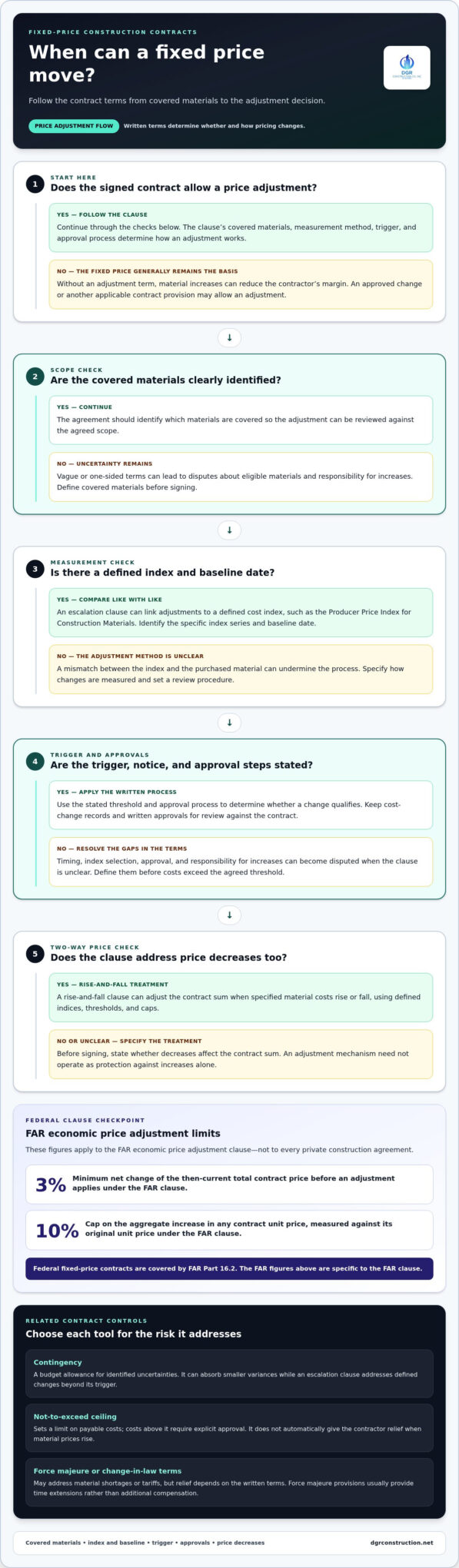
Economic price adjustment clauses specify whether covered costs can change after signing. Their effect depends on which materials are covered, how changes are measured, and what approval process applies.
Escalation Clauses and Cost Indices
An escalation clause links a contract’s material price adjustments to a defined cost index, such as the Producer Price Index for Construction Materials. The clause should identify covered materials, the baseline date, the index series, and how increases and decreases affect the price. Federal fixed-price contracts are covered by FAR Part 16.2, according to the Federal Acquisition Regulatory Council.
For private U.S. construction contracts, written terms and applicable law govern the clause. Under the FAR economic price adjustment clause, a covered labor or material price change must produce a net change of at least 3 percent of the then-current total contract price before an adjustment applies, according to the Federal Acquisition Regulatory Council.
The Federal Acquisition Regulatory Council states that the FAR economic price adjustment clause caps the aggregate increase in any contract unit price at 10 percent of the original unit price. These federal limits concern that FAR clause, not every private construction agreement.
Contingencies for Cost Changes
A contingency is a budget allowance for identified uncertainties, while an escalation clause sets conditions for changing contract pricing. The two mechanisms can work together: a contingency may absorb smaller variances, while an index-based clause addresses defined changes beyond its trigger. Specify how the mechanisms interact and which materials are covered so the parties allocate exposure consistently.
A fixed-price contract can include force majeure or change-in-law language addressing material shortages, but relief depends on the written terms. Force majeure provisions usually provide time extensions rather than additional compensation, and tariff relief depends on the contract language.
Caps and Budget Controls
A not-to-exceed clause sets a ceiling on payable costs, with costs above that limit requiring explicit approval. This can help owners manage a maximum budget, but it doesn’t automatically give the contractor relief when material prices rise. Specify whether an approved escalation changes the ceiling, how the adjustment is calculated, and who authorizes it.
Vague or one-sided escalation terms can lead to disputes over eligible materials, index selection, timing, and responsibility for increases. A mismatch between the index and the purchased material can also undermine the adjustment process. Define these elements and set a review procedure before costs exceed the agreed threshold.
Rise-and-Fall Cost Clauses
A rise-and-fall clause adjusts contract sums when the cost of specified goods, materials, or labor changes during delivery. It can share market risk through defined indices, thresholds, and caps. Applying adjustments in both directions also lets a price decrease reduce the contract sum, rather than treating the mechanism as protection against increases alone.
Before signing, agree on the covered materials, index and baseline date, adjustment trigger, cap, notice process, and treatment of price decreases. For example, the parties can specify that a named index measures changes for listed materials, subject to a defined cap. Clear terms help manage budgets and reduce later disputes.
Contractor exposure to cost overruns under firm fixed price
A firm fixed-price agreement sets the amount payable for the agreed scope, rather than reimbursing actual costs. Without an adjustment term, material increases can reduce the contractor’s margin, even as the owner retains greater budget certainty.
Material-Cost Risk Allocation
In a fixed-price contract, the contractor generally absorbs material cost increases unless the agreement provides a way to adjust the price. The gap between bid and purchase prices therefore matters: if steel, equipment, or another specified input costs more before procurement, the contractor’s margin bears the difference. The owner gains price predictability, but the contractor carries greater exposure.
For example, a bid may price a specified material using supplier information available when the proposal is prepared. If that supplier’s price rises before purchase, the contractor can’t automatically transfer the increase to the owner under a standard firm fixed-price arrangement. An escalation clause, approved change, or other applicable contract provision may allow an adjustment. Without one, the original price generally remains the basis of the contract.
Cost and Budget Certainty
Fixed pricing gives owners a defined contract amount for the agreed scope, supporting budgeting and financing decisions. That certainty doesn’t protect against every project change: the contract’s scope, exclusions, and adjustment terms still shape the final amount. For contractors, the same fixed amount means material overruns can reduce savings or consume anticipated margins.
Cost-plus agreements allocate risk differently. In a U.S. cost-plus contract without a Guaranteed Maximum Price, actual material increases can generally be passed on to the owner, who has less cost certainty. A Guaranteed Maximum Price can establish a ceiling, while a time-and-materials agreement with a not-to-exceed limit caps total costs unless the owner explicitly approves an increase.
Unit-price contracts offer another structure: payment depends on measured quantities at agreed unit rates. Those rates can be tied to published market indices, allowing specified prices to adjust as conditions change. This structure can suit work where quantities or material pricing need a defined measurement method, but the contract must clarify which items qualify and how measurements affect payment.
The choice depends on the project’s priorities and risk allocation. A fixed price can suit an owner seeking defined costs and a stable scope; cost-plus can accommodate changing actual costs but shifts more exposure to the owner. Unit pricing links payment to measured work, while a cap can limit spending. Compare the scope, procurement timing, adjustment rules, and approval controls before signing.
Material price uncertainty from tariffs and supply disruptions
Tariffs, shipping interruptions, and supplier shortages can change material prices or availability after a contract is signed. Procurement planning matters because a substitute product or delayed delivery can affect costs, sequencing, and project coordination.
A tariff increase doesn’t automatically create a right to raise the contract price. Relief depends on the agreement’s language, including any change-in-law or force majeure provisions. A force majeure clause may address delays outside reasonable control, but it usually provides additional time rather than compensation. The contract should distinguish schedule relief from reimbursement for a higher purchase price.
Procurement Timing and Coordination
Procurement timing coordinates purchase decisions with the construction schedule and supplier commitments. A supplier may offer a price commitment lasting no more than 30 days, while project purchasing may occur much later. Identify long-lead or volatile materials early, then compare commitment periods with the planned order date. Earlier purchasing can reduce exposure to later price changes, but requires coordination with delivery, storage, and installation needs.
Relying on one vendor leaves a project exposed if that supplier faces shortages, delays, or a sudden price increase. A second qualified source can provide an alternative, but the product must meet project specifications and fit the delivery sequence. Just-in-time procurement can reduce inventory needs while increasing exposure to price spikes and supply interruptions. The trade-off depends on storage capacity, lead time, and the cost of a schedule disruption.
Supplier and Subcontractor Alignment
Aligning supplier and subcontractor terms means matching their price-adjustment and delivery provisions with the owner contract. If a subcontractor can pass through a documented increase but the prime agreement offers no corresponding adjustment, the contractor may face an uncovered obligation. Compare covered materials, escalation triggers, notice requirements, and delivery assumptions before signing each agreement. Consistent terms help allocate risk across the supply chain.
Product substitutions can keep work moving when a specified item is unavailable or its price changes sharply. Contract language should identify acceptable equivalents and specify who reviews design, performance, and compatibility. A substitute may affect adjoining systems, so procurement approval should account for relevant design interfaces, not just the purchase price. Record the proposed alternative and its schedule effect before ordering.
Direct client procurement can remove a high-risk item’s price uncertainty from the contractor’s purchasing scope, but it creates interface responsibilities. The parties need clear terms for delivery, site handling, design compatibility, warranties, and liability. For example, client-purchased equipment must arrive in sequence and meet the contractor’s installation requirements. Clear coordination reduces avoidable delays and disputes over responsibility.
Which Contract Type Offers the Best Protection against Rising Material Costs?
No single contract type removes every form of material-cost exposure. The right structure depends on who can absorb changes, how costs are measured, and how much budget certainty the owner needs.
Documenting Costs and Market Fluctuations
Cost documentation creates a traceable record connecting a material’s contract allowance, market movement, and actual purchase. Keep supplier quotations, purchase orders, invoices, delivery records, and relevant index data together. For example, a steel price adjustment is easier to evaluate when the baseline quote and later invoice identify the same specification and quantity. This evidence demonstrates the change and supports consistent review.
Market indices show broader movement, but they don’t replace project-specific evidence. Compare the index period and material category with the item purchased, then distinguish a genuine market change from differences in grade, quantity, or delivery. Regular cost reviews can help owners and contractors spot variances while procurement options remain available, rather than discovering the effect after purchasing is complete.
Early Purchasing and Inventory Costs
Early purchasing secures materials before later market changes, but shifts costs into inventory management. Pre-purchased goods may require storage, insurance, handling, security, and protection against obsolescence. The ability to lock in a price must be weighed against cash tied up before installation and the risk that design changes make stored items unsuitable.
Match each early order to approved specifications, delivery sequencing, and site storage capacity. A long-lead equipment package, for example, may warrant earlier procurement than standard materials, but only if design interfaces and installation timing are coordinated. This helps owners and contractors judge whether price certainty outweighs carrying costs and supply-chain risks.
Contract structure also affects direct and indirect costs. Direct costs include specified materials and quantities; indirect costs can include project overhead associated with delays, resequencing, or idle crews. A price-adjustment mechanism may address defined material changes without automatically covering schedule-related overhead. Clear scope, procurement assumptions, and approval procedures help distinguish these cost categories when project conditions shift.
Time-and-materials contracts can pass actual material costs through to the owner, with the agreed markup applied separately. This approach can suit uncertain supply-chain conditions, but owners trade a fixed total for visibility into actual purchases and greater exposure to changing costs. A not-to-exceed limit can cap total spending, with costs above it requiring explicit approval.
For predictable scope and budget certainty, fixed pricing may fit if its risk allocation is acceptable. Index-linked adjustments, unit pricing, or time-and-materials with a cap can better accommodate specific uncertainties. Compare documentation requirements, purchasing timelines, indirect-cost treatment, and approval controls before signing. These practices determine whether the contract’s protections work during actual market changes.
Price adjustment documentation and approval
A price adjustment is defensible when the contract procedure connects a documented cost change to written authorization. Keep the original pricing basis, evidence of the change, and approval together so owners and contractors can review the same record before revising payment or scope.
Start with the contract’s notice and submission requirements. For each requested adjustment, identify the covered material, original quoted price, purchase date, revised supplier price, affected quantity, and calculation. Attach comparable supplier quotations, purchase orders, invoices, and delivery records. For example, a request involving a substituted electrical component should separate the price difference from unrelated labor or schedule costs.
Accurate records help distinguish a market increase from a change in specification, quantity, or purchasing decision. A supplier quote may show a new price, while the invoice confirms the actual transaction. Compare equivalent products and quantities, and retain the dates for each document. This sequence gives both parties a clear basis for the adjustment and makes the calculation easier to assess.
Written change orders should state what changed and its price effect. For a product substitution, document the original specification, proposed alternative, and any corresponding increase or deduction. For an added item, describe the scope and reprice it before work proceeds. Authorized representatives should approve the change in writing under the contract’s process, rather than relying on informal messages or verbal direction.
Market-indexed adjustments need a clear calculation method. Identify the index series, baseline reading, comparison period, covered materials, and method for applying the change to eligible quantities. Retain the relevant index readings alongside supplier documentation. If the index rises but the project’s purchase price does not, the clause should specify which measure controls. A defined method helps prevent disputes over the basis for adjustment.
- Match each request to a contract clause or approved change.
- Show the calculation and the quantities affected.
- Keep supplier evidence, index data, and approvals together.
- Record deductions as clearly as increases.
Consistent approval practices also support forecasting: approved adjustments can be separated from pending requests, while rejected items remain outside the revised contract amount. This helps owners track commitments and helps contractors assess project margins without treating every quote as an approved change. For construction projects that need coordinated scope, procurement, and approvals, discuss your commercial construction project.
DGR Construction Co.: Aerospace Construction
DGR Construction Co. is a design-build commercial general contractor for projects where scope, design, engineering, and construction need coordinated oversight. Its Aerospace Construction service supports facility projects involving complex requirements and material decisions that must align with the overall design and schedule. DGR coordinates directly with architects, owners, and engineers, helping keep project teams aligned as plans move into construction.
For owners planning aerospace facilities, early coordination can connect design choices, procurement assumptions, and contract documentation before work begins. DGR also provides Data Center Construction, Industrial Construction, and Tenant Improvement services for commercial projects.
To discuss an upcoming commercial construction project, contact DGR Construction Co. through dgrconstruction.net.
Bring project decisions into focus before work begins
The next step is to connect contract protections with real project decisions. A practical approach to handling material price volatility in a fixed-price contract starts by aligning procurement assumptions, design choices, and approval responsibilities before they become active commitments. This gives project teams a shared basis for managing changes instead of reacting to each issue in isolation.
DGR Construction Co. supports commercial projects where coordinated construction delivery is central, including Aerospace Construction, Data Center Construction, and Industrial Construction. Bringing the project team’s priorities together early can clarify how scope, material selection, and construction planning fit within the agreed approach.
As you shape the next project phase, focus on making decisions, responsibilities, and approvals clear to everyone involved. To discuss how DGR Construction Co. can support your project, contact DGR Construction Co.. A disciplined start can make a complex build feel more manageable.
Frequently Asked Questions
How Can Procurement Strategy Reduce Cost Risk?
A coordinated procurement strategy reduces exposure by matching purchasing decisions to the project schedule and approved specifications. A buyout plan can identify which materials need early orders, which purchases can wait, and where an equivalent product could keep work moving. For example, an approved alternative supplier may help maintain a scheduled installation if the preferred source faces a shortage. Handling material price volatility in a fixed-price contract also means coordinating procurement choices with the contract’s risk allocation.
What Is Raw Materials Price Volatility?
Raw material price volatility means prices fluctuate for inputs such as steel, copper, lumber, or petroleum-based products. A supplier’s quote may change between estimating and purchasing, while a published index tracks broader market movement. These measures aren’t identical: a project’s actual price can also reflect product grade, availability, delivery, and order quantity. Distinguishing market movement from specification or purchasing differences helps explain why a material’s final price changed.
Who Bears the Burden of Tariff-Induced Price Escalations?
The contract generally determines who bears a tariff-related increase. In a U.S. fixed-price construction contract without an escalation clause, the contractor bears material price increases, including tariff-related increases. A tariff doesn’t automatically entitle a contractor to compensation or schedule relief. The parties should distinguish tariff costs from delivery delays and identify any applicable change-in-law or adjustment language. The key is whether the contract expressly allocates that risk, not simply which party first receives the supplier’s revised quote.
What contract clauses address material price volatility in fixed-price contracts?
Common protections include economic price adjustment or escalation clauses, rise-and-fall provisions, material cost pass-through terms, substitution language, and defined change-order procedures. A force majeure clause may address delays beyond reasonable control, but it usually provides time relief rather than additional compensation. Each clause serves a different purpose. A substitution provision, for example, can address an unavailable specified item, while an escalation term governs how a covered price change affects the contract sum.
How do price escalation clauses work in construction contracts?
A price escalation clause sets conditions for adjusting the contract amount when specified material costs change. It typically identifies eligible items, the pricing reference, the measurement period, and the adjustment process. For instance, an adjustment may apply only to the affected material quantity, rather than the full contract value. The clause can also address decreases, so the contract sum responds to falling prices as well as increases. Defined notice and approval procedures make the mechanism practical during procurement.
What materials and price indexes can be used for an escalation clause?
An escalation clause can name particular materials and link them to a relevant published index. The Producer Price Index for Construction Materials may track broad construction-input movements, while a relevant commodity index can better match a specific material such as copper. Select an index that reflects the item’s market and purchasing conditions. If imported goods are involved, the clause may also address currency exchange rates, since currency movements can affect purchase prices independently of commodity prices.
How should a contract define the price baseline, adjustment dates, and calculation method?
Define the baseline as a specific index reading or documented supplier price tied to the contract’s pricing date. State which later reading or purchase event triggers review, and explain how the comparison applies to eligible quantities. For example, the contract can distinguish materials already purchased from those still awaiting orders. It should also identify required supporting records and the review process, so both parties use the same dates, source data, and eligible scope.
What are common caps, floors, thresholds, and sharing formulas for material cost increases?
A cap limits how far an adjustment can raise the contract price, while a floor can limit the effect of price decreases. A threshold sets the change required before adjustment begins. A sharing formula divides an eligible increase or decrease between the parties. These terms aren’t universal percentages; they’re negotiated risk controls. Compare how each mechanism applies to likely purchasing scenarios, including small movements, sustained increases, and market declines, before setting the contract language.