

A board-ready construction budget is a decision framework, not a spreadsheet walkthrough. When presenting a commercial construction budget to the board, your task is to make technical line items, design assumptions, and project risks clear enough for members to assess without overwhelming them with detail.
That can be difficult when scope is still developing, labor and material conditions may affect costs, and agenda items call for different kinds of action. A useful presentation separates what needs approval from what is shared for awareness, explains how the estimate was developed, and identifies where uncertainty remains.
This 2026 guide explains how to organize a concise, traceable budget presentation, communicate assumptions and contingencies, and describe options and trade-offs in plain language. It also covers how to identify key risks, frame the decision before the board, and close with clear approvals, owners, and follow-up actions. The result is a focused discussion that helps board members understand the proposed budget, what it depends on, and what happens next.
Key Takeaways
- Open with the decision the board needs to make, the action requested, and the timing, so members know what the discussion must resolve.
- For presenting a commercial construction budget to the board, identify the estimate’s design stage, assumptions, exclusions, and date to make its basis clear.
- Compare options using the same scope, schedule, assumptions, and risk criteria. Then show what changes and what each choice means for the decision.
- Keep presentation slides concise and move detailed estimates and supporting documents into appendices for questions and review.
- Document the approved scope, budget basis, conditions, delegated authority, open items, and owners so follow-up reporting has a clear reference point.
Presenting a Commercial Construction Budget to the Board: Start With the Decision
State the decision the board needs to make, such as approving a defined project scope and budget authorization for the next phase. Include the date by which a decision is needed to support the planned schedule. Name the decision-making body or person, and explain what a delay would affect, such as design work, coordination, or the planned start. Put this request before the detailed estimates so members know what they are being asked to decide.
A board-ready construction budget connects a defined scope to an estimate basis and a set of assumptions. It shows what the proposed budget covers, what remains uncertain, and what action is requested. Authorization to proceed is not the same as certainty about final construction cost, particularly while design is still developing. State the estimate’s level of detail and identify what must be confirmed before costs can be refined.
What should the board approve?
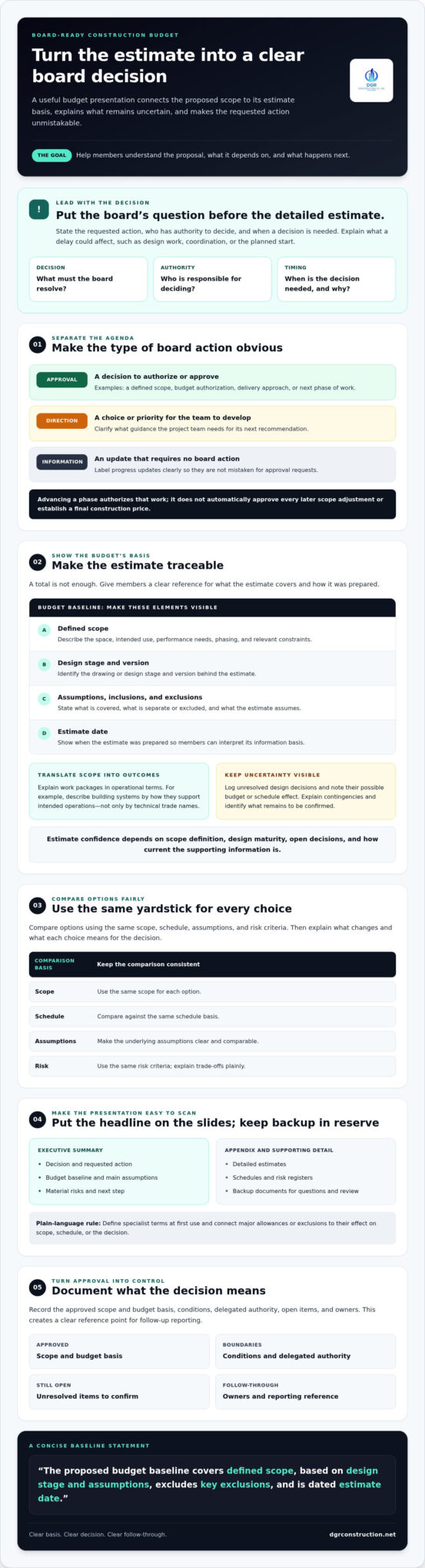
Separate agenda items into three categories so approval requests don’t get confused with discussion points:
- Approval: A defined scope, budget authorization, delivery approach, or next phase of work.
- Direction: A choice or priority the project team needs to develop its next recommendation.
- Information: A progress update that requires no board action at this meeting.
For each approval, state who has authority to decide, the deadline, and the practical consequence of waiting. If the board is authorizing design development, for example, clarify that the authorization lets the team advance that phase. It does not automatically approve every later scope adjustment or establish a final construction price.
Make the summary useful to non-construction board members
Lead with a concise executive summary covering the decision, budget baseline, main assumptions, material risks, and next step. Put detailed schedules, risk registers, and backup estimates later in the presentation or in appendices. This lets members understand the business implications first and consult technical detail when needed.
Translate work packages into outcomes. Instead of listing “mechanical, electrical, and plumbing,” explain that the budget includes the building systems needed to support the intended operations. Define specialist terms at first use, and connect each major allowance or exclusion to its effect on scope, schedule, or decision-making. Cost engineering includes estimating, cost control, forecasting, and risk analysis. These cost engineering principles can help frame the budget as an actively managed project tool rather than a single figure.
Use a clear baseline sentence: “The proposed budget baseline covers [defined scope] based on [design stage and assumptions], excludes [key exclusions], and is dated [estimate date].” When presenting a commercial construction budget to the board, this gives members a concise reference point for evaluating the request and asking focused questions.
Build a Defensible Commercial Construction Budget From Scope to Assumptions
A defensible estimate needs more than a total. Build it through a repeatable sequence so board members can trace how the project scope becomes a budget, see what remains uncertain, and understand the estimate’s limits. This traceability helps distinguish a grounded estimate from a number detached from its basis.
Estimate accuracy depends on how clearly the scope is defined, how mature the design is, which decisions remain open, and how current the information behind the estimate is. Put the basis on the first page of the detailed estimate: drawing or design stage and version, project assumptions, exclusions, and the date the estimate was prepared. This gives the board a reference for interpreting the figures and future revisions.
Document scope, inclusions, and exclusions
Describe the space and its intended use in operational terms. Capture performance requirements, phasing, and constraints that could affect construction or ongoing operations. Then list major inclusions and exclusions explicitly. For example, identify whether equipment is included in the estimate or shown separately, rather than leaving members to infer what a cost category covers.
Use an unresolved-items log for design decisions that could change scope or cost. For each open item, record its potential budget or schedule effect, the person responsible for resolving it, and a target resolution date. This turns uncertainty into trackable work instead of burying it in a general caveat.
Explain assumptions, allowances, and contingency
Organize costs into categories board members can recognize, such as design, construction, site work, equipment, and owner costs. Define each category’s contents in the supporting estimate. Then explain allowances and contingency separately, using definitions agreed by the project team. An allowance may represent a defined budget placeholder for an item not yet selected; contingency may be reserved for identified uncertainty. The project documents should state what each covers.
For every reserve, identify the risk it addresses, who controls its use, and how any draw will be documented and reported. Don’t present a percentage as a universal benchmark. Support any proposed amount with project-specific evidence, such as design completeness, known scope gaps, or identified site conditions, and distinguish it clearly from the base estimate.
A practical review sequence is:
- Confirm the scope and the design information being priced.
- Record assumptions, inclusions, exclusions, and estimate date.
- Group costs into understandable categories and reconcile them to the total.
- Identify open decisions, allowances, contingencies, owners, and resolution dates.
Design-build coordination can bring design, engineering, and construction inputs into budget discussions as scope develops. For commercial projects in Los Angeles and Orange County, organizations evaluating a construction partner can review DGR Construction Co.’s commercial construction capabilities, including its design-build and construction management services.
Compare Construction Budget Options Without Hiding Cost or Schedule Risk
Options are useful only when the board can compare them on equal terms. Keep the scope, estimate date, design assumptions, and schedule basis consistent wherever possible. If an alternative changes the project brief, identify that change rather than presenting its estimate as a direct comparison. A different budget may reflect a different outcome, sequence, or allocation of risk, so make the trade-off visible.
A developing estimate can change as drawings advance, decisions are resolved, or project conditions are verified. That doesn’t make the estimate meaningless. Explain what information changed, which cost or schedule items it affects, and what remains unpriced. When presenting a commercial construction budget to the board, show the estimate alongside its maturity and limits, not as a falsely precise final figure.
Compare options on a consistent basis
Use a table to summarize the base option and viable alternatives. Compare delivery approaches, such as design-build and another approach under consideration, only if both suit the project. Describe who coordinates design and construction, what sequence is assumed, and which decisions or dependencies could affect the schedule. Identify a preferred option and its trade-offs, while explaining why another option may still be reasonable.
| Option | Scope or approach change | Schedule and risk considerations | Decision implication |
|---|---|---|---|
| Base option | Current approved project brief and estimate basis | Risks and dependencies documented for the current scope | Confirms whether to advance the proposed plan |
| Alternative A | Different delivery approach, if suitable | May change sequencing, coordination, and responsibilities | Board weighs delivery trade-offs against project priorities |
| Alternative B | Revised scope, such as a phased or reduced requirement | Identify operational impacts and any added dependencies | Board decides whether the changed outcome meets the need |
Don’t imply a saving or schedule benefit unless the estimate and supporting assumptions substantiate it. Note which items are quantified in the estimate and which remain unresolved, such as a decision awaiting confirmation. Keep these categories distinct so uncertainty isn’t hidden inside a single total.
Present risk with ownership and a next checkpoint
For each material risk, state its likelihood, potential impact, mitigation, and accountable owner. For a Los Angeles or Orange County project, verify relevant permitting, site, utility, and labor assumptions with the responsible project team or a qualified source before relying on them. Don’t present local conditions as confirmed until they’ve been checked.
Close the comparison by listing what must be validated before the next approval milestone, who will confirm it, and when. That gives the board a clear basis for deciding now while preserving visibility into issues that could change the estimate or schedule.
Prepare the Board Presentation and Answer Budget Questions Clearly
A concise board deck should guide members from context to decision without asking them to interpret a crowded estimate. Keep the main presentation focused on the project need, budget summary, viable options, material risks, and specific action requested. Presenting a commercial construction budget to the board is easier when technical backup is available but doesn’t compete with the decision on the main slides.
Separate the main deck from supporting material
Move detailed estimate schedules, scope documents, assumptions, and project schedules into clearly labeled appendices. Use the same cost category names throughout the deck and supporting documents, and place a visible version date on each file. That way, board members can trace a summary figure back to its source and know they’re reviewing the current basis.
A sample agenda can assign each topic to the person best placed to explain it:
- Project need and requested action: executive sponsor or board liaison.
- Scope, estimate basis, and maturity: project lead or estimating representative.
- Schedule and construction sequencing: construction or project manager.
- Funding, owner costs, and authorization: finance lead.
- Risks, open decisions, and next steps: project lead, with accountable owners identified.
Adjust roles to match the project team. The important point is that every topic has a prepared speaker, and the presenter can direct detailed questions to the person with the relevant information.
Answer difficult budget questions with clarity
Prepare concise responses to questions about scope, estimate maturity, contingency, schedule, and change control. Start with the documented basis, then state what remains uncertain. For example: “This estimate uses the current design package and includes the listed scope. The equipment selection is not final, so that item remains subject to confirmation.” This is more credible than implying every detail is settled.
If a board member asks how a proposed scope change affects cost or timing, explain the likely direction and dependencies only when supported by project information. Don’t offer unverified figures. If the effect needs analysis, record the question, name the person responsible for the follow-up, and give a specific date for delivering the answer. The presenter can say, “The project manager will confirm the schedule effect and provide an update by [date].”
Before the meeting, align presenters on the estimate version, definitions, and approved assumptions so answers don’t conflict. A consistent record helps the board follow the discussion and supports clear follow-up. For help preparing construction budget materials and project updates, learn about DGR Construction Co.’s commercial construction services.
Turn Board Approval Into Budget Controls and Clear Next Steps
Board approval establishes a basis for action, not permission to treat every later cost change as already approved. Document the decision promptly so the project team, finance lead, and board can work from the same authorized scope and budget baseline. Clear records help preserve accountability as design and construction progress.
Document the decision and control changes
Record the approved scope, budget basis and estimate version, conditions attached to approval, delegated authority, and unresolved items in the meeting minutes. Distribute the decisions and action items with named owners and due dates, then retain the approved estimate and supporting documents in an auditable project record.
Use a consistent sequence after the meeting:
- Confirm the record: Capture approvals, conditions, open questions, owners, and deadlines.
- Set the baseline: Update the working budget only after authorized changes and supporting documentation are confirmed.
- Review proposed changes: Document the reason, scope impact, cost and schedule implications, funding source, and required reviewers before commitment.
- Report consistently: Track estimate revisions, commitments, forecast changes, and contingency use against the approved baseline.
The change-control path should identify who may request a change, who assesses its effect, and which level of approval is required before the team commits to it. If a change falls outside delegated authority, refer it to the appropriate decision-maker rather than incorporating it informally. This creates a clear distinction between a forecast update and an approved budget change.
Choose support that sustains visibility
For the next phase, assess whether the project team can coordinate design, engineering, construction, and budget communication. Ask how it documents decisions, reports progress, identifies schedule changes, and presents budget variances. Relevant commercial project experience and self-perform capabilities may also help the owner understand how work will be coordinated. Evaluate these in relation to the project’s actual requirements.
DGR Construction serves commercial clients in Los Angeles and Orange County. Its services include design-build project delivery and construction management, and its in-house union drywall and T-bar teams can support relevant commercial project work. DGR uses Procore for project documentation, along with weekly updates and daily reports. Discuss the project’s reporting needs and confirm how those needs will be addressed.
When presenting a commercial construction budget to the board, the final measure of a productive meeting is not approval alone. It’s a documented decision, a controlled baseline, assigned follow-up, and a reporting process that keeps the board informed as assumptions are tested and the work advances.
Move From Board Approval to a Clear Project Path
A strong construction budget presentation gives board members more than a total to approve. It connects the requested decision to a defined scope and estimate basis, makes alternatives and uncertainty visible, and establishes how changes will be reviewed and reported. That structure helps the team move forward with shared expectations, even as project details develop.
After approval, document the conditions, delegated authority, open items, and next actions. Keep the budget baseline tied to its supporting information, and make revisions traceable so the board can distinguish approved changes from forecast updates. These practices make presenting a commercial construction budget to the board part of a wider process of disciplined project oversight.
DGR Construction is a commercial general contractor based in Los Angeles and serving clients in Orange County. The company offers construction management and design-build services, coordinating architectural design, engineering, and on-site construction for commercial projects. To discuss your project, contact DGR Construction.
With a clear decision, documented assumptions, and accountable follow-through, your board can make informed choices and your project team can proceed with greater clarity.
Frequently Asked Questions
How do you present a construction budget to a board?
Start by stating the decision the board needs to make, the authorization requested, and the timing. Then summarize the project scope, estimate basis and date, key assumptions, alternatives, and material risks. When presenting a commercial construction budget to the board, distinguish approved amounts from developing estimates and explain what could change. Keep detailed line items and backup documents in an appendix. Close by naming the next steps, owners, and due dates.
What should be included in a commercial construction budget presentation?
Include the project purpose, defined scope, estimate date and maturity, major cost categories, assumptions, exclusions, schedule implications, risks, alternatives, and requested decision. Explain allowances and contingency using project-specific definitions, including what each covers and who controls its use. Keep supporting estimates and scope documents available in a clearly labeled appendix. Identify unresolved items, assign an owner to each, and state when the team expects to confirm them.
How do you explain construction contingency to a board?
Explain contingency as a project-specific reserve for identified uncertainties, and state what risks it is intended to address. Distinguish it from allowances for items not yet selected, known costs, and owner-directed scope changes. Tell the board who can authorize its use and how each decision will be recorded. Avoid presenting a generic percentage as universally appropriate. The project team should support any proposed amount with the scope, estimate maturity, and documented risks.
How much detail should a board construction budget presentation include?
Include enough detail for the board to make its decision, but don’t turn the meeting into a line-by-line estimate review. The main deck should summarize major cost categories, assumptions, exclusions, alternatives, and material risks. Put detailed estimates and backup documents in an appendix, with figures traceable to a dated estimate. Adjust the level of detail to the board’s oversight responsibilities, project complexity, and decision stage.
What happens if a construction estimate changes after board approval?
First document what changed, why it changed, and whether it affects scope, schedule, risk, or the approved budget basis. Then follow the project’s change-control process and delegated approval limits before making commitments. Provide the revised estimate and supporting assumptions, and clearly state what decision is needed and by when. Approval of an early estimate doesn’t remove the need for later review as design information and project conditions develop.
Should a board approve a construction budget before design is complete?
It depends on the decision being requested and how much scope and design information is available. Explain the estimate’s maturity, assumptions, unresolved design items, and potential exposure before seeking authorization. The board may be asked to approve funding for a defined next phase rather than a final construction amount. Make the distinction explicit, and confirm the appropriate approval language with the organization’s finance and governance teams.
How can a contractor help make a construction budget easier for the board to review?
A contractor can help organize scope, estimate assumptions, options, schedule relationships, and risks into a consistent decision package. Ask how the team documents revisions, reports progress, and explains changes. For design-build work, clarify how design and construction inputs are coordinated. DGR Construction is based in Los Angeles and serves clients in Orange County. Its construction management services and design-build approach can help coordinate the project team and budget communication. Contact DGR Construction to discuss your commercial project.