
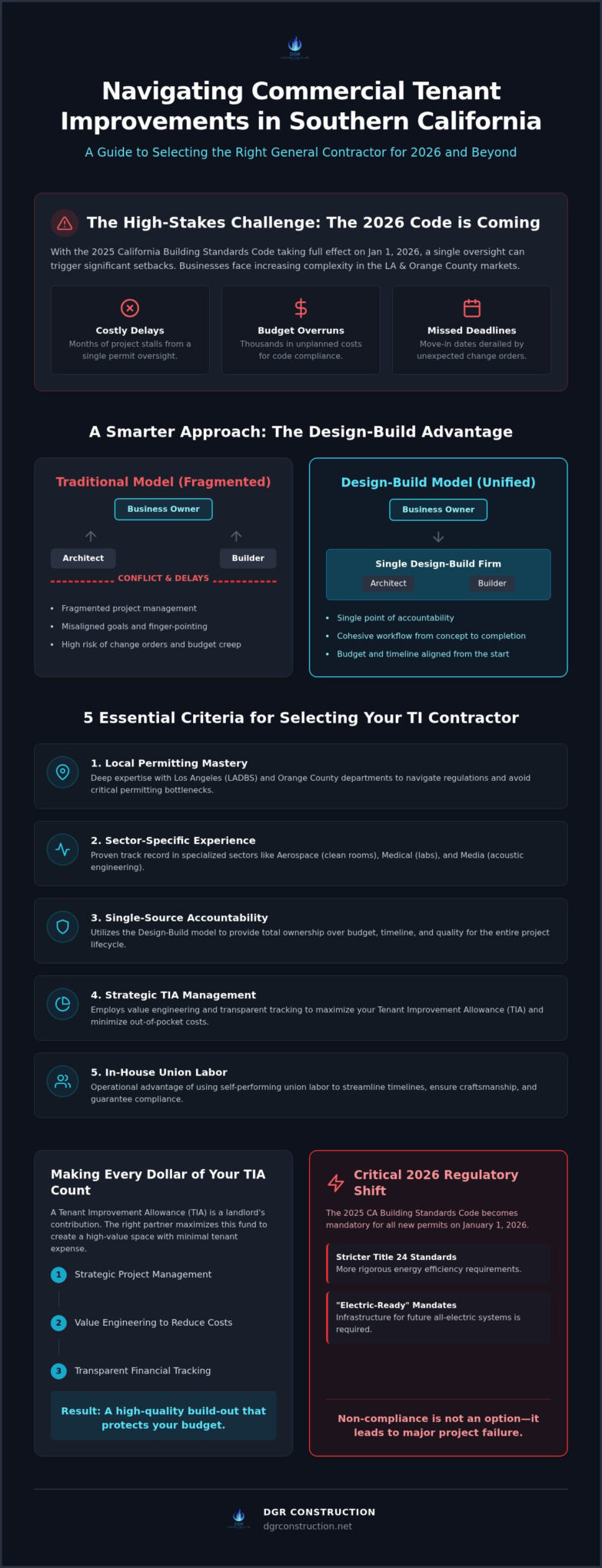
With the 2025 California Building Standards Code taking full effect on January 1, 2026, a single oversight in your permit application can now trigger months of delays and thousands in unplanned compliance costs. You likely recognize that the Los Angeles and Orange County markets are becoming increasingly complex. Finding the right tenant improvement general contractors is no longer just about the lowest bid; it’s about securing a partner who understands how to bridge the gap between your Tenant Improvement Allowance and the actual cost of construction. It’s frustrating when miscommunication between architects and builders leads to change orders that stall your move-in date and exhaust your budget.
This selection guide will show you how to identify a partner who utilizes a design-build model to protect your investment and ensure your facility meets the latest Title 24 energy standards. You’ll learn how to maximize your TIA through strategic project management and transparent tracking. We will examine the critical 2026 regulatory updates, the financial benefits of self-performing union labor, and the specific criteria for vetting a firm that manages the entire project lifecycle with total precision.
Key Takeaways
- Understand the specialized role of interior modifications in transforming commercial shells into functional, code-compliant business environments.
- Learn why the design-build model offers a superior alternative to traditional bidding by providing a single point of accountability for your entire project.
- Identify the essential criteria for vetting tenant improvement general contractors in Southern California, including local permitting expertise and sector-specific experience.
- Discover strategic value engineering methods to maximize your Tenant Improvement Allowance (TIA) while maintaining high standards of craftsmanship.
- Explore the operational advantages of utilizing in-house union labor to streamline construction timelines and ensure compliance with the 2026 California Building Standards Code.
What are Tenant Improvement General Contractors?
What are Tenant Improvement General Contractors? These specialized firms serve as the primary point of accountability for modifying the interior of a commercial property. Unlike ground-up builders who focus on the building’s exterior envelope, these contractors concentrate on the space within the walls. They manage everything from structural modifications to the final finishes that define a brand’s physical presence. In the high-stakes markets of Los Angeles and Orange County, these professionals ensure that a leased space actually functions for the business occupying it. They act as the technical lead, coordinating various trades to transform a vacant area into a productive workspace.
Tenant improvement is the critical bridge between a leased shell and an operational business environment. This process differs significantly from a standard renovation. While a renovation might simply refresh an existing office, a tenant improvement (TI) build-out often starts with a “cold shell” consisting of bare concrete and unfinished utilities. The contractor must install the entire infrastructure required for the tenant’s specific operations. This includes managing the Tenant Improvement Allowance (TIA) provided by the landlord. Effective tenant improvement general contractors ensure that every dollar of this allowance is used to maximize the value of the build-out, minimizing out-of-pocket costs for the tenant.
Specialized sectors demand a higher tier of technical expertise. Aerospace facilities require precise clean rooms and reinforced slabs for heavy machinery, while medical offices need complex plumbing and specialized HVAC systems for laboratory environments. Media and high-end studios in Los Angeles require advanced acoustic engineering that standard builders often overlook. Choosing a firm with deep roots in these specific industries is essential for a successful outcome that meets both functional and regulatory demands. For businesses with more complex structural needs, partnering with an experienced industrial construction company in Los Angeles that also handles tenant improvements ensures the technical precision required for demanding environments.
Common Components of a TI Project
- Partitioning and Drywall: Creating functional office or lab layouts through precise framing and wall installation.
- Flooring and T-bar Ceilings: Enhancing acoustics and aesthetics while providing access to critical overhead utilities.
- MEP Adjustments: Customizing mechanical, electrical, and plumbing systems to support specialized equipment and high-density occupancy.
The 2026 Los Angeles Market Landscape
The Southern California market is currently driven by a demand for flexible office spaces and hybrid-ready environments. As of January 1, 2026, the 2025 California Building Standards Code is the new mandatory standard for all permit applications. This includes more rigorous Title 24 energy standards that require “electric-ready” infrastructure for many commercial spaces. Navigating these updates requires a partner who understands the nuances of the Los Angeles Department of Building and Safety (LADBS) and Orange County building departments. Local experience is the only way to avoid the permitting bottlenecks that often stall projects in Downtown Los Angeles and surrounding areas.
The Design-Build Advantage in Commercial Tenant Improvements
Traditional construction methods often lead to fragmented project management and misaligned goals. By adopting the design-build model, tenant improvement general contractors consolidate architecture, engineering, and construction into a single, cohesive workflow. This integration removes the friction that typically occurs when designers and builders operate in silos. It prevents the costly finger-pointing that often arises when a design proves difficult or expensive to execute in the field. Instead, the team works toward a unified vision from the initial concept through to the final permit sign-off. Businesses operating across Southern California can explore how this same integrated approach applies to commercial renovation in Orange County, where the design-build model is proving equally effective at eliminating permit bottlenecks and mid-project corrections.
Single-source contracting provides a stabilizing force for complex projects. When one firm manages the entire project lifecycle, they assume total accountability for both the budget and the construction timeline. This level of responsibility is a vital part of the Essential Criteria for Selecting a TI Contractor, as it ensures the team is aligned on feasibility from the start. Technical sectors, such as aerospace facility construction California, rely on this integrated precision to ensure that intricate mechanical systems and specialized framing are installed without compromising the structural integrity or the tenant’s operational requirements.
A successful build-out considers the final move-in long before the first wall is framed. A streamlined partner manages early-stage coordination for furniture installation and specialized final cleaning schedules. This foresight ensures that the transition from a construction site to a professional workspace is frictionless. You can streamline your next build-out by engaging a partner who prioritizes these operational details as much as the physical structure itself.
Streamlining Communication and Accountability
Managing multiple contracts creates an unnecessary administrative burden for your internal team. The design-build model offers one contract and one point of contact, which simplifies communication and accelerates decision-making. By overlapping the design and construction phases, projects often reach completion faster than traditional “design-bid-build” methods allow. This methodical approach ensures that your resources are spent on the build-out rather than on managing conflicting schedules between different vendors.
Technology-Driven Transparency with Procore
Modern commercial construction requires more than just manual oversight. Utilizing industry-leading platforms like Procore gives stakeholders real-time access to daily reports, submittals, and high-resolution project photography. This digital transparency includes detailed “look-ahead” schedules and meeting minutes that keep all parties aligned. It transforms a complex building process into a manageable, data-driven experience where progress is documented and visible at every stage of the project.
5 Essential Criteria for Selecting a TI Contractor in Southern California
Selecting the right partner in the Southern California market is a high-stakes decision. It requires looking beyond the bottom line to evaluate operational stability and technical proficiency. Tenant improvement general contractors must possess a Class A license to handle the structural complexities of modern commercial spaces. Deep roots in Los Angeles and Orange County are equally vital, as local relationships with building departments can significantly impact your move-in date. A contractor who understands the nuances of local permitting can often anticipate challenges before they result in a project stoppage.
Evaluate sector-specific experience carefully. A contractor who excels in standard retail may lack the technical precision required for high-end media studios, aerospace facilities, or medical suites. Verify safety records; a history of zero workplace accidents indicates a disciplined, organized job site where risk is actively managed. Additionally, look for firms with “self-perform” capabilities. When a contractor uses their own crews for critical path items like drywall and T-bar ceilings, they maintain superior control over the schedule. Union affiliations further guarantee high-tier craftsmanship and strict adherence to California’s evolving labor and building codes. These credentials ensure that your tenant improvement general contractors can deliver a product that meets institutional standards. The same design-build principles that define excellence in tenant improvements also apply to larger-scale projects; reviewing what sets apart a leading industrial construction company in Los Angeles can offer valuable benchmarks for evaluating any commercial contractor’s capabilities.
Licensing and Regulatory Compliance
A reputable contractor should maintain active standing with the California Contractors State License Board (CSLB), holding both a Class A General Engineering license and specialized certifications like a C9 license for drywall. Insurance coverage is a critical safeguard for the tenant. Ensure your partner carries a minimum of $3 million in public liability and comprehensive workers’ compensation insurance. For businesses with internal diversity initiatives, confirming minority contractor certifications adds significant value to the partnership while meeting corporate social responsibility goals.
Evaluating the Project Management Team
The success of your build-out depends on the specific individual assigned to lead it. A TI-specific project manager understands the urgency of commercial timelines and the nuances of working within occupied buildings. They should provide weekly communication and detailed “look-ahead” schedules to prevent surprises. This level of oversight ensures that the project remains transparent and accountable from demolition to final walk-through. For a deeper dive into vetting these professionals, see our 2026 Selection Checklist for Office TI Project Managers.
Maximizing Your Tenant Improvement Allowance (TIA) and Budget
A successful build-out requires a clear understanding of your financial framework. Many commercial leases offer a Tenant Improvement Allowance (TIA), which is a specific dollar amount provided by the landlord for space modifications. This is distinct from a turnkey build-out, where the landlord manages the entire project to a predetermined standard. While turnkey projects offer convenience, TIA-based projects provide the tenant with greater control over the final environment. Experienced tenant improvement general contractors act as financial stewards in this process, ensuring that every dollar is allocated to high-impact areas that improve operational efficiency.
Value engineering is a core strategy for maintaining your budget without sacrificing quality. This involves identifying alternative materials or construction methods that achieve the desired aesthetic at a lower cost. For example, selecting high-performance T-bar systems can provide the acoustic benefits of more expensive custom ceilings. Additionally, working with a firm that utilizes in-house union labor for drywall and framing significantly reduces the “subcontractor markup” that often inflates budgets. By eliminating the middleman on these critical path items, you can redirect those funds toward specialized equipment or high-end finishes. You can optimize your TIA budget by partnering with a contractor who prioritizes this level of fiscal transparency.
High-rise environments in Los Angeles introduce unique financial variables that standard budgets often overlook. Hidden costs frequently include mandatory freight elevator fees, specialized debris removal protocols, and requirements for after-hours work to avoid disrupting neighboring tenants. Tenant improvement general contractors with deep local experience anticipate these expenses during the pre-construction phase. This proactive approach prevents the budget creep that occurs when logistical fees are discovered mid-project.
Budget Planning and Cost Control
Current data for 2026 shows that office tenant improvements in Los Angeles typically range from $50 to $200 per square foot, depending on the building class and scope. A disciplined budget must prioritize high-impact areas such as acoustics, advanced lighting systems, and mandatory ADA compliance upgrades. The process concludes with a comprehensive Close-out Package. This documentation ensures that all warranties, as-built drawings, and operation manuals are captured, protecting your long-term investment in the facility.
Navigating High-Traffic Urban Logistics
Managing a project in an iconic DTLA location like 707 Wilshire requires meticulous logistical planning. These sites often feature multi-sided street access that demands precise coordination for material deliveries and labor staging. Minimizing disruption to neighboring tenants is a primary objective. A methodical partner manages these complexities through staggered delivery schedules and strict adherence to building-specific construction hours, ensuring the project moves forward without administrative friction.
Streamlining Your LA Build-Out with DGR Construction’s In-House Expertise
DGR Construction Co. has spent over 26 years refining its role as a stabilizing force in the Southern California commercial market. While many tenant improvement general contractors rely heavily on a rotating list of third-party subcontractors, our approach centers on internal accountability. We understand that the complexity of the Los Angeles and Orange County building departments requires a partner with deep-rooted local knowledge. Navigating the LADBS plan check process or meeting the specific requirements of Orange County inspectors isn’t just about technical skill; it’s about a history of reliable execution. We act as a singular point of responsibility to ensure your move-in happens as planned.
The strength of our methodology lies in our ability to self-perform critical phases of construction. Our in-house union drywall and T-bar teams are our secret weapon for maintaining project speed. By removing the reliance on outside schedules, we ensure that the most labor-intensive parts of a build-out are completed with union-tier precision and on our own timeline. This control extends to specialized structural work, such as building custom platforms, ramps, and reinforced walls for medical or aerospace environments. We manage every detail to ensure the final product is both seamless and clean. You can trust our tenant improvement general contractors to maintain a disciplined job site that respects your budget and your vision.
Our Specialized Divisions
- In-house Union Drywall and T-bar: We control quality and timelines directly by using our own signatory crews for framing and acoustic ceilings.
- Structural Self-Perform Work: Our team handles technical interior elements including equipment platforms, ADA ramps, and specialized wall supports.
- Furniture Coordination and Final Clean: We manage the finishing touches of a professional build to ensure the space is ready for immediate operation.
A Track Record of Excellence in SoCal
Our portfolio includes high-profile projects for industry leaders such as WME Beverly Hills and OBB Media. These projects demonstrate our ability to manage high-stakes environments where acoustic precision and aesthetic craftsmanship are non-negotiable. The DGR promise is built on delivering these complex projects under budget and on time. We focus on building long-term relationships through total transparency and expert execution. Ready to transform your commercial space? Contact DGR Construction for a Design-Build Consultation to begin your next project with a proven partner.
Secure Your Commercial Future with Expert Execution
Navigating the complexities of the 2026 Southern California market requires more than just a standard builder. It demands a partner who integrates design-build precision with a deep understanding of local regulatory standards. By prioritizing firms that offer self-perform capabilities and transparent project tracking, you protect your investment and ensure your facility meets the latest California building codes. Selecting the right tenant improvement general contractors is the most significant step you can take toward a seamless move-in experience that stays within your Tenant Improvement Allowance.
DGR Construction Co. brings over 26 years of local expertise and a disciplined approach to every build-out. As a signatory to the Carpenters Union with an A+ BBB rating and a record of zero workplace accidents, we provide the stability needed for high-stakes projects. We manage the entire lifecycle of your project to remove administrative stress and deliver operational excellence. Start Your Los Angeles Tenant Improvement Project with DGR Construction to transform your commercial space into a high-performing asset. We look forward to helping you build a professional environment that supports your long-term business goals.
Frequently Asked Questions
What is a typical Tenant Improvement Allowance (TIA) in Los Angeles for 2026?
Typical office tenant improvement allowances in Los Angeles currently range from $60 to $80 per square foot. Medical spaces often command higher allowances between $50 and $100 per square foot due to specialized infrastructure requirements. These figures vary based on building class and the length of the lease term. Landlords use these allowances to attract high-quality tenants in competitive markets like Downtown Los Angeles and the Westside.
How long does a standard office tenant improvement project take from design to occupancy?
A standard office build-out typically requires four to six months from the initial design phase to final occupancy. This timeline includes approximately two to three months for the LADBS commercial plan check and permitting process. Construction duration depends on the scope of work; however, overlapping the design and construction phases through a design-build model can significantly reduce the total project schedule and prevent move-in delays.
What is the difference between a tenant improvement and a commercial remodel?
Tenant improvements focus specifically on customizing a leased interior space for a business’s operational needs, whereas a commercial remodel often involves refreshing an existing layout for aesthetic purposes. TI projects frequently begin with a “shell” space and require full infrastructure installation, including specialized MEP adjustments. Commercial remodels are typically less intensive and may not involve the same level of structural or code-related modifications required for a new tenant’s occupancy.
Why should I choose a design-build contractor for my TI project?
Choosing a design-build approach provides a single point of responsibility that eliminates the common friction between architects and tenant improvement general contractors. This model ensures that the design is feasible within your established budget from the start, preventing the need for costly redesigns. It streamlines communication and accountability, making the entire process more efficient and predictable for the client while reducing administrative overhead.
Does DGR Construction handle permitting with the Los Angeles Department of Building and Safety (LADBS)?
Yes, we provide comprehensive management of the permitting process with the Los Angeles Department of Building and Safety and the Orange County building departments. Our team understands the nuances of the 2025 California Building Standards Code and the specific ignition-resistant requirements for Very High Fire Hazard Severity Zones. We handle all submittals and corrections to ensure your project stays compliant and moves forward without administrative bottlenecks.
What are the acoustic requirements (STC ratings) for media or recording studio TI?
Media and recording studio projects typically require high Sound Transmission Class (STC) ratings, often ranging from 50 to 65 depending on the level of isolation needed. Achieving these standards involves specialized wall assemblies, double-stud framing, and acoustic sealants to prevent sound leakage. Our tenant improvement general contractors specialize in these high-precision builds, ensuring that the finished space meets the rigorous technical demands of professional audio production and sound engineering.
How does ‘self-performing’ work benefit the overall project budget?
Self-performing critical work like drywall and T-bar ceilings reduces the subcontractor markup and provides direct control over the construction schedule. This methodology eliminates the scheduling conflicts often associated with third-party vendors, allowing for faster project delivery. It ensures a higher standard of craftsmanship and quality control, as the work is performed by our own trained union crews rather than outsourced labor, ultimately maximizing your TIA budget.


Pingback: Commercial Renovation in Orange County: The 2026 Guide to Design-Build Excellence