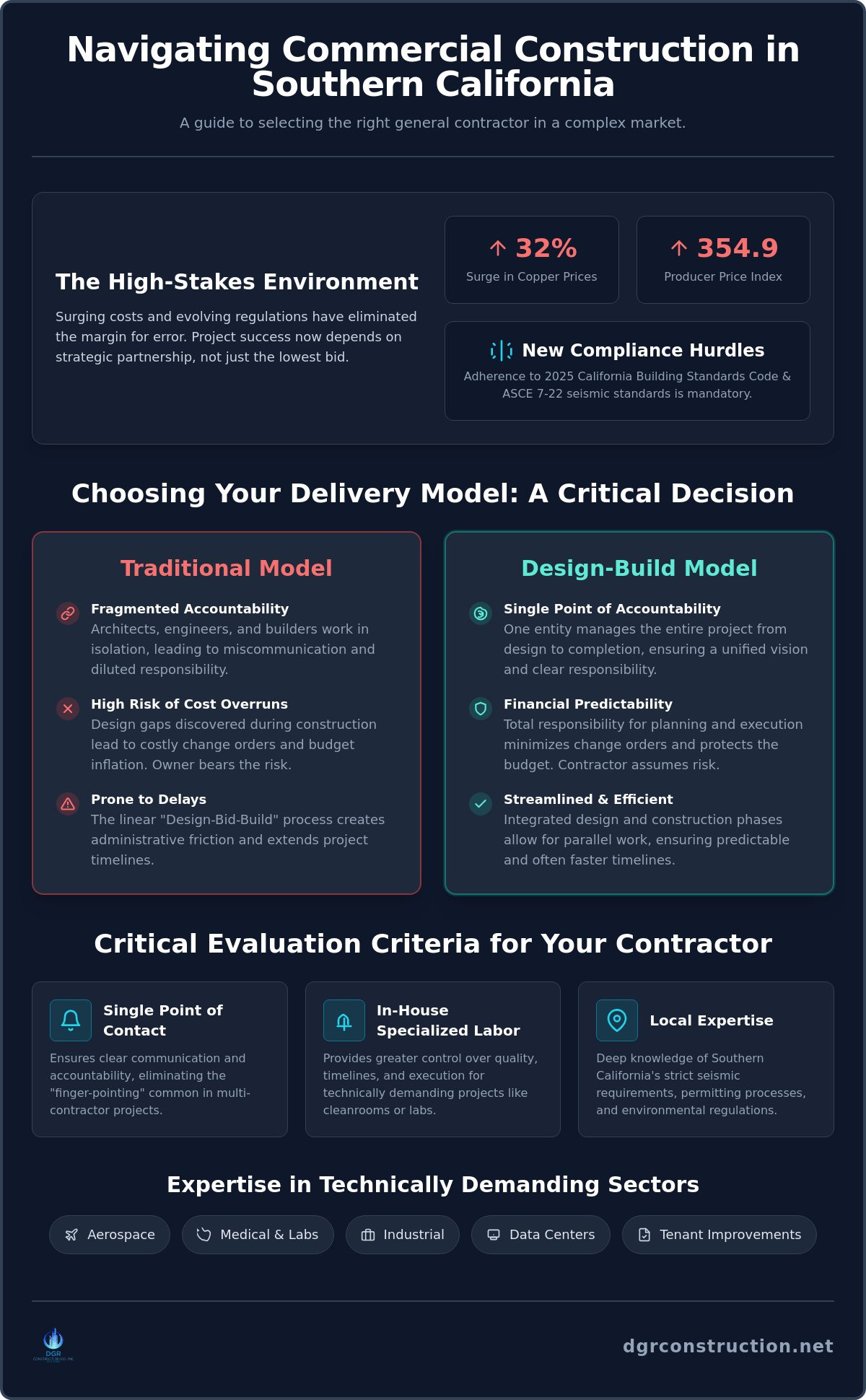
With the Producer Price Index for construction materials climbing to 354.9 in early 2026 and copper prices surging by 32 percent, the margin for error in Southern California development has effectively vanished. You likely recognize that managing a project in this environment requires more than just a builder; it requires a partner who can navigate the 2025 California Building Standards Code and the new ASCE 7-22 seismic standards without triggering costly delays. Selecting the right commercial general contractors is no longer just about the lowest bid. It’s about finding a firm that balances technical precision with the operational stability needed to absorb market volatility.
In this guide, you’ll learn how to evaluate partners based on their ability to provide a single point of accountability and maintain predictable timelines through complex permitting processes. We’ll explore why a design-build model and in-house specialized labor are essential for meeting strict industry standards in sectors like aerospace, medical, and industrial construction. By the end, you’ll have a clear framework for securing high-quality craftsmanship that protects your investment and ensures a frictionless project delivery from start to finish.
Key Takeaways
- Understand how modern delivery models like Design-Build consolidate accountability to prevent the cost overruns often found in traditional construction methods.
- Identify the essential criteria for evaluating commercial general contractors, including the specific advantages of utilizing in-house labor for specialized technical projects.
- Learn to navigate the complexities of the 2026 California Building Standards Code to ensure your project remains compliant and avoids unnecessary delays.
- Discover how localized expertise in the Southern California market provides the oversight needed to manage strict seismic requirements and environmental regulations effectively.
What is a Commercial General Contractor and Why Does Your Delivery Model Matter?
Understanding What is a Commercial General Contractor begins with recognizing them as the primary point of accountability for a project’s success. This lead entity manages every facet of the build, from initial site preparation to the final inspection. In the past, the industry relied heavily on the “Design-Bid-Build” model, which often created a fragmented environment where architects and builders worked in isolation. This separation frequently led to miscommunications, cost overruns, and delayed timelines. Modern commercial general contractors have shifted toward streamlined delivery methods that integrate design and construction phases. This evolution ensures that technical constraints are addressed during the planning stage, resulting in a more predictable and efficient process.
In Southern California, the complexity of the regulatory environment makes this choice even more critical. High-stakes sectors such as aerospace construction and data center construction leave no room for error. These facilities require specialized knowledge of environmental controls, power density, and structural integrity. The contractor you select directly influences the long-term ROI of your facility. A project delivered with precision and high-quality craftsmanship will maintain its value and operational efficiency far longer than one plagued by shortcuts or poor coordination. Choosing a partner who understands these nuances is the most effective way to protect your capital investment.
For property owners considering broader portfolio upgrades that include high-end residential work, check out Daniels Contractors for their expert guide on 2026 construction investment and value.
The Role of the Modern CGC in 2026
By 2026, the expectations for a contractor have moved beyond simple labor management. A modern CGC acts as a strategic partner, offering insights into architectural design and engineering feasibility long before the first shovel hits the ground. They manage a complex network of subcontractors, ensuring that every trade aligns with the project’s overarching goals. This “quiet expert” approach is essential for handling the high-pressure milestones inherent in large-scale commercial builds. They handle the permits and safety standards with a methodical discipline, allowing the client to focus on their core business operations while the construction remains under control and within the established budget.
Identifying Your Project Scope
Clearly defining your project scope is the first step toward a successful partnership. Ground-up industrial construction involves different logistical challenges than complex tenant improvements in an active office building. If your facility requires specialized cleanroom environments or strict acoustic engineering standards, such as those found in studio construction, a generalist approach won’t suffice. “One-size-fits-all” contractors often struggle with the nuances of medical office construction or high-tech retail builds. These projects demand a partner who understands the technical standards of the industry and possesses the disciplined oversight to execute them without friction.
Design-Build vs. Traditional Contracting: Comparing Your Options
Traditional delivery methods often force project owners to act as intermediaries between separate entities, creating a fragmented environment where accountability is diluted. When technical issues arise during the build, the lack of a unified team frequently leads to administrative friction and budget inflation. Modern Design-Build vs. Traditional Contracting strategies address this by integrating the architectural and construction phases under one roof. This single-contract approach ensures that professional fees are transparent and that the project remains focused on the final physical outcome rather than managing conflicting interests.
The shift toward this model has been driven by the need for greater financial predictability in a volatile market. In a multi-contractor project, change orders often stem from design gaps that weren’t identified during the bidding phase. By contrast, commercial general contractors operating under a design-build model assume total responsibility for both the planning and execution. This single-source accountability prevents the “finger-pointing” common in traditional projects; if a discrepancy occurs, the builder is responsible for the solution without requesting additional funds for errors that should have been caught during the design phase.
The Design-Build Advantage for Complex Projects
Facilities requiring high-density infrastructure or specialized environments benefit from overlapping the design and construction phases. This concurrency allows for faster timelines that respect aggressive business goals.
- Streamlined communication: A single point of contact reduces administrative overhead and ensures that design intent is carried through to the field.
- Faster timelines: Critical path activities like site preparation can begin while the final interior details are still being refined.
- Specialized integration: Technical experts provide input during the earliest design stages, ensuring that complex systems are buildable and efficient.
For organizations looking to minimize risk and consolidate oversight, exploring specialized design-build services provides a clear path to operational excellence.
Understanding Contract Structures
The financial framework of your project is just as important as the delivery model. Fixed-price contracts offer the highest level of budget certainty by establishing a total cost upfront, which shifts the risk of material price fluctuations to the builder. Cost-plus models, however, offer a transparent “open-book” view of all expenses, which can be beneficial for projects with evolving scopes. A disciplined partner uses these structures to protect the client from unforeseen costs, ensuring that safety enforcement and budget management remain the primary focus throughout the build. This methodical approach transforms a high-stakes construction project into a controlled, professional experience that respects both your time and your capital.
Critical Evaluation Criteria for Selecting a Commercial Partner
Vetting a partner for a multimillion-dollar project requires a disciplined approach that goes beyond comparing line items on a spreadsheet. While price is always a factor, the most reliable commercial general contractors are defined by their technical depth and their direct control over the construction process. In California, verifying a firm’s standing with the Contractors State License Board (CSLB) and their insurance coverage is the non-negotiable baseline. However, these certifications don’t guarantee the precision engineering required for a data center or the acoustic standards of a studio build. You must look for a track record of handling specialized environments that demand rigorous technical oversight.
Safety records and OSHA compliance are equally vital, particularly on industrial and aerospace sites where the risk profile is significantly higher. A contractor’s Experience Modification Rate (EMR) provides a transparent look at their safety history; a rating below 1.0 indicates a firm that prioritizes the well-being of its crew and the security of your job site. When establishing Critical Evaluation Criteria for Selecting a Commercial Partner, you must also investigate the workforce’s composition. Many firms operate as “paper contractors” who subcontract 100 percent of the work. This model often leads to scheduling conflicts and diluted quality control, as the lead entity has less direct influence over the daily execution of tasks.
The Power of In-House Union Teams
A significant advantage in the Southern California market is the use of in-house labor. When a contractor maintains their own union drywall and T-bar teams, they gain direct oversight of the project’s critical path. This internal capability ensures that craftsmanship standards are met without the need for constant third-party negotiations. It also provides a direct cost benefit to the client. By removing the markups typically associated with subcontracted drywall and ceiling work, the contractor can pass those savings directly to the budget. This hands-on management style results in faster timelines and a level of quality control that generalized firms simply cannot match.
Assessing Past Performance and Local Reputation
Reviewing a commercial portfolio should reveal more than just aesthetic success. Look for project diversity and, more importantly, longevity in the Los Angeles and Orange County markets. A firm with deep local roots understands the nuances of regional permitting and the specific demands of California’s environmental regulations. When speaking with previous clients, ask about the contractor’s ability to provide frictionless execution during high-pressure milestones. A partner who has spent over two decades building a reputation for reliability in Southern California is far more likely to manage your project with the methodical precision it deserves. For those specifically planning facility expansions in the region, reviewing how top firms approach an industrial design build Orange County project can provide a valuable benchmark for evaluating accountability and pre-construction budgeting practices.
Navigating the Southern California Landscape: Local Expertise Matters
Building in Southern California requires more than technical skill. It demands an intimate understanding of a regulatory environment that is arguably the most complex in the nation. For commercial general contractors, success in Los Angeles and Orange County is measured by their ability to anticipate hurdles before they disrupt the project timeline. The 2025 California Building Standards Code, which became effective for all new permit applications on January 1, 2026, introduced significant updates to Title 24. These changes impact everything from energy efficiency to wildfire-resistant construction. A contractor without deep local roots may struggle to interpret these nuances, leading to failed inspections and costly rework.
The role of the CGC extends beyond the job site. They serve as the central coordinator between local architects, property owners, and city engineers. This is particularly vital when navigating the ASCE 7-22 standards for seismic and wind loads, which replaced the previous ASCE 7-16 requirements as of early 2026. In high-density areas, managing these variables requires a methodical approach that respects the technical standards of the region while maintaining a steady project flow. This grounded sense of authority is what allows a project to move from the planning phase to completion without the friction of regulatory surprises.
Permitting and Code Compliance in LA and OC
Navigating the LA County commercial permitting process is a logistical challenge that can stall even the most well-funded projects. An authoritative partner ensures that all engineering and architectural plans are meticulously reviewed to pass local inspections on the first attempt. This includes meeting the strict requirements of the 2025 CALGreen code, which has expanded its focus on electric-ready infrastructure and waste diversion. By acting as a stabilizing force, the contractor removes the administrative stress from the owner, ensuring that compliance is a frictionless part of the delivery process. For a detailed breakdown of how municipal boundaries and code requirements affect project costs and timelines, the 2026 selection checklist for a general contractor in Orange County offers a comprehensive framework for evaluating compliance readiness before committing to a partner.
Sector-Specific Challenges in the Region
Different industries in Southern California present unique obstacles. In the aerospace corridor of El Segundo, projects often involve high-security environments and precision assembly requirements that demand strict access control and technical oversight. Conversely, medical office construction and retail tenant improvements require a partner who can manage heavy construction without disrupting neighboring businesses or existing patient care. For data center construction, the focus shifts to power redundancy and cooling infrastructure capable of withstanding the regional climate. To ensure your next project meets these rigorous local standards, contact DGR Construction Co. to discuss your specific facility needs.
Conclusion: Partnering with DGR Construction for Frictionless Execution
The 2026 commercial construction market in Southern California demands more than just a builder; it requires a stabilizing force capable of navigating extreme material volatility and rigorous new regulatory standards. As project complexities increase, the role of commercial general contractors must evolve into that of a strategic partner who assumes total accountability for the project’s lifecycle. DGR Construction Co. fills this role by combining technical precision with a disciplined management style that prioritizes the client’s budget and timeline. By integrating the design and construction phases, the firm removes the traditional friction points that lead to cost overruns and administrative delays.
With a legacy spanning over 26 years, DGR has refined a methodology that anticipates the specific challenges of the Los Angeles and Orange County markets. This experience is particularly valuable for high-stakes sectors like aerospace construction and data center construction, where the margin for error is non-existent. The firm’s design-build approach ensures that technical constraints are identified during the architectural phase, allowing for a seamless transition into the field. This level of foresight provides owners with a sense of stability, knowing that their capital investment is protected by a partner with a proven track record of reliability.
A distinct competitive advantage of DGR is the utilization of in-house union drywall and T-bar divisions. Unlike many commercial general contractors who rely entirely on a shifting network of subcontractors, DGR maintains direct control over these critical trades. This internal capability guarantees a higher standard of craftsmanship and allows for more aggressive scheduling without sacrificing quality. By eliminating the markups associated with third-party drywall labor, DGR passes direct cost savings to the client while ensuring that the project remains on its critical path. This hands-on oversight is what transforms a complex industrial build into a predictable, professional experience.
The DGR Approach to Commercial Success
Success in modern commercial development is defined by the removal of stress and the achievement of operational excellence. DGR Construction Co. operates as a streamlined partner, managing every detail from the initial architectural design to the final building inspection. This “quiet expert” persona allows clients to focus on their core business operations while the construction process moves forward with methodical discipline. The result is a high-quality facility that meets strict industry standards and supports long-term business growth. If you are ready to move forward with a partner who values precision and transparency, Contact DGR Construction Co. for a project consultation to discuss your upcoming facility needs.
Building with Technical Precision and Operational Certainty
The 2026 construction landscape in Southern California demands a shift from fragmented bidding to integrated project delivery. Success now hinges on selecting commercial general contractors who serve as a single point of accountability, managing everything from ASCE 7-22 seismic compliance to the final technical finishes. By prioritizing firms with in-house labor and deep regional roots, you eliminate the communication gaps that traditionally lead to budget overruns and scheduling conflicts. This methodical approach ensures that your facility is built to the highest industry standards without the friction of administrative delays.
DGR Construction Co. brings over 26 years of Southern California experience to this complex environment, providing specialized expertise in aerospace, data centers, and medical offices. Our in-house union drywall and T-bar divisions ensure superior quality control and streamlined timelines, removing the markups and coordination risks often found with fully subcontracted models. We manage the entire experience to ensure it’s professional, meticulous, and disciplined from start to finish. When you’re ready to stabilize your next high-stakes project, our team is prepared to deliver the oversight your investment deserves.
Request a Comprehensive Project Quote from DGR Construction Co.
We look forward to building a successful and stable future for your commercial operations.
Frequently Asked Questions
What is the difference between a commercial and residential general contractor?
Commercial contractors focus on business facilities and industrial structures that must adhere to different legal and structural codes than single-family homes. These projects require higher insurance limits, specialized bonding capacities, and a deep understanding of high-occupancy safety regulations. DGR Construction Co. operates exclusively in the commercial sector, managing the complex engineering and technical standards that business environments demand.
How much does it cost per square foot for a tenant improvement in Los Angeles?
Costs for tenant improvements in Los Angeles are influenced by the project’s technical requirements and the current state of the 2026 material market. Factors such as mechanical upgrades, electrical density, and specialized finishes for medical or studio spaces will dictate the final budget. DGR Construction Co. provides detailed, transparent estimates based on your specific architectural plans to ensure fiscal predictability from the start.
Why should I choose a design-build contractor over a traditional one?
Choosing a design-build model consolidates your project’s responsibility into a single contract, which removes the owner from the role of mediator between architects and builders. This integrated approach allows commercial general contractors to identify technical challenges early in the design phase, preventing the change orders that often plague traditional delivery methods. It’s a more efficient way to manage complex builds while maintaining a steady project rhythm.
Does DGR Construction Co. handle specialized aerospace facility requirements?
Yes, DGR Construction Co. has extensive experience meeting the high-security and precision engineering standards required for aerospace facilities in Southern California. We understand the nuances of building in the El Segundo aerospace corridor, including the installation of specialized environmental controls and high-tolerance assembly areas. Our team handles these high-stakes projects with the quiet expertise and meticulous discipline they require.
What are the benefits of using in-house union labor for drywall and T-bar ceilings?
Employing in-house union labor for drywall and T-bar ceilings gives DGR Construction Co. direct control over the project’s critical path and craftsmanship quality. This internal capability removes the layer of subcontractor markups and reduces the risk of scheduling conflicts that can delay a build. It ensures that the most labor-intensive interior phases are managed with the same professional standards as the rest of the project.
How long does the commercial permitting process typically take in Orange County?
The permitting timeline in Orange County depends on the municipality and the complexity of the 2025 California Building Standards Code requirements for your specific site. While some minor tenant improvements move quickly, larger industrial or medical projects require a more thorough review of seismic and energy compliance. DGR Construction Co. uses its local expertise to coordinate with city engineers, ensuring that all plans are meticulously prepared for a frictionless approval process.
Can DGR Construction Co. manage ground-up industrial projects as well as renovations?
DGR Construction Co. possesses the operational capacity to manage both ground-up industrial construction and large-scale renovations or tenant improvements. We scale our project management methodology to fit the scope, whether we’re erecting a new warehouse or retrofitting a data center with high-density cooling infrastructure. Our start-to-finish partnership ensures that the same level of technical precision is applied to every square foot of the build.
What safety standards does DGR Construction Co. enforce on its job sites?
DGR Construction Co. maintains a comprehensive safety program rooted in strict OSHA compliance and regular on-site inspections. We focus on risk mitigation to protect both the workforce and the client’s physical assets, maintaining a low Experience Modification Rate (EMR) that reflects our track record of reliability. This disciplined approach ensures that even the most technical commercial general contractors projects are executed in a safe, controlled, and professional environment.