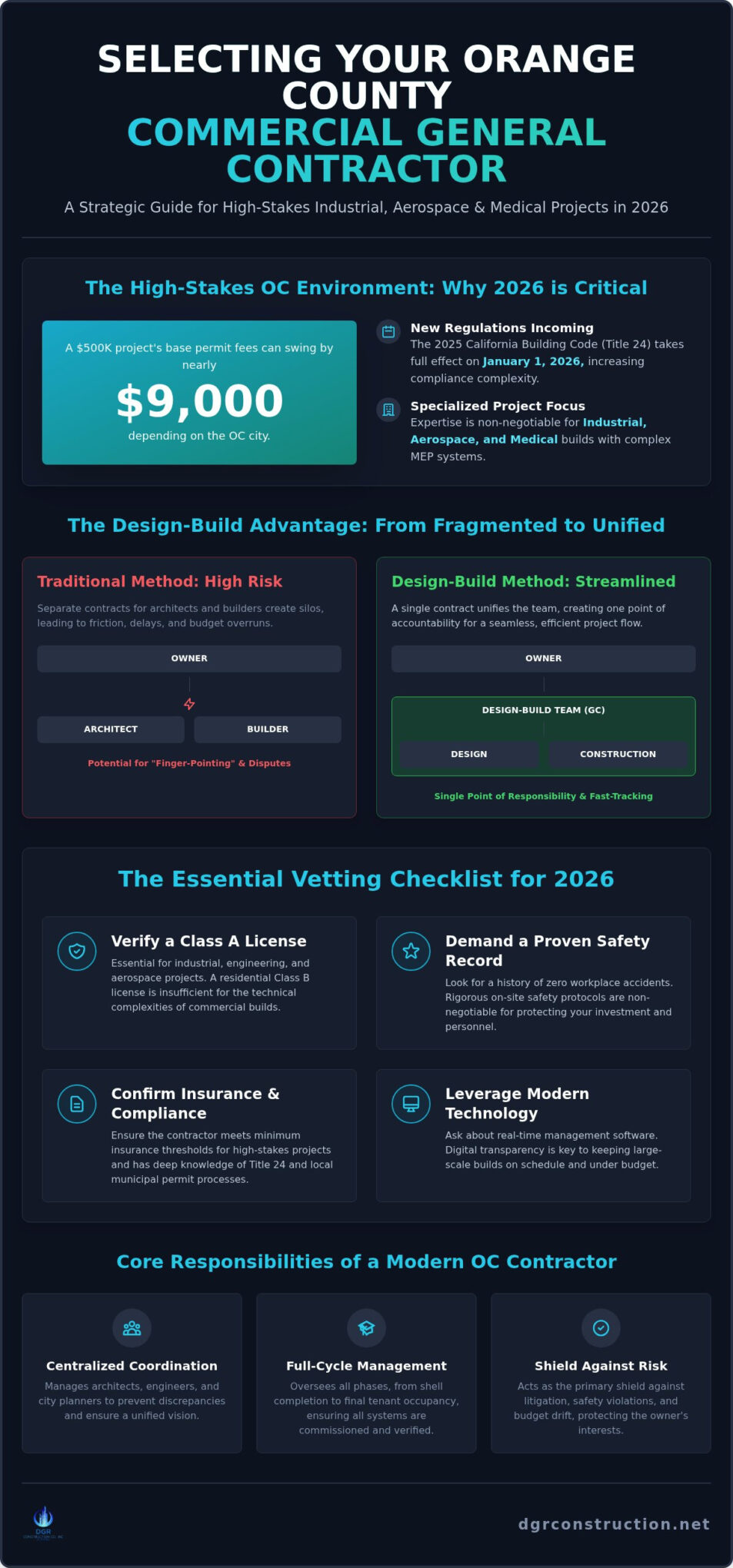
Did you know that a $500,000 commercial project in Orange County can see base permit fees swing by nearly $9,000 depending solely on which city boundary your site falls within? With the 2025 California Building Code (Title 24) taking full effect on January 1, 2026, the complexity of local compliance has reached a critical peak. You likely recognize that in this environment, a single permitting oversight or a delay in subcontractor management can quickly erode your project’s contingency fund.
Securing a general contractor orange county who understands these municipal nuances is no longer just an advantage; it’s a requirement for financial stability. This guide provides a comprehensive checklist for vetting, selecting, and managing partners for high-stakes 2026 projects, specifically focusing on industrial, aerospace, and medical builds. We will outline how to verify technical credentials, utilize modern management software for real-time transparency, and implement a design-build approach that ensures your facility is finished on time, under budget, and with zero safety incidents.
Key Takeaways
- Understand why a Class A licensed specialist is essential for managing the technical complexities of industrial and aerospace builds in California’s commercial sector.
- Learn how to use the design-build model to streamline project communication and eliminate the common friction points associated with hiring a general contractor orange county.
- Identify critical vetting requirements for 2026, including minimum insurance thresholds and the importance of a proven safety record for high-stakes projects.
- Navigate the latest Title 24 energy standards and municipal permitting processes to ensure your project remains compliant and avoids unexpected delays.
- Discover how leveraging in-house union trades and real-time management software provides the transparency needed to keep large-scale builds under budget.
Defining the Role of a Commercial General Contractor in Orange County
Within the high-density business corridors of Irvine, Anaheim, and Santa Ana, the scope of a commercial build goes far beyond basic framing and drywall. Defining the Role of a Commercial General Contractor in this region requires looking at the position as a centralized hub of accountability. A qualified partner manages the intricate balance between architectural intent, engineering constraints, and the fiscal realities of the project owner. In the Southern California market, where land is at a premium and regulatory scrutiny is intense, the contractor acts as the primary shield against litigation, safety violations, and budget drift.
For high-stakes projects like data centers or aerospace facilities, the general contractor is responsible for integrating complex Mechanical, Electrical, and Plumbing (MEP) systems that residential builders simply don’t encounter. These systems require precise coordination to ensure that high-voltage power requirements or specialized medical gas lines don’t conflict with structural supports. By serving as the single point of contact, a professional general contractor orange county simplifies the communication chain, allowing stakeholders to focus on their core business operations while the build progresses.
Commercial vs. Residential: Navigating the Licensing Gap
It is a common mistake to assume that a successful residential remodeler can seamlessly transition into the commercial sector. California licensing laws and building codes draw a sharp line between these disciplines. Residential-focused contractors often operate under a Class B license, which may not prepare them for the technical rigors of industrial tenant improvements or medical office construction. Choosing a “crossover” contractor for a technical build introduces significant risk. Commercial specialists, particularly those with Class A General Engineering experience, understand the load-bearing requirements and fire-life-safety standards unique to public and industrial spaces. At DGR Construction, our focus remains strictly on commercial and industrial sectors to ensure this specialized expertise is never diluted.
The Core Responsibilities of an OC Construction Manager in 2026
As we move into 2026, the responsibilities of a construction manager have evolved to include heavy emphasis on energy compliance and digital transparency. Precision is non-negotiable. The modern contractor must synchronize specialized MEP systems with rigid structural requirements to ensure long-term operational success. This includes:
- Direct Coordination: Managing the interface between architects, structural engineers, and city planners to prevent design discrepancies.
- Safety Enforcement: Maintaining a record of zero workplace accidents through rigorous on-site protocols.
- Transition Management: Oversight of the critical phase between shell completion and final tenant occupancy, ensuring all systems are commissioned and verified.
A reliable general contractor orange county doesn’t just build a structure; they manage the entire professional experience to ensure it is frictionless, compliant, and delivered to the exact technical specifications required for your industry.
The Design-Build Advantage: Efficiency for OC Commercial Projects
Traditional construction delivery often creates a fragmented environment where the architect and the builder operate in separate silos. This separation frequently leads to “finger-pointing” when design discrepancies arise on-site, leaving the owner to mediate disputes. The Design-Build Advantage lies in the consolidation of these entities under a single contract. For an Orange County business owner, this means the general contractor orange county assumes total responsibility for the project’s trajectory. By placing design and construction under one roof, administrative overhead is significantly reduced, as the client no longer needs to coordinate between competing interests.
Construction timelines in Southern California are often compressed by market demand and financing requirements. Design-build allows for “fast-tracking,” a method where site preparation and foundation work begin while the interior finishes are still being finalized. This overlap can shave weeks or even months off a schedule compared to the linear, sequential nature of bid-build projects. When the builder is involved during the design development phase, they provide real-time feedback on material availability and cost, ensuring the project remains feasible before the first shovel hits the ground.
Single-Source Responsibility and Risk Mitigation
A single point of accountability fundamentally changes the risk profile of a commercial build. In the traditional model, the owner often bears the financial burden of design errors discovered during construction. With design-build, the contractor and design team work collaboratively from day one to identify potential conflicts before they reach the field. This early integration prevents the costly change orders that frequently derail industrial projects. For those evaluating partners for complex facilities, reviewing an Industrial Design Build Orange County comparative analysis can clarify how different firms manage these high-stakes risks and maintain budget integrity.
Leveraging In-House Union Labor for Faster Delivery
Control over the schedule is only as strong as the labor force executing the work. Many firms rely on a “subcontractor lottery,” where the quality of work depends on whichever third-party crew is available that week. We mitigate this uncertainty by utilizing in-house union drywall and T-bar teams. As a signatory to the Carpenters Union, DGR Construction ensures that the most critical phases of interior construction are self-performed by skilled professionals. This direct oversight allows for tighter schedules and consistent craftsmanship that non-union builders struggle to match. If you are planning a facility that requires technical precision, partnering with DGR Construction ensures your project benefits from this streamlined, high-quality approach.
The Essential Checklist: Vetting an Orange County General Contractor
Selecting a general contractor orange county requires a rigorous audit that goes far beyond surface-level reviews. While online ratings might offer a glimpse into client satisfaction, they rarely reflect technical compliance or insurance adequacy for large-scale commercial work. A disciplined vetting process begins with confirming that the firm meets all California contractor licensing requirements for Class A or specialized Class B operations. This ensures the entity is legally authorized to manage the structural and engineering complexities of your specific build. A comprehensive checklist should include the following five steps:
- Verify Licensing: Confirm active CSLB standing and appropriate classifications for commercial work.
- Insurance Audit: Require a minimum of $3M in general liability coverage to protect against large-scale project risks.
- Safety Milestones: Review the firm’s history for zero-accident records, which indicates a disciplined culture of site management.
- Industry Experience: Evaluate their portfolio for projects that match your specific sector, such as aerospace or medical facilities.
- Management Software: Confirm the use of sophisticated platforms like Procore for real-time reporting and budget transparency.
By following these steps, you eliminate the ambiguity that often leads to project friction. Using professional management software is particularly critical. It allows for daily transparency through field reports and digital tracking, preventing the information silos that cause delays in high-stakes environments. For a broader framework on how modern commercial general contracting practices in 2026 address rising input costs and new Title 24 mandates, reviewing a dedicated project guide can help you benchmark your selection criteria against current industry standards.
Verifying Professional Credentials and Union Affiliations
Verification should extend to specific license designations, such as LIC: 1010921 B and C9, to ensure the contractor has the legal standing for both general building and specialty trades. Beyond basic licensing, an A+ BBB rating and minority contractor certifications provide layers of third-party validation. Being a signatory to the Carpenters Union is another significant indicator of reliability. It guarantees access to a pool of highly trained labor, which is essential for maintaining schedules in a competitive market. These affiliations suggest a firm that is deeply integrated into the local industry and committed to established technical standards.
Assessing Technical Expertise for Specialized Facilities
A qualified general contractor orange county must demonstrate technical literacy in niche requirements. For recording studios, this includes understanding STC-rated wall assemblies for acoustic isolation. For retail and medical spaces, expertise in Title 24 lighting controls and ADA-compliant handicap lifts is mandatory. If you’re refining your selection process, our guide on Choosing the Right Commercial General Contractors offers further strategic insights into aligning a firm’s portfolio with your project’s technical demands. This alignment ensures the builder understands the operational nuances of your facility from the earliest design phases.
Navigating Orange County Permitting and Compliance in 2026
Starting January 1, 2026, every permit application submitted in Orange County must adhere to the 2025 California Building Standards Code (Title 24). This update introduces rigorous requirements for building electrification, higher energy efficiency, and expanded EV-charging infrastructure. A seasoned general contractor orange county understands that the permitting process in Irvine differs significantly from the requirements in Santa Ana or Anaheim. For instance, in municipalities like Fountain Valley, plan check fees are calculated at 65% of the base permit fee. Missing these local nuances or failing to account for the high volume of applications can delay a project by months.
Successful project delivery hinges on early coordination between MEP (Mechanical, Electrical, and Plumbing) and structural teams. When technical compliance is integrated into the initial design phase, the path to a final occupancy permit becomes predictable. This foresight prevents the frantic, last-minute modifications that often occur when a building inspector identifies a code violation during the final walk-through. We ensure all technical specifications are vetted against the 2026 standards well before construction begins.
Aerospace and Industrial Compliance Standards
Industrial facilities in Southern California face additional layers of regulatory oversight. Aerospace assembly structures and data centers require specific power redundancy and environmental controls that go beyond standard commercial codes. Navigating the complexities of clean room standards or high-voltage electrical service sizing requires a partner with documented experience in technical builds. For a detailed breakdown of these requirements, review our guide on Aerospace Facility Construction in California. This specialized knowledge ensures your facility meets both state energy mandates and industry-specific operational standards.
Transparency Through Technology: Daily Reporting
In a high-stakes 2026 construction environment, waiting for a monthly progress meeting is no longer sufficient. We utilize the Procore management system to provide owners with real-time access to daily field reports, RFIs, and submittal logs. This digital transparency eliminates the information gap and keeps all stakeholders aligned on the project’s progress. It’s about providing a clear, audit-ready trail of every decision made on the job site.
Weekly look-ahead schedules are distributed to ensure that upcoming milestones are clearly understood by all trades. By centralizing all close-out packages and safety documentation in one cloud-based location, we ensure that the transition from construction to occupancy is seamless. If you need a partner who prioritizes this level of operational excellence, contact DGR Construction today to discuss your 2026 project requirements and secure your timeline.
Why DGR Construction is the Premier Choice for Orange County Commercial Projects
DGR Construction has spent over 25 years establishing a reputation for stability and professional confidence within the Southern California market. While many firms focus on high-volume residential work, we’ve remained a “quiet expert” in the commercial and industrial sectors. Our track record includes the successful execution of high-stakes builds for prominent clients such as WME and OBB Media. As a seasoned general contractor orange county, we provide the grounded authority needed to make complex projects feel manageable. We don’t just build structures; we manage the entire professional experience to ensure it remains frictionless for our clients.
The strength of our operational model lies in our self-perform division. By utilizing our own union teams for structural and architectural components, we maintain total control over the precision of the build. This internal oversight is why we’ve maintained a record of zero workplace accidents across decades of service. Owners who want to understand how rigorous commercial construction safety standards protect both their workforce and their capital investment will find that this discipline is embedded in every phase of our project delivery. It’s a level of discipline that translates directly to client peace of mind. Our communication rhythm is steady and logical, ensuring that project owners are never left guessing about the status of their investment.
Our Specialized Commercial Portfolio
Our portfolio reflects a deep understanding of technical facility requirements across diverse industries. We’ve managed everything from 10,000 square foot tenant improvements to state-of-the-art recording studios that demand extreme acoustic isolation. Our team is equally comfortable navigating high-rise commercial renovations in DTLA as they are executing medical office builds in the heart of Orange County. We take pride in delivering custom architectural features that require a high degree of craftsmanship, including integrated waterfall installations and complex radius walls. This versatility ensures that regardless of your sector, we have the technical literacy to execute your vision.
Start Your Project with a Professional Consultation
A successful commercial project requires a partner who understands the transition from design development to final occupancy. We assist our clients through every phase of this lifecycle, providing guidance on everything from initial engineering constraints to final furniture coordination. This comprehensive oversight is how we consistently deliver projects on time and under budget. We value your resources as much as the final physical product, and our disciplined methodology reflects that commitment. If you’re planning a high-stakes build for 2026, Contact DGR Construction for your Orange County project to schedule a professional consultation and secure a streamlined path to completion.
Securing Your Project’s Success in 2026
Success for your next commercial build depends on a partner who understands the shifting landscape of Orange County permitting and the technical rigors of the 2025 California Building Code. By prioritizing the design-build model and verifying professional credentials, you effectively mitigate the risks of cost overruns and scheduling delays. Selecting an experienced general contractor orange county ensures that your facility is built to the highest standards of precision, compliance, and safety from the first day of design through the final walk-through.
DGR Construction brings a legacy of stability and professional confidence to every project, backed by a Class A license and an A+ BBB rating. As a signatory to the Carpenters Union with a record of zero workplace accidents, we provide the singular point of accountability required for complex industrial, medical, and aerospace facilities. We manage the technical details and regulatory hurdles so you can focus on your organization’s core operations. We look forward to helping you turn your 2026 project vision into a high-performing reality.
Request a Commercial Construction Consultation with DGR Construction
Frequently Asked Questions
What is the difference between a general contractor and a construction manager in OC?
A general contractor orange county typically assumes the full contractual risk and responsibility for project delivery, whereas a construction manager often acts as a consultant or agent for the owner. As a Class A licensed contractor, we serve as the primary point of accountability for the entire build. This structure provides a streamlined communication chain and ensures that the project owner has a singular partner responsible for budget, safety, and technical execution.
Does DGR Construction handle residential home remodeling in Orange County?
DGR Construction does not provide residential home building or kitchen and bath remodeling services. Our expertise is focused exclusively on the commercial and industrial sectors, including aerospace, medical, and data center facilities. By concentrating on high-stakes commercial builds, we ensure our technical knowledge and union labor resources are dedicated to the specific complexities of professional and industrial environments.
How much does a commercial tenant improvement cost per square foot in 2026?
Commercial tenant improvement costs in 2026 are influenced by local municipal fees, technical MEP requirements, and compliance with the latest Title 24 energy standards. Because every project has unique structural and architectural demands, we provide customized estimates that account for these variables. Owners should consider that city-specific plan check fees and specialized materials for industrial builds will impact the final budget more than a generic square-foot average.
Why is the design-build model better for medical office construction?
The design-build model is superior for medical office construction because it integrates specialized clinical requirements with the build process from day one. Medical facilities involve intricate plumbing, electrical, and gas systems that must meet strict regulatory standards. By placing design and construction under one contract, we identify potential system conflicts early. This prevents the costly mid-project revisions often seen in traditional bid-build models.
Is DGR Construction fully insured and licensed for public works in California?
Yes, DGR Construction is a Class A licensed general contractor and is fully insured for large-scale commercial and public works projects. We maintain an A+ BBB rating and are a signatory to the Carpenters Union. Our status as a certified minority contractor and our history of zero workplace accidents provide additional layers of reliability for both state and private sector stakeholders.
How long does the commercial permitting process typically take in Orange County?
Commercial permitting timelines for a general contractor orange county depend on the specific municipality and the complexity of the project. Applications submitted after January 1, 2026, are subject to the new California Building Code, which may lead to longer plan check durations due to high application volume. We manage this process by coordinating early with city planners in Irvine, Anaheim, and Santa Ana to ensure all submittals are complete and compliant.
What specialized trades does DGR Construction perform in-house?
We perform specialized drywall and T-bar installations in-house using our own union labor teams. Self-performing these critical architectural trades allows us to maintain a tighter schedule and ensure a higher level of craftsmanship than firms that rely entirely on outside subcontractors. This internal control is a primary reason we can offer predictable timelines and consistent quality for technical interior builds.
Can DGR Construction handle high-security aerospace facility builds?
We have the technical expertise and experience required to handle high-security aerospace and industrial facility builds. Our team understands the precision needed for assembly structures, clean rooms, and power redundancy systems. By utilizing the Procore management system, we provide the rigorous documentation and real-time reporting necessary for the high-stakes environment of aerospace construction.