Over half of all satellites and vehicles currently in space were manufactured within the borders of El Segundo. This remarkable concentration of engineering talent has solidified the aerospace el segundo hub as the global center for orbital innovation, yet it presents unique challenges for those tasked with building its infrastructure. You likely understand that developing a mission-critical facility in this region requires more than just standard commercial expertise; it demands a deep understanding of high-security environments and the specific operational pressures of the defense sector.
This article provides the technical framework you need to manage successful aerospace construction, from meeting the 2025 California Building Standards Code to ensuring sensitive compartmented information facility (SCIF) integrity. We’ll explore the local regulatory landscape, including the 9.75% combined sales tax and the city’s E-Z Permit Hub, to help you make informed decisions. You’ll gain a clear strategy for selecting a design-build partner who can manage fast-tracked timelines while maintaining the precision required for the next generation of space exploration. By focusing on integrated project management, we can transform complex building requirements into streamlined, operational assets.
Key Takeaways
- Understand why the concentration of elite engineering talent in the aerospace el segundo hub dictates higher infrastructure standards for mission-critical facilities.
- Learn the specific design requirements for high-security environments, including SCIF construction and acoustic precision using STC-rated materials.
- Gain clarity on navigating El Segundo’s unique permitting process and the 2025 California Building Standards Code to avoid project delays.
- Discover how the design-build model streamlines complex projects by providing a single point of accountability and integrating engineering with construction.
- Identify the benefits of using in-house union labor and specialized management technology to maintain quality control in high-precision aerospace environments.
The El Segundo Aerospace Hub: Why Location Dictates Infrastructure
El Segundo isn’t just a coastal city; it’s a specialized industrial ecosystem where the concentration of high-level intelligence—often called the “PhD Braintrust”—dictates every aspect of the built environment. When you build for El Segundo, The Aerospace Capital of the World, you aren’t just following standard municipal codes. You’re answering to technical rigors established by entities like The Aerospace Corporation and the Los Angeles Air Force Base. This proximity creates a unique set of security and construction demands that don’t exist in other markets.
The “Aerospace Capital” Legacy
The city’s history is inextricably linked to American flight, stretching from the moon landing era to the 2026 boom in orbital logistics and “New Space” startups. Industry giants like Northrop Grumman, Boeing, Raytheon, and Lockheed Martin have long anchored the aerospace el segundo landscape. This established presence has fostered a dense supply chain of specialized subcontractors who require highly specific facility designs. Today, we’re seeing a shift from traditional defense warehouses to “Deep Tech” labs. These modern spaces must support AI-driven engineering and additive manufacturing, requiring a level of precision that mirrors the hardware produced within their walls.
Strategic Advantages of the El Segundo Corridor
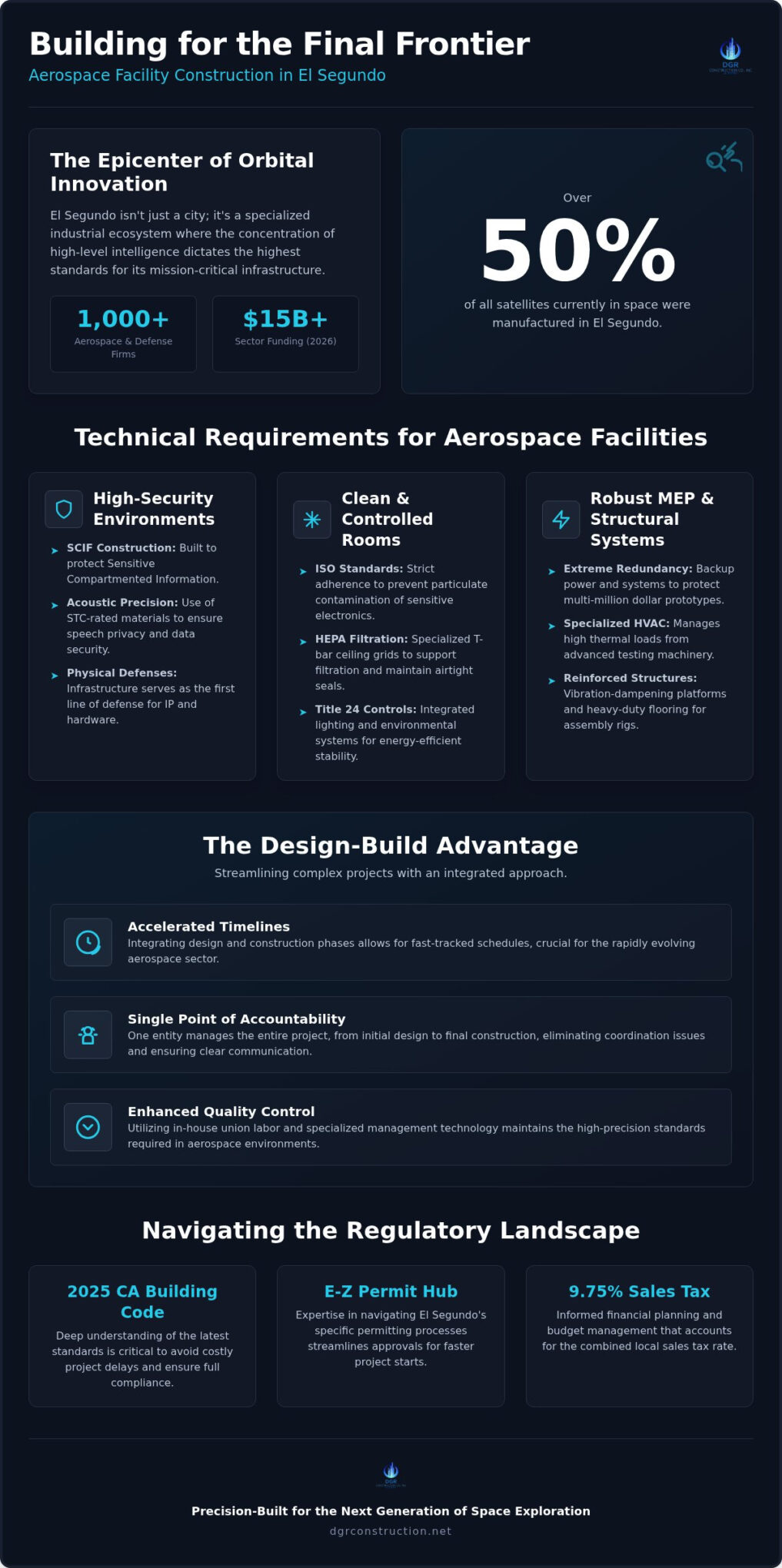
Location is the primary asset for the 1,000+ aerospace and defense firms operating in the region. Proximity to LAX and major logistics hubs allows for the rapid movement of high-value components. There’s a constant synergy between private enterprise, federally funded research, and military oversight. Because over half of all satellites currently in space were manufactured in this city, the infrastructure must be as sophisticated as the technology it houses. With the sector garnering over $15 billion in funding in 2026, the demand for mission-critical aerospace el segundo facilities has never been higher. For a partner like DGR Construction, the goal is to ensure that these physical structures provide the stability and security necessary to support such high-stakes innovation.
Technical Requirements for Aerospace Facility Construction
Constructing a facility for aerospace el segundo operations requires a shift in mindset from traditional commercial building. These structures are high-performance environments that must protect sensitive intellectual property while housing delicate orbital hardware. The physical infrastructure serves as the first line of defense for both data security and hardware integrity. Every structural choice, from the density of the concrete slab to the gauge of the steel studs, must align with the specific mission of the tenant.
Clean Rooms and Controlled Environments
Clean room construction is a foundational requirement for satellite and component assembly. We adhere to strict ISO standards to ensure that particulate matter doesn’t compromise sensitive electronics. This involves integrating Title 24 lighting controls and environmental monitoring systems that maintain atmospheric stability without sacrificing energy efficiency. Our in-house union drywall and T-bar teams specialize in the installation of high-performance ceiling systems. These specialized T-bar grids support HEPA filtration units and integrated lighting while maintaining the airtight seal necessary for ISO-rated environments. Maintaining air quality isn’t just about the filtration; it’s about the precision of the initial envelope construction.
Mechanical, Electrical, and Plumbing (MEP) systems in this sector demand extreme redundancy. A power fluctuation can jeopardize years of research or damage multi-million dollar prototypes. We design and install MEP systems with dedicated backup power and specialized HVAC units capable of managing the high thermal loads generated by advanced testing machinery. Structurally, these facilities often require reinforced flooring to support heavy assembly rigs and vibration-dampening platforms that isolate sensitive equipment from the surrounding industrial activity. Precision in the early stages of MEP coordination prevents costly delays during the final commissioning of the lab.
High-Scale Security and Acoustic Engineering
Security is the defining technical hurdle in El Segundo. Many projects require the construction of Sensitive Compartmented Information Facilities (SCIFs) that meet the rigorous standards of the Los Angeles Air Force Base and its Space Systems Command. This involves specialized shielding and physical barriers that prevent electronic and acoustic eavesdropping. Acoustic precision is equally vital in R&D environments. We utilize STC-rated walls that extend from the floor to the structural deck, ensuring full-height sound attenuation in private offices and labs. Designing these spaces often involves custom architectural elements, such as radius walls and specialized door assemblies, to accommodate unique testing paths. If you’re managing a complex build, partnering with an experienced aerospace construction specialist can help you navigate these technical hurdles with confidence.
Navigating Regulatory Compliance in Southern California
Regulatory hurdles in Southern California are notorious for stalling high-stakes projects. For firms operating in the aerospace el segundo corridor, these challenges are compounded by the need to meet both municipal codes and federal security standards. The city has implemented the E-Z Permit Hub to facilitate online submissions, yet the technical depth of aerospace builds often requires manual oversight from both city and county officials. Understanding Southern California’s Aerospace History helps one realize why these regulations have evolved into such a robust framework. It isn’t just about safety; it’s about protecting the integrity of a global innovation hub.
The 2025 California Building Standards Code, taking effect January 1, 2026, introduces new structural load requirements under ASCE 7-22. Navigating these updates requires a partner who stays ahead of legislative shifts. We ensure that every project accounts for these changes during the pre-construction phase to avoid mid-build corrections that can derail a timeline. This includes strict adherence to Title 24 energy standards and green building requirements, which are mandatory for any modern industrial expansion in the region.
Streamlining the Permit Process
Common pitfalls in aerospace permitting usually involve late-stage MEP revisions that don’t align with structural capacities. By utilizing a design-build model, we can start long-lead procurement and site preparation while the final architectural details are still being refined. This integrated approach allows for early coordination between structural engineers and city planners. We ensure that the heavy structural loads required for aerospace assembly machinery are approved well before the first slab is poured, removing the administrative friction that typically slows down traditional builds.
Zoning for Aerospace and Defense
Transforming an industrial warehouse into a high-tech lab is a common tenant improvement strategy in El Segundo. These conversions must address environmental compliance and ADA accessibility, including the installation of specialized handicap lifts in multi-level industrial spaces. Safety is paramount during these high-risk builds. We maintain a zero-workplace accident record by treating every site with the same level of discipline required by the aerospace industry itself. Our use of Procore technology keeps every regulatory document and safety log accessible in real-time, providing a transparent audit trail for both clients and inspectors. This methodical approach ensures that your facility isn’t just compliant, but optimized for long-term operational excellence.
The Design-Build Model: Efficiency in Aerospace Construction
Traditional construction delivery methods often fracture the communication between architects and contractors. In the high-stakes world of aerospace el segundo, where technical specs for SCIFs and clean rooms are non-negotiable, these gaps lead to costly delays. The design-build model offers a single point of accountability that bridges this divide. By integrating architectural and engineering teams from the project’s inception, we eliminate the administrative overhead that typically bogs down large-scale industrial builds. This model ensures that the team building the structure understands the exact acoustic and security requirements established during the design phase.
Efficiency in this sector is further enhanced by self-performing critical trades. DGR Construction utilizes in-house union drywall and T-bar teams, which allows for tighter control over the project schedule. We don’t have to wait on a third-party subcontractor’s availability to move a project forward. Coupled with Procore technology, our clients receive real-time updates and transparent communication. This digital oversight creates a centralized hub for all RIs and submittal logs, ensuring that every stakeholder is looking at the same set of verified blueprints. It’s a methodical approach that turns a complex, high-pressure environment into a manageable, professional experience.
Accelerating Timelines for 2026 Projects
As we move into 2026, the speed of the “New Space” market requires construction partners who can move as fast as the technology they house. Self-performing work is the most effective way to reduce reliance on external schedules. We use detailed “look-aheads” and weekly meeting minutes to maintain project momentum. This proactive management was instrumental in our success with 10,000+ SF tenant improvement projects for high-profile clients, where we delivered mission-critical spaces by managing every variable internally. This level of oversight makes complex aerospace el segundo infrastructure projects feel controlled and predictable.
Cost Management and Transparency
Managing a budget in a volatile market requires a disciplined approach to contracting. Whether navigating cost-plus or fixed-price agreements, sophisticated construction software prevents the cost overruns that often plague industrial projects. Our methodology focuses on precision from the initial estimating phase through the “final clean” of the facility. We even coordinate furniture installation to ensure the lab or office is fully operational the moment you occupy it. This start-to-finish partnership values your resources as much as the final physical product. If you’re planning a mission-critical expansion, contact DGR Construction to discuss how our design-build expertise can streamline your next project.
DGR Construction: Your Aerospace Partner in El Segundo
Selecting a general contractor for mission-critical infrastructure requires a partner who understands the local landscape’s technical and regulatory nuances. DGR Construction brings over 26 years of experience in the Los Angeles and Orange County commercial sectors, providing a foundation of reliability for the aerospace el segundo community. We’ve built a reputation as a “quiet expert,” a firm that prioritizes precision and operational excellence over aggressive marketing. Our track record spans complex builds in entertainment, healthcare, and industrial sectors, proving our ability to manage high-stakes projects with professional discipline and a grounded sense of authority.
Quality control in aerospace construction starts with the skill of the labor force. As a signatory to the Carpenters Union, we provide access to a highly trained workforce that understands the rigors of specialized builds. This partnership ensures that every member of our team is proficient in the latest safety protocols and technical standards required for sophisticated facility work. This commitment to craftsmanship is matched by our dedication to workplace safety. We maintain a zero workplace accidents record, strictly adhering to California’s evolving safety standards on every job site. For our clients, this means a frictionless construction experience where the primary focus remains on the quality of the final physical product.
Tailored Solutions for Space and Defense
Whether you’re planning a minor renovation or a large-scale facility expansion, we provide solutions tailored to the unique demands of the defense sector. Our in-house teams manage the installation of structural walls, specialized ramps, and heavy-duty platforms designed for aerospace testing. By keeping these critical tasks internal, we maintain absolute control over the quality and timing of the work. This hands-on management style makes DGR a stable, singular force in a complex industry. We position ourselves as the primary point of accountability, ensuring that every architectural detail meets our high standards for integrity and security in high-precision environments.
Getting Started on Your El Segundo Project
Early-stage consultation is essential for any aerospace facility to succeed in this high-demand market. As you plan your 2026 expansion, leveraging our design-build proficiency can help you identify potential regulatory or structural hurdles before they impact your budget. We provide a comprehensive project delivery assessment to outline the most efficient path from initial design to final occupancy. Our methodology integrates advanced project management technology to ensure transparency and precision throughout the process. Our goal is to remove the stress of construction, allowing your team to focus on the innovations that define the aerospace el segundo hub. To begin your assessment, contact DGR Construction today.
Building the Future of Orbital Innovation
The physical infrastructure of the aerospace el segundo hub must be as sophisticated as the technology it houses. Successful projects in this sector require more than just standard commercial building; they demand a deep understanding of SCIF requirements, ISO-rated clean rooms, and the rigorous 2025 California Building Standards. By adopting a design-build model, you ensure that technical precision is maintained from the initial architectural drawings through the final occupancy of the lab. This integrated approach eliminates communication gaps and keeps mission-critical timelines on track.
DGR Construction offers a streamlined path to facility operational excellence. With 26+ years of specialized commercial experience and a zero workplace accidents safety record, we manage the complexities of the build so you don’t have to navigate them alone. As a signatory to the Carpenters Union, we provide the skilled labor and integrated project management necessary for high-stakes expansions. Partner with DGR Construction for your next El Segundo aerospace project and experience the reliability of a partner who values your resources as much as the final product. We look forward to helping you build the infrastructure for the next generation of space exploration.
Frequently Asked Questions
Why is El Segundo considered the aerospace capital of the world?
El Segundo earned its title because it houses the highest concentration of aerospace engineers and defense contractors in the world. Major entities like the Los Angeles Air Force Base and The Aerospace Corporation anchor a dense ecosystem that includes Boeing, Raytheon, and Northrop Grumman. This clustering effect is so significant that over half of all satellites currently in space were manufactured within the city limits.
What are the specific building code requirements for aerospace facilities in El Segundo?
All projects must comply with the 2025 California Building Standards Code starting January 1, 2026. This includes adopting ASCE 7-22 for structural loads and meeting strict Title 24 energy efficiency mandates. The city’s E-Z Permit Hub streamlines the process, but the technical nature of aerospace el segundo builds often requires advanced structural engineering to support heavy testing equipment and specialized assembly machinery.
How does the design-build model benefit aerospace construction projects?
The design-build model provides a single point of accountability by integrating architectural and engineering teams from the project’s start. This approach reduces administrative overhead and prevents the communication gaps that often occur in traditional contracting. By starting long-lead procurement and site preparation during the design phase, we significantly accelerate project timelines for complex industrial environments that require specialized infrastructure.
What is a SCIF and why is it necessary for El Segundo aerospace firms?
A SCIF is a Sensitive Compartmented Information Facility designed to meet federal standards for handling classified intelligence. These high-security environments are necessary for defense contractors to prevent electronic and acoustic eavesdropping. Building a SCIF requires specialized shielding, physical barriers, and acoustic attenuation that meet the rigorous oversight of the Space Systems Command and other military agencies located in the region.
How long does a typical aerospace tenant improvement project take?
Timelines for tenant improvement projects depend on the facility’s technical complexity and scale, such as 10,000+ square foot labs. While standard commercial builds move quickly, aerospace projects often involve specialized MEP systems and high-security requirements. We utilize in-house union drywall and T-bar teams to reduce reliance on third-party schedules and ensure project momentum stays consistent throughout the entire build process.
Why should I choose a union-signatory contractor for aerospace construction?
Choosing a union-signatory contractor ensures your project is staffed by a highly trained and disciplined workforce. As a signatory to the Carpenters Union, we provide labor that is proficient in the technical standards and specialized architectural elements required for aerospace facilities. This partnership guarantees consistent quality and a commitment to operational excellence that is essential when building mission-critical infrastructure for the defense sector.
What technical features are essential for a modern aerospace R&D lab?
A modern R&D lab requires ISO-rated clean rooms, redundant MEP systems for mission-critical power, and STC-rated walls for acoustic precision. Reinforced flooring is often essential to support assembly rigs, while specialized HVAC units manage the high thermal loads of testing equipment. These features ensure the facility can protect delicate orbital hardware while maintaining the environmental stability required for advanced space research.
How does DGR Construction handle safety in high-stakes aerospace builds?
Safety is managed through a disciplined culture that has resulted in a zero workplace accident record over 26 years of operation. We utilize Procore technology to maintain real-time safety logs and provide clients with a transparent, digital audit trail. Every project strictly adheres to California building standards, ensuring that high-stakes aerospace el segundo sites remain secure and compliant from groundbreaking to final occupancy.