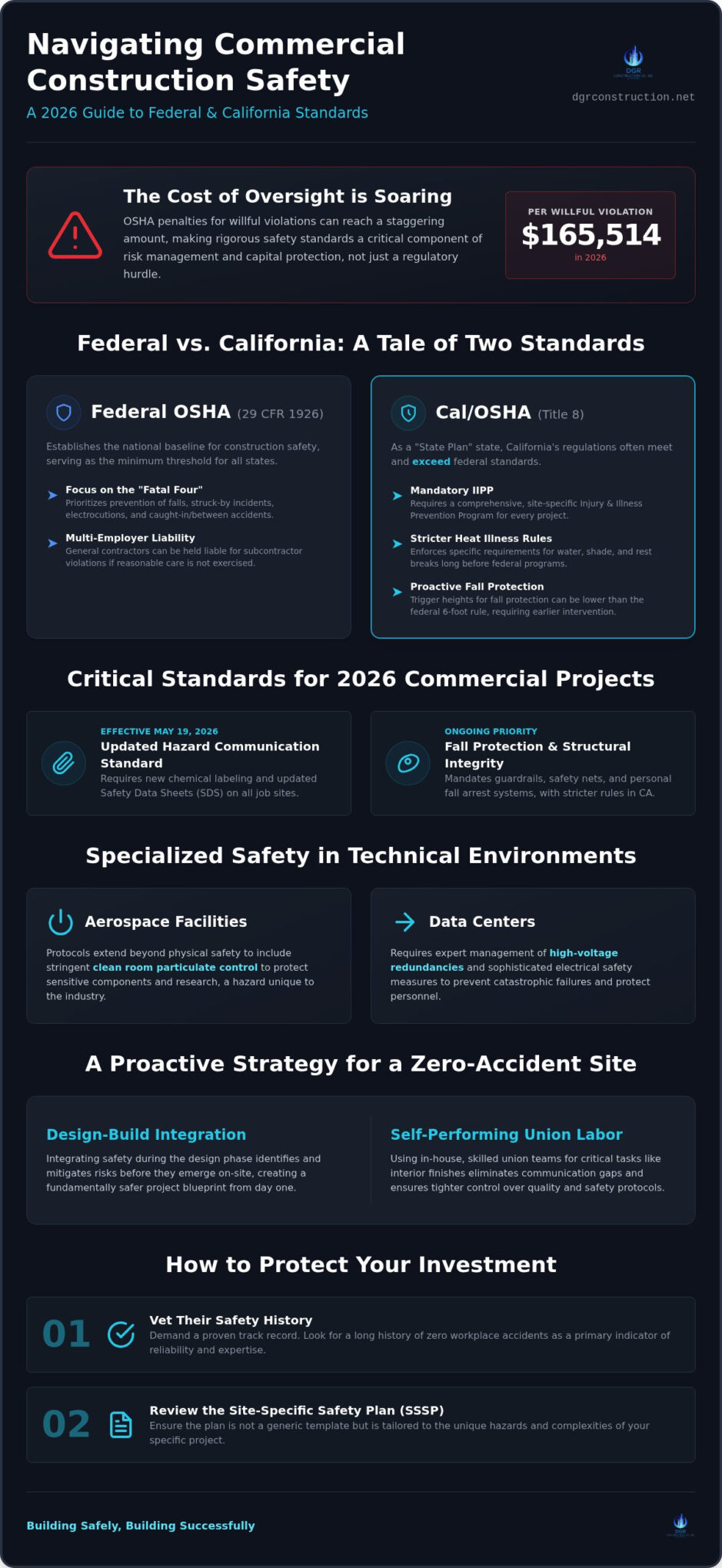
With OSHA penalties for willful violations reaching $165,514 per instance in 2026, a single oversight on a job site can compromise more than just your timeline. It can threaten your entire capital investment. For owners, maintaining rigorous commercial construction safety standards isn’t just a regulatory hurdle; it’s a fundamental component of risk management. You likely recognize that the intersection of federal OSHA mandates and California-specific Cal/OSHA requirements creates a complex environment where even minor errors lead to costly shutdowns.
We understand that the pressure to deliver high-stakes projects on time often feels at odds with the dense web of safety documentation and field enforcement. This guide provides the clarity you need to master both federal and California-specific regulations to protect your workforce and your capital. We’ll examine the May 2026 Hazard Communication updates, the latest heat illness prevention protocols, and the specialized safety strategies required for complex environments like aerospace and data center construction. By the end, you’ll have a clear path to achieving zero accidents and streamlined project delivery.
Key Takeaways
- Understand the hierarchy between federal OSHA and Cal/OSHA Title 8 to ensure your project meets all current commercial construction safety standards without conflict.
- Identify the May 2026 Hazard Communication updates and specific Fall Protection requirements that prevent costly project delays and legal liabilities.
- Learn specialized safety protocols for technical environments, such as clean room particulate control in aerospace and high-voltage management in data centers.
- Discover why integrating safety during the design-build phase and using self-performing union labor creates a more reliable, accident-free job site.
- Master the process of vetting a contractor’s safety history and reviewing a Site-Specific Safety Plan to protect your investment before construction begins.
The Framework of Commercial Construction Safety Standards
Adhering to rigorous commercial construction safety standards is more than a box-ticking exercise; it’s a strategic shield for your project’s bottom line. In 2026, the regulatory environment has become increasingly granular, particularly for developments in the Southern California market. While federal guidelines provide a foundation, the actual execution on a job site depends on a contractor’s ability to navigate the overlap between national mandates and state-specific requirements. A general construction contractor must treat these regulations as a minimum threshold rather than a final goal to ensure a project remains on schedule and within budget.
The backbone of any compliant California project is the Injury and Illness Prevention Program (IIPP). This isn’t a static document; it’s a living framework that must be tailored to the specific hazards of a site. For owners, the financial stakes of a weak IIPP are high. With OSHA penalties for willful violations now reaching $165,514 per instance, the cost of negligence far outweighs the investment in professional oversight. Beyond direct fines, safety violations often trigger stop-work orders that lead to cascading delays, impacting financing agreements and delivery dates.
Federal OSHA 29 CFR 1926: The National Baseline
Federal OSHA standards under 29 CFR 1926 establish the primary safety expectations for the construction industry nationwide. These standards focus heavily on the “Fatal Four” hazards: falls, struck-by incidents, electrocutions, and caught-in or between accidents. Federal inspectors particularly scrutinize multi-employer worksites. In these scenarios, an owner or general contractor can be held liable for the safety violations of a subcontractor if they failed to exercise reasonable care in overseeing the site. While federal rules are the starting point, California operates as a “State Plan” state, meaning it has its own agency that must meet or exceed these federal baselines.
Cal/OSHA: Why California Standards are Stricter
In California, compliance means following Cal/OSHA Title 8 regulations, which are frequently more demanding than federal rules. For example, while federal standards for heat illness prevention are still evolving through National Emphasis Programs, California has long enforced strict requirements for water, shade, and rest breaks. Fall protection trigger heights in California also differ from federal standards in specific scenarios, requiring more proactive engineering controls. In high-density areas like Los Angeles, local building codes add another layer of complexity, often requiring specialized safety planning for staging and debris management on tight urban footprints. Choosing a partner with a 25-year record of zero workplace accidents ensures these regional nuances are managed with the precision required for high-stakes commercial builds.
Critical Safety Standards for 2026 Commercial Projects
As of May 19, 2026, the updated Hazard Communication Standard is fully in effect, requiring new chemical labeling and Safety Data Sheets (SDS) across all job sites. This shift represents a broader trend in commercial construction safety standards toward technical precision and rigorous documentation. Owners must ensure their partners have updated their protocols to match these federal mandates. Neglecting these updates isn’t just a safety risk; it’s a financial liability, as OSHA penalties for serious violations remain at $16,550 per occurrence. Precision saves lives and protects capital.
Beyond chemical safety, the 2026 landscape demands a sophisticated approach to interior finish work. For projects involving medical offices or retail spaces, the installation of T-bar ceilings and drywall must be managed with meticulous care. Using in-house union teams allows for tighter control over these processes than relying on a revolving door of third-party subcontractors. When you partner with a contractor who self-performs this work, you eliminate the communication gaps that frequently lead to safety lapses. This integrated approach ensures that electrical safety, especially regarding high-voltage redundancies in data centers, is handled by professionals who understand the specific risks of the environment.
Fall Protection and Structural Integrity
While federal guidelines mandate fall protection at heights of 6 feet or more, California’s trigger heights often require earlier intervention depending on the specific task. Guardrails, safety nets, and personal fall arrest systems must be integrated into the workflow long before workers reach height. Every anchor point used in a fall arrest system must be rated for at least 5,000 pounds to ensure absolute structural reliability. For owners of multi-story industrial facilities, verifying these engineering controls is a critical step in project oversight.
Respiratory Protection and Air Quality
Dust control is a primary focus in 2026, especially during interior finish work and tenant improvements in occupied buildings. Silica dust from drywall and masonry requires sophisticated vacuum systems and ventilation to prevent site contamination and long-term health risks. In specialized environments like aerospace assembly, air quality standards are even higher. These projects often require clean room protocols and specialized PPE that goes far beyond the standard hard hat. Proper ventilation planning ensures that project delivery remains streamlined without safety-related shutdowns.
Specialized Safety in Aerospace and Data Center Construction
High-stakes sectors like aerospace and data centers require an operational discipline that standard job sites rarely encounter. In these specialized environments, commercial construction safety standards must evolve into a comprehensive risk mitigation strategy that protects both human life and sensitive technological assets. For an owner, failing to address these unique hazards doesn’t just lead to OSHA fines. It risks catastrophic damage to high-value equipment and mission-critical timelines. Success in these sectors depends on a contractor’s ability to integrate technical precision with a quiet, authoritative approach to safety management.
Aerospace Facility Safety: Technical Precision
Technical precision is the hallmark of aerospace facility construction California. One of the most critical safety protocols involves Foreign Object Debris (FOD) prevention. While standard sites focus on general housekeeping, aerospace safety requires a zero-tolerance approach to loose materials that could migrate into sensitive assembly areas. Additionally, the use of overhead cranes and derricks for moving large structural components necessitates rigorous inspection schedules and specialized rigger certifications. Fire protection also takes on a specialized role; the materials used in aerospace manufacturing often require unique suppression systems that differ from standard commercial sprinklers. Acoustic safety and sound attenuation must also be integrated into the build phase to protect workers from high-decibel testing environments.
Data Center Safety: Power and Infrastructure
Data center construction presents a different set of high-consequence risks, primarily centered on massive power redundancies and cooling infrastructure. Arc flash protection is a non-negotiable safety standard in these facilities. Technicians must follow strict electrical grounding protocols and wear specialized PPE when working near energized equipment. The installation of high-density cooling systems also introduces risks related to pressurized lines and hazardous refrigerants, requiring a hands-on approach to pressure testing and leak detection.
Managing these complex installations requires a workforce that is both technically skilled and safety-conscious. This is where the advantage of in-house union labor becomes apparent. For example, installing T-bar ceilings and raised flooring in a data center requires ergonomic precision to prevent repetitive strain injuries among technicians. By using signatory union teams, owners ensure that every worker has undergone standardized, rigorous safety training. This level of oversight ensures that the security and safety requirements of sensitive or government-contracted sites are maintained with absolute integrity from start to finish.
The Safety Advantage of Design-Build and Union Labor
While many owners focus on site inspections, the structural framework of a project’s delivery model dictates its safety trajectory. Achieving elite commercial construction safety standards requires more than reactive policing; it demands a delivery system where safety is engineered into the project from day one. The design-build model provides this foundation by unifying the architectural and construction phases under a single point of accountability. By leveraging the planning and design expertise of firms like Kluger Architects, owners can ensure that safety considerations for specialized educational or religious facilities aren’t an afterthought, but a core component of the project’s DNA.
At DGR Construction Co., this commitment to safety is validated by a 25-year milestone of zero workplace accidents. This record isn’t a matter of chance. It’s the direct result of a “Self-Perform” methodology where in-house union teams execute critical trades. By maintaining direct control over our workforce, we eliminate the volatility and communication gaps that often occur when juggling multiple tiers of third-party subcontractors. When the same entity designing the space is also responsible for the union craftsmen installing the drywall and T-bar systems, the risk of safety-related shutdowns is virtually eliminated.
Single-Source Accountability
Single-source accountability removes the common “safety vs. budget” conflict by aligning the designer’s vision with the builder’s operational safety protocols. We utilize digital management tools like Procore to provide real-time safety monitoring and documentation. This transparency allows for immediate correction of potential hazards before they escalate into violations. Because the design-build model streamlines communication, site-specific safety plans are more accurate and easier for the field teams to execute. This methodical approach transforms a complex high-stakes project into a manageable and controlled environment for the owner.
Union Craftsmanship and Safety Culture
The correlation between union training and a lower Experience Modifier Rate (EMR) is a well-documented industry fact. As a signatory to the Carpenters Union, DGR Construction Co. employs craftsmen who have undergone thousands of hours of standardized, rigorous safety and trade training. This professional literacy is especially vital when navigating the technical complexities of commercial general contractors who manage specialized sectors like aerospace or medical facilities.
Our in-house union drywall and T-bar teams operate with a shared safety culture that third-party subs simply cannot replicate. This internal alignment ensures that every worker on-site is empowered to stop work if they identify a risk, a trait that is essential for maintaining our zero-accident record. If you are ready to secure your project with a partner who prioritizes precision and reliability, contact our team today to discuss your upcoming build.
Implementing a Safety-First Strategy for Your Project
The final phase of protecting your investment involves a transition from regulatory understanding to active oversight. While the technical aspects of commercial construction safety standards are managed by your builder, the owner’s role in vetting and ongoing monitoring is the ultimate safeguard against liability. A project’s success is often determined before the first shovel hits the dirt, starting with the selection of a partner who views safety as a non-negotiable operational standard rather than a compliance burden.
Effective oversight requires a structured approach to communication. This includes reviewing daily safety reports and attending weekly “look-ahead” meetings where potential hazards are identified before they impact the schedule. Transparency isn’t just about identifying risks; it’s about documenting the resolution of those risks. This methodical approach ensures that even the most complex builds, such as aerospace or medical facilities, proceed with the precision and stability you expect.
Safety Prequalification for Contractors
Vetting a general contractor orange county requires a deep dive into historical performance metrics. You should demand more than just a list of completed projects. Request the firm’s Experience Modifier Rate (EMR); a rate below 1.0 indicates a safety record that’s better than the industry average. Additionally, review the contractor’s OSHA 300 logs from the past three years to identify any patterns of recurring incidents. In an industry where the fatal work injury rate reached 9.2 deaths per 100,000 workers in 2024, a record of zero workplace accidents over 25 years is a powerful indicator of a mature safety culture. Verify that the firm holds a Class A license and maintains strong union affiliations, as these credentials signal a commitment to the highest tiers of craftsmanship and training. For a broader understanding of how general contracting has evolved to address California’s 2026 regulatory and economic landscape, reviewing a comprehensive project guide can help you ask the right questions during the prequalification process.
Ongoing Oversight and Communication
Once construction begins, the Site-Specific Safety Plan (SSSP) becomes your primary tool for accountability. This document must outline the exact protocols for the unique hazards of your site, from high-voltage electrical work to clean room particulate control. We utilize advanced project management software to provide owners with real-time transparency into these safety logs. This digital trail ensures that every inspection, meeting minute, and safety audit is recorded and accessible. The process concludes with a final clean and a post-construction safety audit to ensure the facility is ready for occupancy without lingering hazards. To secure this level of precision for your project, partner with the safety experts at DGR Construction Co. for your next build.
Secure Your Investment with Proactive Safety Oversight
Protecting a capital investment in 2026 requires moving beyond basic compliance toward a culture of operational precision. As we have examined, the integration of the design-build model and the use of signatory union labor creates a stable environment for technical projects across Los Angeles and Orange County. By mastering the current landscape of commercial construction safety standards, owners can effectively mitigate the risks of legal liability and project delays while ensuring the seamless delivery of high-stakes facilities.
DGR Construction Co. provides this level of oversight through more than 25 years of experience and a distinguished milestone of zero workplace accidents. As a Certified Minority Contractor with an A+ BBB rating, our firm focuses on removing the stress of navigating complex regulatory landscapes. We invite you to Contact DGR Construction Co. for a Safety-First Project Consultation to discuss your specific build requirements. Partnering with an authoritative expert ensures that your project remains a managed, controlled, and ultimately successful endeavor.
Frequently Asked Questions
What are the most common OSHA violations in commercial construction?
Fall protection remains the most frequent violation cited by inspectors on job sites. The “Fatal Four” hazards, including falls, struck-by incidents, electrocutions, and caught-in or between accidents, account for nearly 60 percent of construction fatalities. Proactive enforcement of commercial construction safety standards helps mitigate these risks by ensuring that guardrails and personal fall arrest systems are correctly installed before work begins at height.
How does Cal/OSHA differ from federal OSHA standards?
California operates under Cal/OSHA, which enforces regulations that often exceed federal baselines. While federal OSHA provides the national foundation, Cal/OSHA Title 8 includes stricter mandates for heat illness prevention and lower trigger heights for fall protection in specific trade scenarios. This local oversight requires a contractor who understands the nuances of Southern California building codes and regional high-hazard industry requirements.
What is an IIPP and why is it mandatory in California?
The Injury and Illness Prevention Program (IIPP) is a mandatory, written safety framework required for all California employers. Under Title 8 Section 3203, this program must outline specific procedures for identifying job site hazards and training employees to mitigate those risks. It serves as the primary document inspectors review to determine if a firm maintains a proactive safety culture rather than a reactive one.
Does the design-build model improve construction site safety?
The design-build model significantly improves safety by unifying the architectural and construction phases under one point of accountability. This integration allows safety experts to identify potential hazards during the design phase, such as safe roof access or electrical grounding requirements, before field work starts. It removes the traditional conflict between budget and safety by making risk management a core component of the project’s initial engineering.
How can a project owner verify a contractor’s safety record?
Owners should verify a contractor’s Experience Modifier Rate (EMR) and review their OSHA 300 logs for the past three years. An EMR below 1.0 indicates a safety record superior to the industry average. Additionally, you should confirm the firm’s Class A licensing and look for milestones such as a 25-year record of zero workplace accidents, which demonstrates a long-term commitment to operational excellence.
What safety standards apply specifically to aerospace facility construction?
Aerospace facilities require specialized protocols like Foreign Object Debris (FOD) prevention and particulate control for clean room environments. These sites also demand unique fire suppression systems and acoustic attenuation to protect workers from high-decibel testing. Managing these commercial construction safety standards requires a high degree of technical precision and experience in sensitive, high-stakes environments where equipment value is exceptionally high.
Why is union labor considered safer for large-scale commercial projects?
Union labor is considered safer due to the standardized, rigorous trade training programs craftsmen must complete. As a signatory to the Carpenters Union, workers possess a high level of professional literacy regarding safety protocols and field enforcement. This collective expertise ensures that every individual on the job site is empowered to identify risks and stop work if conditions become hazardous.
What are the penalties for commercial construction safety violations in 2026?
In 2026, the maximum penalty for serious or other-than-serious violations is $16,550 per instance. Willful or repeated violations carry a significantly higher maximum fine of $165,514. If a firm fails to abate a cited hazard, they face additional penalties of $16,550 per day beyond the abatement date. These financial risks underscore the necessity of maintaining full regulatory compliance from the start of every project. Owners navigating the Los Angeles market can benefit from understanding how commercial construction management Los Angeles projects require a unified approach to both regulatory compliance and cost control in 2026’s challenging environment.


Pingback: Commercial Construction Management in Los Angeles: The 2026 Owner’s Guide