
A general contractor’s bankruptcy doesn’t automatically make a property owner responsible for the contractor’s debts. But unpaid subcontractors may have lien rights against the project property under state law, even if the owner has paid the contractor. If you’re asking what happens if my general contractor goes bankrupt mid-project, the key distinction is between personal liability and the risk of a claim against the property.
It’s understandable to worry about facing a second payment demand for the same work. Whether an owner may owe subcontractors directly depends on the project contracts, payment history, bond coverage, and the law where the property is located.
This article explains how bankruptcy affects unpaid subcontractors, when lien rights and notices matter, and what owners can do promptly to protect project records and assess the remaining work. It also explains why taking over contracts or redirecting project assets without court approval can create additional risk.
Key Takeaways
- A signed lien waiver’s effect can depend on whether it is conditional and whether the referenced payment was actually received.
- Bankruptcy may leave a construction contract subject to assumption or rejection, which affects whether work continues and how unpaid amounts are treated.
- An owner is not automatically responsible for the general contractor’s debts, but subcontractor lien rights may put the project property at risk.
- Bankruptcy protections can limit actions against the contractor and project assets, so avoid unilateral steps such as taking over contracts or redirecting materials.
- Organized payment records, contract documents, and a clear list of unpaid parties can help owners and subcontractors assess their next steps.
Does a signed lien waiver affect a subcontractor’s rights in a GC bankruptcy?
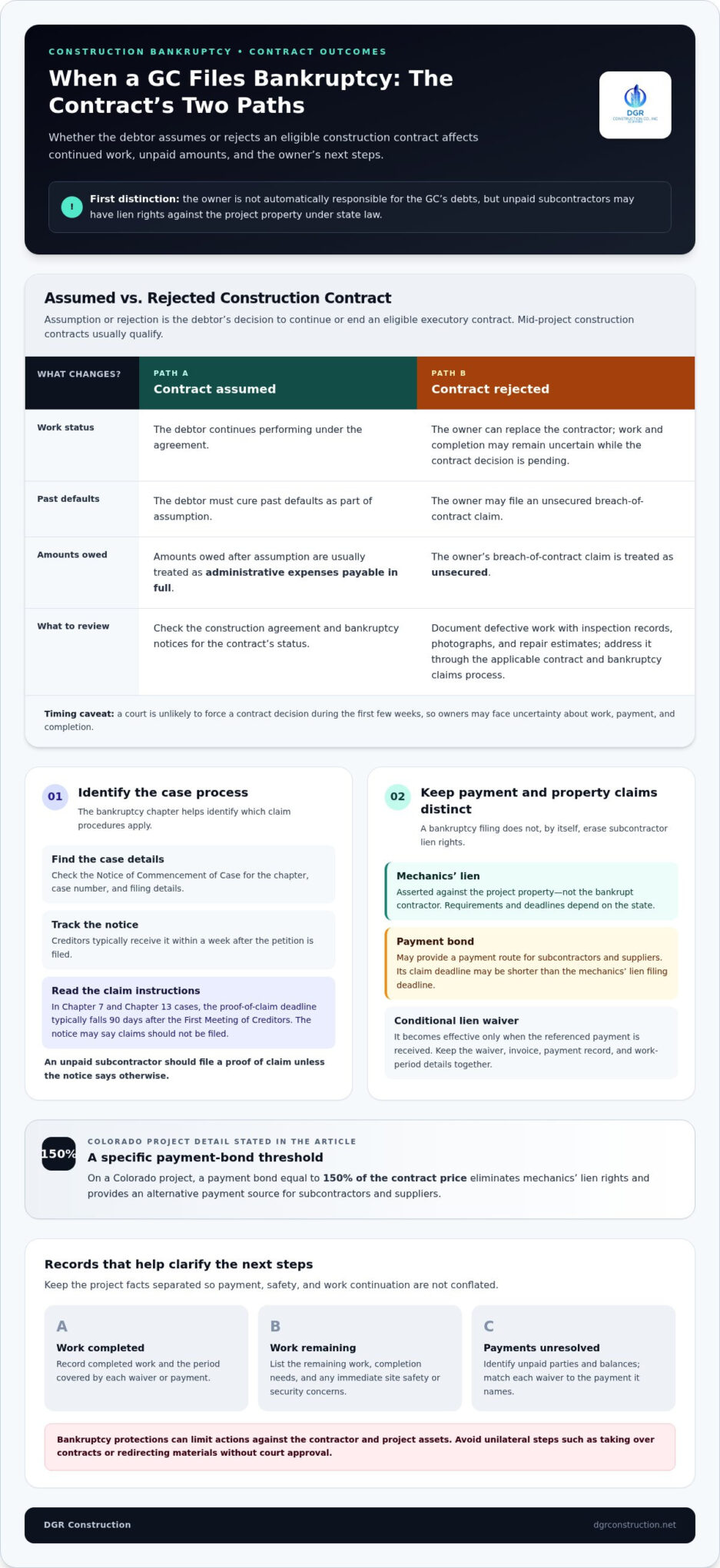
A signed lien waiver can affect a subcontractor’s claim, but its wording and payment conditions matter. A conditional waiver becomes effective only when the referenced payment is received. For example, if a subcontractor signs a waiver for a progress payment that never clears, the waiver does not take effect. A conditional progress waiver acknowledging payment for a particular period can also conflict with a later lien claim for that same period. Keep the waiver, invoice, payment record, and work-period details together.
A general contractor’s bankruptcy does not, by itself, erase subcontractor lien rights. A mechanics’ lien is asserted against the project property, not the bankrupt contractor. Lien requirements and deadlines, however, depend on the state where the project is located. Payment bond claim deadlines may be shorter than mechanics’ lien filing deadlines, so subcontractors should promptly identify the project type and applicable bond documents. Public projects may have payment-bond requirements, depending on the applicable rules. The bond is a surety instrument that guarantees payment to subcontractors and suppliers if the general contractor fails to pay.
Bond coverage changes the payment route, not the need for documentation. A subcontractor on a bonded project may submit a claim to the surety, with invoices, approved changes, and proof of delivered work. Owners with a performance bond may also make a claim against that bond to help secure project completion. Keep the surety informed about site conditions and unpaid claims, and track whether it is addressing them. On a Colorado project, a payment bond equal to 150% of the contract price eliminates mechanics’ lien rights and provides an alternative payment source for subcontractors and suppliers.
Payment disruptions can quickly affect the job site. A supplier may pause deliveries, or a trade contractor may question whether to continue while invoices remain unpaid. Owners should identify unpaid parties, the balance needed to finish, and immediate safety or security concerns. Secure stored materials and document site conditions before work changes. If the project is close to completion, an agreement with the insolvent contractor to finish may be the quickest, most valuable way to conclude it. That decision still requires careful review of outstanding payment obligations and job-site risks.
Where work must continue, joint checks from the owner may help direct payment to both a subcontractor and the general contractor. This arrangement requires coordination and clear records, including the invoice and work period each check covers. A surety may take over the owner’s financial duties and continue construction at a slower pace. Keep written updates on claims, payments, site access, and completion milestones. Don’t treat a waiver as proof that every invoice has been paid; match each release to the payment it identifies.
Separate three issues in the project record: what work is complete, what remains, and which payments are unresolved. For example, a progress waiver may cover framing through a stated period, while later electrical work remains unpaid and unaddressed. A payment bond claim may provide a subcontractor with a payment route, while a performance bond may support the owner’s response to incomplete work. Keeping these records distinct helps the owner, subcontractors, and surety address payment, safety, and work continuation without conflating separate claims.
What happens to unpaid subcontractors when a GC goes bankrupt?
The bankruptcy filing affects how unpaid invoices, ongoing work, and contract claims are handled. To identify the applicable process, first determine the case chapter and whether the construction contract is assumed or rejected.
Assuming or Rejecting Construction Contracts
Assumption or rejection is the bankruptcy debtor’s decision to continue or end an eligible executory contract, and it determines whether performance continues under that agreement. Mid-project construction contracts usually qualify. If the debtor assumes the contract, it must cure past defaults and continue performing. Amounts owed after assumption are usually treated as administrative expenses payable in full.
If the debtor rejects the contract, the owner can replace the contractor and file an unsecured breach-of-contract claim. A court is unlikely to force a decision during the first few weeks, so owners may face uncertainty about work, payment, and completion. Review the construction agreement and bankruptcy notices to determine the contract’s status. Document claims for defective work with inspection records, photographs, and repair estimates, then address them through the applicable contract and bankruptcy claims process.
Identifying the Bankruptcy Chapter
The bankruptcy chapter is the case type identified in the filed notice and court records. It helps owners and subcontractors understand which claim procedures apply. Check the Notice of Commencement of Case for the chapter, case number, and filing details. Creditors typically receive this notice within a week after the petition is filed.
In Chapter 7 and Chapter 13 cases, the proof-of-claim deadline typically falls 90 days after the First Meeting of Creditors. Read the notice carefully, since it may state that claims should not be filed. An unpaid subcontractor should file a proof of claim unless the notice says otherwise. Keep the notice with invoices, contract documents, and payment records so each claim can be matched to the correct case.
An owner’s own bankruptcy affects an active project differently. The project will likely stop, the property and assets become part of the bankruptcy estate, and construction funding stops. Contractors seeking to pursue or perfect a mechanics’ lien may petition the bankruptcy court for permission. The distinction matters: a contractor’s bankruptcy is not the same as an owner’s filing. The affected estate determines who controls project property and funds.
For Colorado projects, construction trust fund rules may be relevant when assessing project payments and claims. Preserve payment records showing amounts received, invoices paid, and balances outstanding. These records help clarify which claims concern unpaid contract work and which may involve construction trust funds. The statute’s citation alone does not resolve a particular claim; the project’s transactions and bankruptcy status remain central to how parties pursue it.
As the project team assesses a restart, organize the contract status, open claims, defect records, and remaining scope in one file. For commercial work requiring a coordinated construction plan, commercial construction planning can be a useful next consideration alongside the bankruptcy case review.
Can a property owner be liable for the GC’s unpaid subcontractors?
A general contractor’s bankruptcy doesn’t automatically make the property owner responsible for the contractor’s unpaid debts. However, an unpaid subcontractor may have lien rights against the project property, depending on state law. This creates a practical risk: an owner who paid the general contractor could still face a lien claim for the same work. Distinguish personal payment liability from a claim against the property when assessing exposure.
The question “what happens if my general contractor goes bankrupt mid-project” often turns on the difference between the GC’s debts and claims tied to the property. When a GC files for bankruptcy, the automatic stay under 11 U.S.C. § 362 immediately stops collection actions, lawsuits, and enforcement proceedings against that contractor. The stay protects the contractor and bankruptcy estate, but doesn’t erase every project claim or automatically stop construction. Unpaid trades may pause work while invoices remain unresolved.
The stay also restricts what an owner can do with project contracts and assets. An owner cannot unilaterally take over subcontractor contracts or redirect materials if the stay prohibits the action. For example, moving materials from the site or arranging direct performance could affect property treated as part of the bankruptcy estate. Review the contract documents and obtain bankruptcy court approval before exercising step-in or assumption rights. This distinguishes site protection from control over estate assets.
A mechanics’ lien recorded before the general contractor’s bankruptcy generally survives the automatic stay and remains attached to the project property. After the stay takes effect, a claimant may need court relief before filing or enforcing a lien. State lien law may allow a later recording to relate back to work performed before bankruptcy, while a foreclosure lawsuit remains subject to the stay. For an owner asking what happens if my general contractor goes bankrupt mid-project, lien deadlines remain a separate concern. Identify the project state, notices, and filing dates rather than assuming bankruptcy pauses them.
If a subcontractor claims payment for completed electrical work, preserve the invoice, proof of payment to the general contractor, contract records, and any lien notice. These documents help clarify whether the owner faces a direct claim, a property lien, or both. The automatic stay protects project assets from being taken by unpaid contractors, subcontractors, or suppliers, but it doesn’t resolve each claimant’s state-law rights. Track every deadline and avoid transferring materials or changing contract control without court authority.
Documentation and immediate steps for subcontractors and suppliers
After a general contractor files for bankruptcy, subcontractors, suppliers, and owners need a clear record of work, payments, and open commitments. Organize documents before discussing new work or payment arrangements.
Gathering Project Documentation
Project documentation is the dated record of labor, materials, invoices, changes, and payments. It helps distinguish completed work from unpaid or disputed work. Assemble the subcontract, purchase orders, invoices, delivery tickets, approved change orders, payment applications, and correspondence. For example, match each delivery ticket to the supplier invoice and project location. Keep a separate ledger of amounts billed, received, and outstanding, and preserve copies of notices already sent.
Establishing Direct Subcontractor Relationships
A direct relationship can let an owner coordinate with key trades if the existing contract documents provide step-in rights. Those rights may appear in a collateral warranty or third-party rights, depending on the contract wording. Identify critical subcontractors, their remaining scope, and any work they say is unpaid. Before directing a trade to continue, review who can authorize the work and how new payment obligations will be documented. A lender or surety may also need project updates.
Mechanics’ Liens and Owner Exposure
A mechanics’ lien is a claim against project property for unpaid construction labor, materials, or services. Subcontractors and suppliers may have direct lien rights even when the owner paid the general contractor, depending on state law. This creates potential double-payment exposure for the same work. Record each claimant’s name, work dates, invoice balance, and notices received. Compare those claims with payment records to identify amounts already paid by the owner and amounts still disputed.
Deadlines require attention. A subcontractor’s lien filing deadline continues to run during the general contractor’s bankruptcy, and timing depends on the project state and work performed. Construction contractors facing nonpayment are advised to send a preliminary notice, then file a mechanics’ lien if payment remains outstanding. Keep proof of delivery and copies of every notice. Suppliers should also document delivery dates, materials supplied, and unpaid invoices rather than relying only on the general contractor’s account statement.
Don’t treat a proposed contract transfer as permission to proceed. An owner should seek court approval before enforcing contractual step-in or assumption rights. Project completion and replacement agreements require bankruptcy court approval. A subcontractor or supplier generally cannot sue the bankrupt general contractor or enforce its contract while the automatic stay applies, without court approval. Record the proposed work, parties, scope, and payment terms before seeking approval. Avoid informal directions that leave responsibility unclear.
For a bonded project, subcontractors and suppliers should contact the surety with a written claim showing payments, unpaid invoices, and the balance to finish. On a private, unbonded project, send the same itemized claim to the owner. Include change orders awaiting approval, delivery records, and work remaining. These records give the owner, lender, and surety a consistent account of project obligations and help prevent missed claims or duplicate payment demands.
What should a homeowner do immediately if their general contractor goes bankrupt mid-project
Use the first 72 hours to establish the site’s condition, open claims, and immediate risks. Make a dated list of every subcontractor and supplier who worked at the property, what work they completed, and whether invoices remain unpaid. This gives you a working record before project details become harder to reconstruct.
Start with a site review. Photograph completed work, unfinished areas, delivered materials, and any visible damage. Note access points, exposed utilities, incomplete weather protection, and safety concerns. Secure the property and materials, and record who holds keys or access codes. If a condition creates an immediate hazard, keep people away from that area and document the steps taken.
Next, gather the signed contract, payment records, change orders, inspection documents, permits, plans, warranties, and communications with the general contractor. Compare amounts paid with the work completed and the remaining scope. For example, match a payment application to the inspection record and subcontractor invoices for that period. Keep copies of texts and emails mentioning delayed payments, unfinished work, or promised delivery dates.
Identify the bankruptcy case and any surety or insolvency practitioner involved. Send a written request to the insolvency practitioner asking whether the general contractor can still complete the work. If a performance or payment bond exists, contact the bonding company and keep a written record of claim updates. Ask who is handling site access, outstanding invoices, and project materials. Don’t redirect materials or take over subcontractor contracts without court approval.
Before hiring replacement trades, review the contract documents and bankruptcy status. A termination clause triggered only by the contractor’s bankruptcy is generally unenforceable, subject to narrow exceptions. The automatic stay may also restrict actions against the bankrupt contractor. Determine whether the court has lifted the stay or approved a project-completion arrangement before changing contractual control. Clearly record the remaining work and proposed transition.
Build a claims register with each subcontractor’s name, scope, invoice balance, notices, and last work date. Add supplier deliveries, unresolved change orders, and payments already made to the general contractor. This helps distinguish a disputed invoice from incomplete work. Keep the register current as new claims arrive, and preserve the original documents with each entry.
Project owners managing an interrupted commercial build can review commercial construction support as they assess the remaining scope and restart requirements.
DGR Construction: Aerospace Construction
DGR Construction Co. can help owners plan the next phase of a commercial project once contract rights, site conditions, and outstanding claims are organized. Its Aerospace Construction work serves owners developing or completing aerospace facilities, while Data Center Construction, Industrial Construction, and Tenant Improvement support other commercial project needs.
For a project transitioning after a general contractor’s bankruptcy, a coordinated design-build approach can bring architectural design, engineering, and on-site construction into one plan. Clear scope definition and alignment among the owner, architects, and engineers help establish a structured path forward. DGR Construction Co. serves projects throughout Los Angeles and Orange County.
To discuss a commercial construction project, contact DGR Construction Co..
Plan the Project’s Next Phase With Confidence
Once the bankruptcy process and project authority are clear, the next decision is how to move work forward without losing sight of scope, safety, or coordination. Understanding what happens if your general contractor goes bankrupt mid-project can help you make that transition with a clearer view of the risks and decisions ahead. Ground the next phase in documented project needs and clear responsibility.
DGR Construction supports commercial projects through Aerospace Construction, Data Center Construction, and Industrial Construction. If your project involves one of these needs, contact DGR to discuss how construction planning can support the work ahead.
Contact DGR Construction to discuss your commercial project and its next phase. With a clear plan and the right project information in hand, you can approach the next steps with greater direction.
Frequently Asked Questions
What Happens When My Builder Files for Bankruptcy?
The filing starts a court-supervised process that can affect contract decisions, collection activity, and payments. The automatic stay generally stops collection actions against the builder, while the bankruptcy case sets out how creditors may submit claims. Check the case notice for the chapter, case number, and any instructions for filing a proof of claim. Keep the notice with your contract and payment records so you can track the case requirements.
What If My Builder Goes Out of Business Without Filing Bankruptcy?
If a builder closes without filing for bankruptcy, there is no bankruptcy case or automatic stay triggered by a petition. That doesn’t automatically settle the contract or payment dispute. Review the agreement for notice, default, and termination provisions, then document unfinished work, payments, and communications. State lien rules and available bond documents may still affect claims. For example, record a supplier’s unpaid delivery invoice separately from the builder’s remaining work.
What Can the Employer Do to Protect Themselves Against the Threat of Contractor Insolvency?
Owners can reduce exposure by reviewing a contractor’s trading and project history, financial position, and payment practices before awarding a contract. During the project, requests for large advance payments or subcontractor complaints about nonpayment can signal liquidity pressure. Keep project records current, and have security documents signed early. An escrow account or dedicated project bank account can ring-fence funds; a performance bond may be preferable to a parent guarantee if the parent faces similar financial strain.
What Happens When Your Contractor Becomes Insolvent Mid-Project?
Insolvency can disrupt work, payments to trades, and the completion plan, but the next steps depend on the contract and any bond arrangements. Identify the insolvency practitioner and ask whether the contractor can still finish. Assess remaining work, site safety, security, and unpaid debts as separate priorities. For example, a project nearing completion may be better served by an orderly completion arrangement than an immediate transition, subject to contract and court requirements.
What Is a Payment Bond and How Does It Help in a GC Bankruptcy?
A payment bond is a surety instrument that provides a claim route for subcontractors and suppliers when a general contractor fails to pay. On a bonded project, a claimant can submit a written claim with invoices, payment history, and work or delivery records. Bond claim deadlines may be shorter than mechanics’ lien deadlines, so identify the bond terms promptly. A performance bond is different: it may help an owner address project completion.
What Happens to a Construction Project When the General Contractor Files for Bankruptcy?
Work may be interrupted while the bankruptcy process determines whether the contractor will continue or reject its construction contract. If the contract is assumed, the debtor must cure past defaults and continue performing. If rejected, the owner may replace the debtor and file an unsecured breach-of-contract claim. Meanwhile, document site access, safety concerns, stored materials, and remaining scope so the project’s condition is clear during transition planning.
Can I Terminate a Construction Contract After My General Contractor Files for Bankruptcy?
Usually, an owner cannot terminate solely because the contractor filed for bankruptcy. A contract clause allowing termination or stopped performance for that reason is generally unenforceable, subject to narrow exceptions. The automatic stay can also restrict actions involving the bankrupt contractor, so an owner may need the bankruptcy court to lift it before terminating. Review the agreement’s other default provisions separately, and don’t take over subcontractor contracts without court approval.
How Do I Protect Deposits and Recover Money Paid to a Bankrupt Contractor?
Start by tracing each deposit through the contract, payment confirmations, invoices, and project account records. An escrow or dedicated project bank account can help separate project payment funds from other business funds. Unpaid amounts owed before bankruptcy generally become pre-petition claims against the estate, paid from available assets after secured creditors. File a proof of claim when required, follow the case notice, and distinguish unearned deposits from payments tied to completed work.