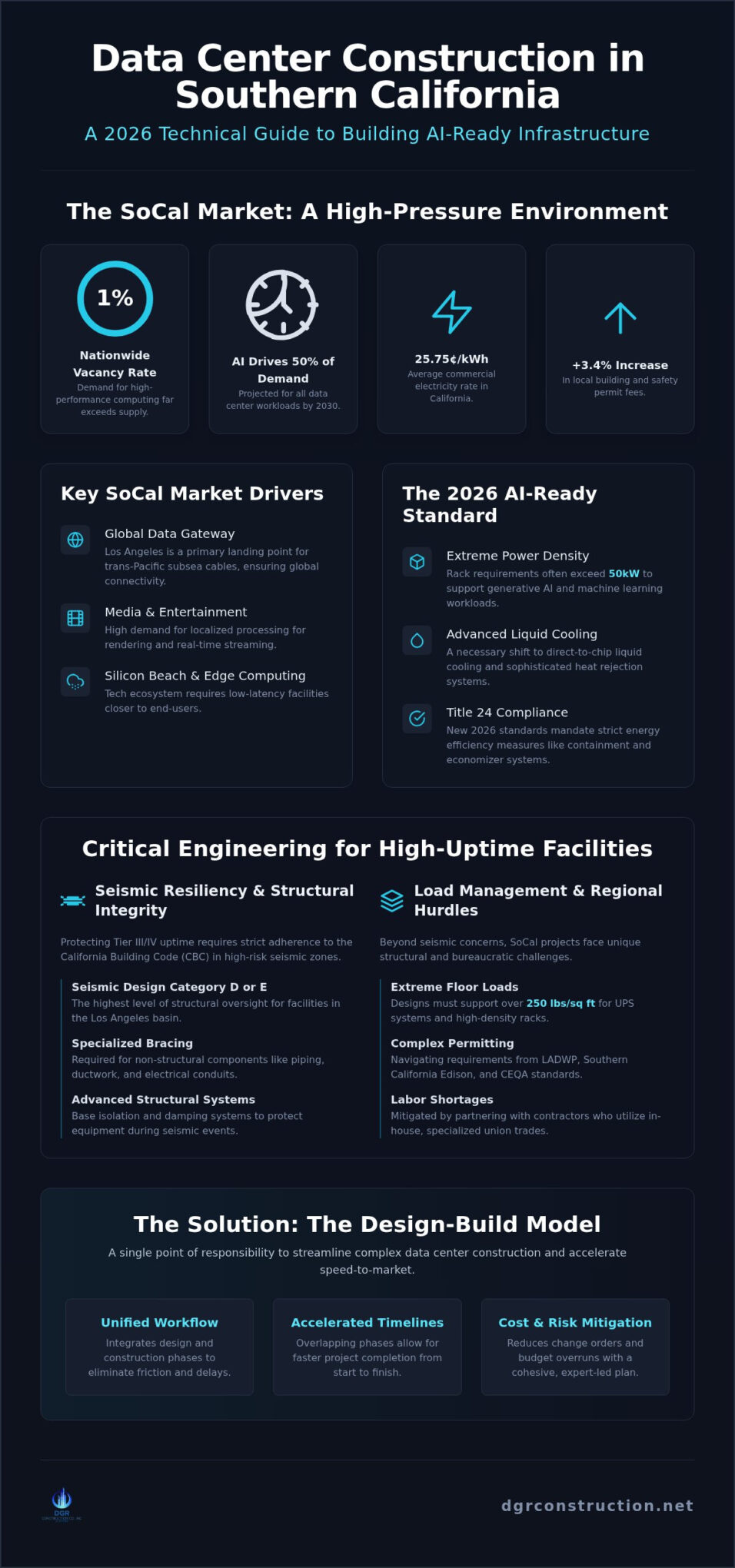
With a nationwide data center vacancy rate of just 1 percent and AI workloads expected to drive half of all demand by 2030, the race for digital infrastructure in Los Angeles and Orange County has reached a critical point. You’re likely feeling the pressure of a market where commercial electricity rates have climbed to 25.75¢/kWh and power availability is at a premium. Successfully executing data center construction southern california requires more than just a plot of land; it demands a partner who understands the friction between rapid growth and stringent regulatory hurdles.
This 2026 guide provides the technical insights necessary to manage these complexities, from the latest Title 24 energy efficiency mandates to the 3.4 percent increase in local building and safety fees. We’ll explore how specialized seismic engineering and in-house trade management can protect your investment while shortening delivery timelines. By the end of this article, you’ll have a clear strategy for building resilient, AI-ready facilities that thrive within California’s unique environmental and economic constraints.
Key Takeaways
- Understand how the surge in AI and edge computing is reshaping the Los Angeles and Orange County digital infrastructure landscape.
- Identify the critical seismic engineering and liquid cooling requirements necessary to maintain Tier III and IV uptime in high-risk zones.
- Learn why the design-build model serves as a single point of responsibility to streamline data center construction southern california and accelerate speed-to-market.
- Navigate the specific permitting hurdles and utility coordination processes required by LADWP, Southern California Edison, and current CEQA standards.
- Discover the operational advantages of partnering with a local Class A contractor who utilizes in-house union trades to mitigate regional labor shortages.
The Southern California Data Center Landscape in 2026
The digital infrastructure market in Los Angeles and Orange County has reached a critical juncture where the demand for high-performance computing far exceeds current supply. Despite average commercial electricity rates in California climbing to 25.75¢/kWh, the region remains a Tier 1 priority for global enterprises. This resilience is fueled by the Southland’s massive consumer base and the logistical necessity of low-latency connectivity. Modern data center construction southern california is no longer focused on simple colocation; it has pivoted toward specialized, high-density environments designed to support generative AI and large-scale machine learning. With a nationwide data center vacancy rate of just 1 percent, developers are aggressively seeking ways to bring new capacity online in an environment where land and power are increasingly scarce.
Market Drivers in Los Angeles and Orange County
The geographic position of Los Angeles as a primary landing point for trans-Pacific subsea cables ensures its continued dominance as a global data gateway. Locally, the demand is amplified by the entertainment and media sectors, which require localized processing for high-fidelity rendering and real-time streaming. The Silicon Beach tech ecosystem further drives the need for edge computing facilities that sit closer to end-users. Because greenfield opportunities are limited in urban centers, the 2026 market is characterized by the strategic conversion of industrial warehouses. These retrofits require a sophisticated understanding of existing load-bearing capacities and utility constraints to transform legacy structures into high-performance digital hubs.
Defining the 2026 Data Center Standard
An “AI-ready” facility in today’s market is defined by its ability to support extreme power densities, with rack requirements often exceeding 50kW in metropolitan cores. This shift necessitates a move toward direct-to-chip liquid cooling and advanced heat rejection systems. Understanding data center fundamentals regarding energy efficiency is vital, especially as the 2025 Building Energy Efficiency Standards (Title 24, Part 6) became effective on January 1, 2026. These regulations mandate specific containment strategies and economizer systems that significantly impact mechanical design. Navigating these requirements during data center construction southern california demands a builder who can balance technical performance with regulatory compliance. DGR Construction Co. provides this level of methodical oversight, ensuring that every facility is engineered to meet both current operational demands and future scalability needs.
Critical Technical Requirements for SoCal Data Facilities
Developing high-uptime environments in the Southland requires a precise engineering approach that accounts for the region’s unique geographical and regulatory constraints. Unlike standard commercial builds, data center construction southern california must prioritize structural integrity to support the extreme weight of modern hardware. This involves managing floor loads that frequently exceed 250 pounds per square foot to accommodate heavy uninterruptible power supply (UPS) systems and high-density server racks, often requiring the specialized concrete expertise of Born Integrated Construction for reinforced slab work. Every technical decision impacts the facility’s ability to maintain a 99.999 percent uptime rating during environmental or grid-related stress.
Seismic Resiliency and Structural Bracing
Protecting Tier III and IV uptime in a high-risk zone starts with strict adherence to the California Building Code (CBC). For facilities in Los Angeles and Orange County, non-structural components like piping, ductwork, and electrical conduits require specialized bracing to prevent failure during a seismic event. Implementing base isolation systems or advanced structural damping allows the building to move independently of the ground, significantly reducing the risk of internal equipment damage. In the Los Angeles basin, facilities typically fall into Seismic Design Category D or E, which dictates the highest level of structural oversight and specialized anchoring for critical infrastructure components.
Ceiling systems also demand attention to prevent collapse over sensitive hardware. Utilizing specialized T-bar bracing and in-house union teams for installation ensures that the suspension systems supporting critical cabling and lighting remain intact. DGR Construction Co. leverages its 25 years of local experience to manage these technical installations, ensuring that every seismic brace meets or exceeds municipal safety standards without compromising the project timeline.
Thermal Management and Power Density
As rack densities increase, the mechanical infrastructure must evolve beyond traditional air-cooled systems. Modern data center construction southern california now integrates direct-to-chip or immersion cooling infrastructure to manage the intense heat generated by high-performance processing units. These liquid-based systems require complex plumbing and leak detection protocols that must be integrated early in the design-build phase. It’s a shift that requires a contractor capable of managing both heavy industrial systems and delicate technical cooling loops. Our comprehensive data center cooling solutions for high-density AI environments outline the specific structural and mechanical requirements that must be addressed when transitioning from legacy air systems to advanced liquid cooling.
Power redundancy strategies are also shifting as developers face grid integration challenges across the state. While diesel generators remain a staple for backup power, the 2026 market increasingly incorporates Battery Energy Storage Systems (BESS) to provide immediate load support and comply with evolving sustainability requirements. These systems require specific fire-rated enclosures and advanced monitoring, adding another layer of complexity to the facility’s structural and electrical design.
Why Design-Build is the Standard for SoCal Projects
The fragmented nature of the traditional design-bid-build methodology creates unnecessary friction that modern digital infrastructure projects can’t afford. In that model, the owner is forced to act as an intermediary between architects and contractors, which leads to communication gaps and finger-pointing when technical hurdles arise. Transitioning to a design-build model establishes a single point of responsibility. This approach streamlines data center construction southern california by consolidating accountability under one firm from the initial conceptual phase through final activation. It transforms the relationship from a series of transactional handoffs into a collaborative partnership focused on the final physical product. This integration is vital when managing the sophisticated cooling loops and seismic bracing systems required for high-density facilities.
Overcoming the Traditional Linear Schedule
Speed-to-market is the primary driver for most developers in Los Angeles and Orange County. Design-build allows for overlapping phases, meaning structural work and site preparation can begin while final interior details are still being refined. We utilize integrated project management tools like Procore to reduce RFI delays and ensure that every stakeholder has real-time access to the latest schematics. This methodical oversight is what allows for the early procurement of long-lead items, such as specialized power distribution units or substation components. For a 10,000 square foot project for WME, DGR Construction Co. utilized this integrated model to compress delivery timelines by several months compared to traditional linear schedules.
In-House Labor as a Competitive Advantage
Relying on a rotating door of third-party subcontractors often leads to scheduling conflicts and inconsistent quality control. A significant advantage in the local market is the use of in-house union trades. By maintaining dedicated teams for drywall and T-bar installation, a general contractor gains total control over the most labor-intensive phases of the build. This internal capability ensures that critical ceiling suspension systems and fire-rated partitions are installed with precision and craftsmanship. It eliminates the “wait time” typically associated with subcontractor availability, allowing the project to move with a steady, predictable rhythm.
Managing data center construction southern california with in-house union labor also ensures full compliance with local labor standards and specialized technical requirements. These teams are intimately familiar with the stringent California Building Codes and the specific bracing needs of sensitive technical environments. This level of oversight results in a frictionless experience for the client, where quality is guaranteed and workplace safety remains the highest priority. It’s a disciplined approach that values the client’s resources as much as the final structural integrity of the data center.
Navigating Regional Hurdles: Permitting and Utility Coordination
Navigating the bureaucratic landscape of Los Angeles and Orange County is often the most significant bottleneck in data center construction southern california. With the regional market projected to reach 778.60 megawatts in 2026, the strain on existing infrastructure is immense. Success depends on identifying power-rich pockets where substation capacity hasn’t yet been exhausted. This requires a granular understanding of utility grids that spans beyond simple proximity to transmission lines. It involves a strategic assessment of local zoning and noise ordinances, especially in dense urban cores where the hum of cooling towers and backup generators can trigger community opposition or require costly sound-attenuation measures.
The Utility Interconnection Process
Engaging utility engineers from the Los Angeles Department of Water and Power (LADWP) or Southern California Edison (SCE) during the pre-construction phase is mandatory. Waiting until the design is finalized often results in catastrophic delays, as substation upgrades or circuit reinforcements can carry multi-year lead times. We prioritize verifying available capacity before a single shovel hits the ground. Managing the procurement of long-lead items like transformers and switchgear is equally critical. To maintain momentum, we often implement temporary power solutions to support early-stage construction while the permanent utility interconnection is finalized. This proactive approach removes the stress of uncertainty and keeps the delivery schedule on track.
Permitting and Regulatory Compliance
The regulatory environment in 2026 has become increasingly rigorous. Effective July 1, 2026, building and safety fees in Los Angeles increased by 3.4 percent, adding another layer of financial oversight to the project. Navigating the California Environmental Quality Act (CEQA) is also shifting; proposed legislation like Senate Bill 887 aims to remove certain exemptions for data center projects, requiring more exhaustive environmental reviews. Compliance with the 2025 Building Energy Efficiency Standards (Title 24, Part 6), which became effective on January 1, 2026, is another non-negotiable requirement. These standards mandate specific economizer systems and containment strategies that must be integrated into the mechanical design early. To ensure your facility meets these evolving standards without delaying your activation date, partner with DGR Construction Co. for expert entitlement and permitting management.
Beyond building codes, data centers must comply with South Coast AQMD requirements for backup generator emissions. This involves securing permits for diesel-fired emergency engines and ensuring that emission control technologies meet local air quality standards. By integrating these regulatory requirements into the initial design-build phase, we eliminate the risk of late-stage redesigns or permit denials. It’s a disciplined, methodical process that ensures your facility is not only built to high technical standards but is also fully compliant with the complex legal framework of Southern California.
As developers look to capitalize on the AI boom, securing grants and project funding becomes a critical step; dynamiccontractsconsultants.com can assist in this process through their specialized grant writing and AI-driven proposal development services.
Partnering with a Specialized SoCal General Construction Company
Large national firms often lead with their global scale, but they frequently lack the localized agility and deep-rooted relationships required for technical builds in the Los Angeles basin. In a market where utility lead times and labor availability fluctuate, having a partner with 25 years of local experience is a strategic necessity. Data center construction southern california is a high-stakes undertaking that benefits from a “quiet expert” persona. This means relying on a firm that understands the nuances of regional building codes and has an established track record of reliability within the local trade ecosystem. By positioning ourselves as the primary point of accountability, we remove the friction typically associated with managing multiple specialized vendors.
Proven Expertise in High-Stakes Environments
Technical facilities share a common DNA of precision and compliance. Whether we’re managing the vibration-sensitive requirements of Aerospace Facility Construction in California or the extreme thermal loads of an AI-ready data center, the engineering standards remain equally rigorous. We translate this aerospace-grade precision to digital infrastructure, ensuring that every seismic brace and cooling loop is installed to exact specifications. Our zero-accident safety record is a testament to this disciplined approach. In a Tier III or IV environment, where operational continuity is the only acceptable outcome, a methodical and safety-first culture isn’t just a preference; it’s a requirement for protecting your mission-critical investment.
Transparency Through Procore Integration
Complex construction projects shouldn’t feel like a black box to the owner. We utilize Procore integration to provide real-time project dashboards, giving clients daily peace of mind through total transparency. This digital oversight allows you to track schedule milestones, budget status, and RFI progress from any device. It ensures that every stakeholder remains aligned, which is vital when data center construction southern california involves tight urban sites and complex utility interconnections. This methodical approach continues through the final handoff, where we manage comprehensive as-built drawings and close-out packages for a seamless facility transition.
Our commitment to a turn-key solution means we manage the entire experience from the initial structural design to the final placement of technical furniture. This end-to-end partnership ensures that the finished facility is not just a shell, but a fully integrated environment ready for hardware deployment. We value your time and resources, which is why we prioritize a streamlined process that delivers craftsmanship without the typical industry fluff. To begin planning your facility with a partner who understands the local landscape, contact DGR Construction for your next SoCal build.
Securing Resilience in the Southern California Digital Market
Success in the 2026 digital infrastructure market requires a departure from fragmented delivery methods. As power densities climb and regulatory standards tighten, the value of a single point of responsibility becomes undeniable. Navigating the intersection of seismic safety, AI-ready power requirements, and utility coordination demands a partner who’s deeply rooted in the local landscape. By integrating design and construction phases, developers can overcome the bottlenecks that typically stall large-scale projects in Los Angeles and Orange County.
DGR Construction provides over 25 years of specialized expertise as a Class A General Contractor. Our use of in-house union drywall and T-bar teams allows us to achieve 20% faster delivery timelines, ensuring your data center construction southern california project moves from concept to activation with precision. We prioritize a methodical, safety-driven approach that protects your investment and removes the stress of complex technical builds. Streamline your Southern California data center build with DGR Construction. We’re ready to help you build a resilient foundation for the next generation of computing.
Frequently Asked Questions
What is the average timeline for data center construction in Southern California?
The timeline for data center construction southern california typically ranges from 18 to 24 months for most mid-scale facilities. This duration accounts for the complex utility interconnections and long-lead equipment procurement required for modern builds. Using a design-build model with in-house union trades can compress this schedule by allowing structural work to begin while final interior details are still being refined.
Why are seismic requirements stricter for data centers in Los Angeles?
Los Angeles is situated in high-risk seismic zones, typically classified under Seismic Design Category D or E. These designations require advanced structural damping and base isolation systems to protect mission-critical hardware from ground movement. We implement specialized bracing for non-structural components like piping and electrical conduits to ensure the facility maintains Tier III or IV uptime during a seismic event.
How do I secure enough power for a high-density AI data center in Orange County?
Securing power for high-density AI workloads requires early engagement with Southern California Edison to verify existing substation capacity. Because AI racks often exceed 50kW, we coordinate with utility engineers to manage infrastructure upgrades before the design phase is finalized. This proactive approach ensures that your facility has the necessary electrical headroom to support liquid-cooled hardware and high-performance computing.
What is the benefit of the design-build model for data center owners?
The design-build model provides a single point of responsibility, which eliminates the communication gaps found in traditional contracting. Owners benefit from a streamlined process where architects, engineers, and contractors work in a unified partnership from the start. This integration reduces RFI delays and allows for more accurate cost-certainty. It’s a methodical approach that simplifies the management of complex technical facilities.
Can a general construction company help with site selection in Southern California?
A specialized general contractor provides critical technical due diligence during the site selection process. We evaluate potential locations based on power availability, seismic risk, and local zoning ordinances. Our team assesses whether a site can support the heavy structural loads and cooling infrastructure required for data center construction southern california. This early-stage involvement helps owners avoid costly technical hurdles before committing to a property.
What are the Title 24 energy requirements for California data centers in 2026?
The 2025 Building Energy Efficiency Standards, effective January 1, 2026, introduce rigorous mandates for data centers. These include requirements for advanced economizer systems and strict fan power consumption limits to reduce environmental impact. Facilities must also implement hot aisle or cold aisle containment to optimize thermal management. Compliance with these Title 24 standards is essential for achieving operational efficiency and meeting state sustainability goals.
How does DGR Construction handle specialized acoustic and cooling needs?
We apply precision-grade engineering from our aerospace and medical projects to manage complex acoustic and cooling requirements. Our teams specialize in the installation of data center cooling solutions including direct-to-chip and immersion cooling systems for high-density environments. We also implement sound-attenuation measures to comply with local noise ordinances in dense urban cores. This comprehensive oversight ensures that your facility operates at peak thermal efficiency without disrupting the surrounding community.
Is it better to retrofit an existing warehouse or build a new data center in LA?
Retrofitting an existing warehouse is often the most viable path in Los Angeles due to extreme land scarcity. These projects allow for faster speed-to-market but require significant structural upgrades to support heavy UPS systems and server racks. New builds offer more design flexibility for AI-ready densities but face longer entitlement processes. We help owners weigh these factors to determine the most cost-effective solution for their operational goals.