Design-build projects are now delivered 102% faster than traditional design-bid-build workflows, yet many commercial leaders still find themselves caught between fragmented teams and mounting delays. It’s a common frustration when an architect’s design doesn’t match the contractor’s reality, especially while navigating the strict 2026 Title 24 energy standards and complex permitting in Los Angeles and Orange County. You need a process where every technical detail and physical build-out moves in perfect alignment.
This guide provides a professional framework to master the complexities of modern general construction through the lens of design-build excellence. We’ll explore how a single point of responsibility eliminates unpredictable cost overruns and how utilizing in-house union trades ensures rapid delivery. You’ll learn how a streamlined partnership can help you achieve zero workplace accidents and seamless execution in Southern California’s most demanding markets. By adopting this integrated approach, you can transform a high-stakes project into a controlled, professional experience that respects both your timeline and your bottom line.
Key Takeaways
- Learn why the design-build model is the 2026 industry standard for cutting project timelines and reducing administrative friction.
- Discover the specialized technical requirements for high-stakes aerospace and data center infrastructure in Southern California.
- Understand how modern general construction leverages in-house union trades to maintain speed and precision while ensuring zero workplace accidents.
- Identify strategies to streamline permitting and compliance within the unique regulatory environments of Los Angeles and Orange County.
- Establish a professional framework for vetting partners based on Class A licensing, comprehensive insurance, and sector-specific experience.
What is General Construction in the Modern Commercial Landscape?
General construction has moved far beyond the scope of mere oversight. In the 2026 commercial market, it represents a comprehensive suite of management and engineering services designed to bring complex visions to life. While the traditional model often left owners balancing separate contracts for architects and builders, the industry has shifted decisively toward the design-build model. This approach integrates every phase of a project, from initial schematic design to the final structural inspection, into a single workflow. By consolidating commercial general contractor responsibilities under one roof, companies like DGR Construction Co. eliminate the communication silos that typically lead to budget bloat.
For high-scale projects in Los Angeles and Orange County, a Class A General Engineering license is a critical differentiator. It permits the execution of complex structural works that standard builders aren’t qualified to handle. This credential, combined with a design-build framework, provides the single-source accountability necessary to navigate California’s evolving Title 24 energy standards and CALGreen embodied carbon mandates. It’s the most effective way to ensure a project remains compliant while avoiding the friction of fragmented management.
The Evolution of the General Contractor Role
Modern project leadership requires managing architectural design, engineering, and physical build-out concurrently rather than sequentially. This overlap allows for faster permitting at the LADBS and earlier procurement of long-lead items. With over 25 years of industry experience, DGR applies a refined methodology to risk mitigation, ensuring that potential site conflicts are identified in the digital design phase before a single shovel hits the ground. It’s about moving from reactive problem-solving to proactive project orchestration. For those seeking this same level of single-source accountability for private residences, Jarvis Contracting applies the design-build model to custom homes and renovations.
Commercial vs. Residential: Why Specialization Matters
Commercial general construction requires a level of technical precision that residential home building simply doesn’t demand. Industrial-scale facilities, such as aerospace labs or high-density data centers, involve specialized structural platforms and complex utility integration. DGR focuses exclusively on these high-stakes sectors, including medical offices and creative studios. As a signatory to the Carpenters Union, DGR ensures that every project benefits from skilled craftsmanship and rigorous safety protocols. This specialization is why we maintain a record of zero workplace accidents across more than 510 completed projects. You can learn more about our specific approach to these sectors at learn more.
The Design-Build Advantage: Streamlining Complexity
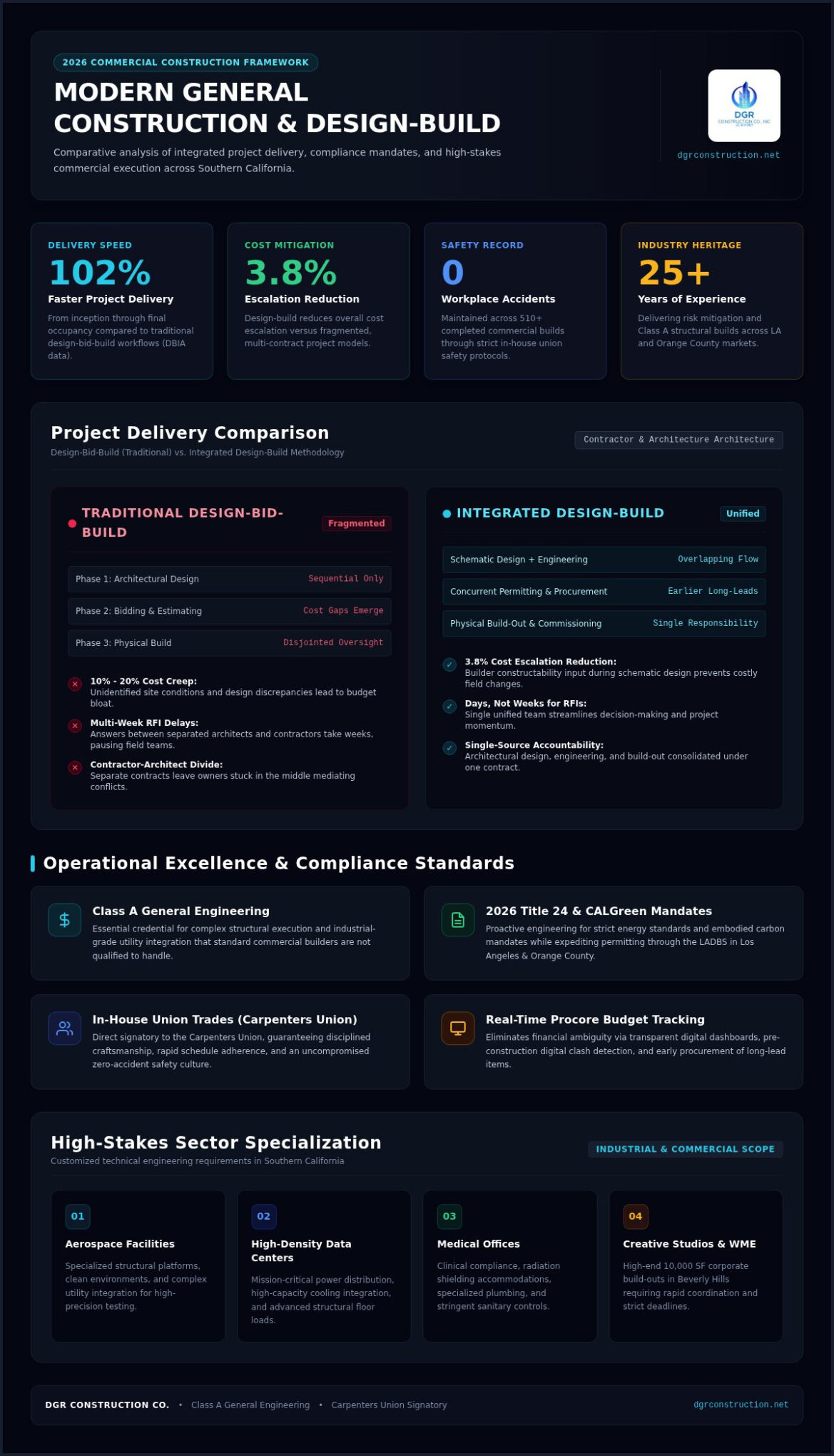
The design-build model represents a fundamental shift in how commercial entities approach general construction. By integrating design and construction under a single contract, this methodology allows phases to overlap, which saves months on the total schedule. According to the Design-Build Institute of America, this delivery method is 102% faster than traditional workflows from inception through occupancy. It reduces administrative overhead by consolidating architectural and engineering contracts, ensuring the builder is involved from the earliest schematic stages. When a contractor provides input during design, budget accuracy improves because the team addresses constructability issues before they become expensive field changes.
Eliminating the Architect-Contractor Divide
Fragmented communication is the primary cause of project friction. In a traditional setup, delays often trigger a blame game between the architect and the contractor, leaving the owner to mediate. Design-build creates a unified team that shares responsibility for the outcome of the general construction process. This structure streamlines the Request for Information (RFI) process; answers that usually take weeks now arrive in days. For example, DGR Construction Co. applied this integrated approach to 10,000 SF build-outs for WME in Beverly Hills, where rapid coordination was essential to meet strict entertainment industry deadlines.
Cost Control and Financial Transparency
Traditional bidding often leads to a 10-20% cost creep as hidden site conditions or design gaps emerge. Design-build projects typically achieve a 3.8% reduction in cost escalation compared to separate tracks. DGR uses Procore to provide real-time budget tracking and daily field logs, giving clients complete transparency into the project’s financial health. We coordinate directly with MEP and structural teams to ensure technical systems are optimized for the building’s specific needs. If you’re planning a complex facility, exploring the design-build model can significantly mitigate financial risk.
In-house union trades further facilitate this speed. By utilizing our own drywall and T-bar teams, we can begin preliminary site work while final architectural details are being polished. This proactive stance ensures that the transition from design to physical build-out is frictionless and professional.
Specialized General Construction: Aerospace, Data Centers, and Medical
High-stakes commercial sectors require a level of technical literacy that standard builders often lack. Whether it’s the precise environment of an aerospace clean room or the high-density power requirements of a data center, general construction in these fields is a matter of engineering precision. DGR Construction Co. approaches these projects by identifying the specific regulatory and structural hurdles early in the design-build phase. This proactive management style prevents the technical bottlenecks that typically stall specialized facilities.
Aerospace and Industrial Precision
Meeting the strict assembly and clean room requirements in hubs like El Segundo requires an expert understanding of air filtration and anti-static flooring. For companies seeking Aerospace Facility Construction in California, the focus often centers on large-scale warehouse improvements and the installation of heavy-duty structural platforms. These projects demand meticulous oversight to ensure every square foot meets the rigorous standards of the aerospace industry. Our team manages these complexities by integrating structural engineering with specialized utility build-outs, ensuring the facility is operational on day one.
In the healthcare sector, compliance is non-negotiable. Medical office construction must adhere to strict ADA standards and the Cal/OSHA Construction Safety Orders to protect both staff and patients. Specialized general construction for data centers requires a similar focus on power redundancy and T-bar ceiling systems designed for high-volume airflow. By self-performing many of these technical installs, we maintain a level of quality control that third-party subcontractors often struggle to match.
High-End Media and Technology Build-Outs
Creative spaces in urban centers like DTLA and Hollywood present their own set of challenges, particularly regarding acoustic privacy. The Ratner/OBB Media project serves as a prime example of this complexity. This state-of-the-art 10,000+ SF studio required the integration of radius walls and high-end AV components while maintaining strict STC-rated sound isolation. To protect HIPAA privacy in medical suites or ensure recording quality in studios, we utilize specialized wall and ceiling assemblies that eliminate sound leakage. The result is a Zen environment where technology and architecture coexist without the interference of high-traffic urban noise.
Operational Excellence: Managing Timelines and Safety in SoCal
Operational success in Southern California is defined by the ability to manage what others leave to chance. In the landscape of general construction, the most significant delays often stem from unreliable third-party scheduling and fragmented communication. DGR Construction Co. mitigates these risks by prioritizing self-performance and digital transparency, ensuring that every project milestone is met with precision. This methodical approach transforms the chaos of a job site into a structured, professional environment that respects both your time and your capital.
The Power of In-House Union Labor
As a signatory to the Carpenters Union, DGR maintains a direct workforce of skilled tradespeople specializing in drywall and T-bar systems. This capability allows us to start critical trades as soon as designs are sufficiently advanced, often weeks before a traditional contractor could secure a reliable subcontractor. By eliminating the middleman markup and avoiding the scheduling conflicts typical of outside vendors, we streamline the path to tenant occupancy. Higher craftsmanship is guaranteed when the team is directly accountable to the project leadership, ensuring that architectural details are executed exactly as intended.
Technology-Driven Project Management
This commitment to precision extends to the final aesthetic stages of a build, where specialized expertise in high-end finishes is required. For those looking for industry-leading standards in restoration and professional finishes, Crandall Painting & Stucco serves as a prime example of the quality needed to finalize a premium commercial space.
We utilize Procore to bridge the gap between the field and the client’s office. This platform serves as a single source of truth for managing submittals, as-builts, and close-out packages digitally. Clients receive daily reports and weekly “look-aheads” that provide total transparency into site progress. For leaders seeking a reliable Industrial Construction Company Los Angeles, this digital-first approach provides the daily peace of mind that comes from real-time monitoring. It ensures that every stakeholder remains informed and that potential bottlenecks are resolved before they impact the critical path.
Maintaining a record of zero workplace accidents is not a matter of luck; it’s the result of disciplined safety management. Our teams adhere to strict protocols that exceed standard requirements, ensuring a secure environment for every worker and visitor. This discipline extends to regulatory compliance, particularly when navigating the intricate permitting processes of Los Angeles and Orange Counties. We stay ahead of the January 1, 2026, Title 24 energy code updates, ensuring that your facility meets the latest ventilation and heat pump mandates without last-minute design revisions. If you’re ready to experience a more disciplined approach to your next build, partner with DGR for a frictionless construction experience.
Selecting Your General Construction Partner in Los Angeles & Orange County
Selecting a partner for general construction in Southern California isn’t just about finding a builder; it’s about securing a stabilizer for your investment. In markets as volatile as Los Angeles and Orange County, you need a firm that understands the technical nuances of specialized sectors. Verify that your potential partner holds a Class A General Engineering license, which is necessary for high-scale structural work. Additionally, ensure they carry at least $3 million in both public liability and workers’ compensation insurance. These credentials aren’t just formalities; they represent a baseline of professional accountability and risk management.
Local rootedness matters because the permitting dynamics in Beverly Hills differ significantly from the industrial requirements in Carson or the high-rise constraints of DTLA. A firm that lacks this regional experience will likely struggle with the specific logistical hurdles of these distinct submarkets. Evaluate their communication rhythm early on. Professional teams provide weekly meeting minutes and consistent schedule updates to ensure stakeholders are never left in the dark. A portfolio that spans from aerospace facilities to high-end retail build-outs demonstrates the versatility needed to handle 2026’s complex regulatory environment.
Critical Questions for Your Potential Contractor
To drill down into a firm’s operational health, you’ve got to ask specific, targeted questions. A contractor who relies entirely on third-party subcontractors often loses control over the project’s pace and quality. Seeking a partner with signatory status to the Carpenters Union ensures that the labor on your site meets elite craftsmanship standards. Consider asking the following during your vetting process:
- Do you self-perform any trades, such as drywall or T-bar, to ensure schedule control?
- What is your safety record, and can you provide documentation of zero workplace accidents?
- Can you manage the project from the initial design-build phase through to furniture installation?
The DGR Construction Commitment
DGR Construction Co. brings a legacy of over 510 completed projects and a track record of serving 146 satisfied corporate clients. Our mission is to make the experience of general construction feel seamless and clean, removing the typical stress associated with large-scale commercial builds. We don’t just build structures; we manage the entire professional experience to ensure it’s frictionless from the first meeting to the final close-out. Our A+ BBB rating and commitment to precision make us the stabilizing force your next project requires.
Start your next commercial project with DGR Construction
Building Your Future with Strategic Precision
The evolution of general construction in 2026 requires a transition from fragmented management to unified, design-build leadership. By consolidating architectural vision with in-house union craftsmanship, commercial leaders can bypass the traditional friction of cost overruns and scheduling delays. Successful projects in Los Angeles and Orange County now rely on this single point of accountability to navigate complex Title 24 mandates and rigorous technical standards.
DGR Construction Co. serves as a stabilizing partner throughout this process. With over 25 years of experience and a documented record of zero workplace accidents, we provide the meticulous oversight necessary for high-stakes aerospace, medical, and industrial facilities. Our status as a signatory to the Carpenters Union and our A+ BBB rating reflect a disciplined commitment to quality that protects your capital and ensures long-term structural excellence.
If you’re ready to transform your next build into a frictionless, professional experience, we’re here to help. Request a Consultation for Your Commercial Build-Out and let us manage your project with the precision it deserves. We look forward to helping you build a legacy of quality in Southern California.
Frequently Asked Questions
What is the difference between a general contractor and a design-build firm?
A traditional general contractor usually executes a pre-existing design, while a design-build firm manages the entire project from architectural development to final build-out. This model provides a single point of responsibility for general construction, which simplifies communication and reduces administrative friction. By consolidating design and construction under one contract, we eliminate the common disconnects between architects and builders that often lead to project delays or budget overruns during execution.
How long does a typical 10,000 SF tenant improvement project take in Los Angeles?
A 10,000 SF tenant improvement project in Los Angeles typically takes six months to over a year to complete. The duration depends on technical complexity and the LADBS plan check process, which averages 60 to 90 days. Our design-build model saves significant time by allowing in-house trades to begin site preparation while design details are finalized. This overlap ensures a more efficient transition from the initial concept to final tenant occupancy.
Does DGR Construction handle the permitting process with the city?
DGR Construction Co. manages the entire permit processing phase as a core component of our design-build service. We coordinate directly with municipal agencies across Los Angeles and Orange County to navigate the nuances of Title 24 energy code compliance. This hands-on management removes the stress of administrative navigation from the client, ensuring that all structural and MEP plans are fully approved before our building teams arrive on the job site.
Why is in-house union labor better than using third-party subcontractors?
In-house union labor provides superior schedule control and craftsmanship compared to third-party subcontractors. As a signatory to the Carpenters Union, we employ skilled tradespeople who are directly accountable to our project managers. This eliminates middleman markups and scheduling conflicts, allowing us to maintain a record of zero workplace accidents. It’s a more reliable way to deliver general construction results that meet the strict quality standards our commercial clients expect.
What specialized construction standards are required for aerospace facilities?
Aerospace facilities require specialized environments such as clean rooms with advanced air filtration and anti-static flooring. These projects often demand heavy-duty structural platforms and complex utility integration to support manufacturing equipment. We manage these high-precision requirements by incorporating technical engineering standards into the initial design phase. This ensures the facility meets all Cal/OSHA and industry-specific safety mandates, providing a functional space that is ready for immediate operation upon project completion.
How does DGR Construction ensure projects stay under budget?
We stay under budget by leveraging our design-build model and self-performing critical structural trades. Early involvement during the design phase allows our team to identify constructability issues before they become expensive field changes. We utilize Procore software to provide real-time budget tracking and daily reporting, ensuring total financial transparency. This proactive approach prevents the 10 to 20% cost creep often associated with traditional bidding processes that lack integrated management and oversight.
What areas of Southern California does DGR Construction serve?
Our team serves commercial clients throughout the Greater Los Angeles Area and Orange County. We have completed significant projects in high-profile regions such as Downtown Los Angeles, Beverly Hills, West Hollywood, and Carson. This local presence allows us to master the specific logistical challenges and permitting requirements of each district. Whether it’s a high-rise build-out or an industrial renovation, we bring a deep understanding of Southern California’s unique construction landscape.
Is DGR Construction licensed and insured for large-scale commercial projects?
DGR Construction Co. is fully licensed and insured for large-scale commercial projects, holding a Class A General Engineering license. We carry $3 million in public liability insurance and $3 million in workers’ compensation coverage to ensure total project security. Our A+ BBB rating and record of over 510 completed projects reflect a commitment to professional excellence. Clients can verify our standing through the CSLB, confirming our status as a reputable and dependable building partner.