What if the most significant cost in your next project isn’t the steel or the concrete, but the weeks lost to fragmented communication and regulatory hurdles? In a market where the 2025 wildfires have introduced a 10% labor premium and LADBS permit wait times often stretch to three months, the complexities of commercial construction management Los Angeles projects face have never been more daunting. You likely recognize that the traditional, disconnected approach to building no longer works in a city with such stringent code requirements and volatile material costs.
We understand that as an owner, you’re seeking more than just a builder; you need a stabilizing force that ensures transparency and protects your bottom line. This 2026 guide provides the expert framework required to master the LA market, from implementing design-build strategies to navigating the latest Title 24 energy standards. We will examine how a unified management approach reduces cost overruns, simplifies compliance with California’s strict ADA laws, and ultimately delivers a streamlined path from initial design to final occupancy.
Key Takeaways
- Navigate the 2026 Los Angeles regulatory landscape to anticipate how evolving zoning and building standards impact your project’s timeline.
- Optimize project delivery by leveraging the design-build model for single-source accountability and earlier cost clarity in commercial construction management los angeles.
- Eliminate middleman markups and ensure superior craftsmanship by partnering with a firm that self-performs work and is signatory to the Carpenters Union.
- Identify the five essential criteria for vetting a general contractor, from verifying Class A licenses to auditing industry-specific portfolios.
- Streamline high-stakes projects like aerospace facilities or data centers by integrating real-time project management software and comprehensive oversight.
The Landscape of Commercial Construction Management in Los Angeles
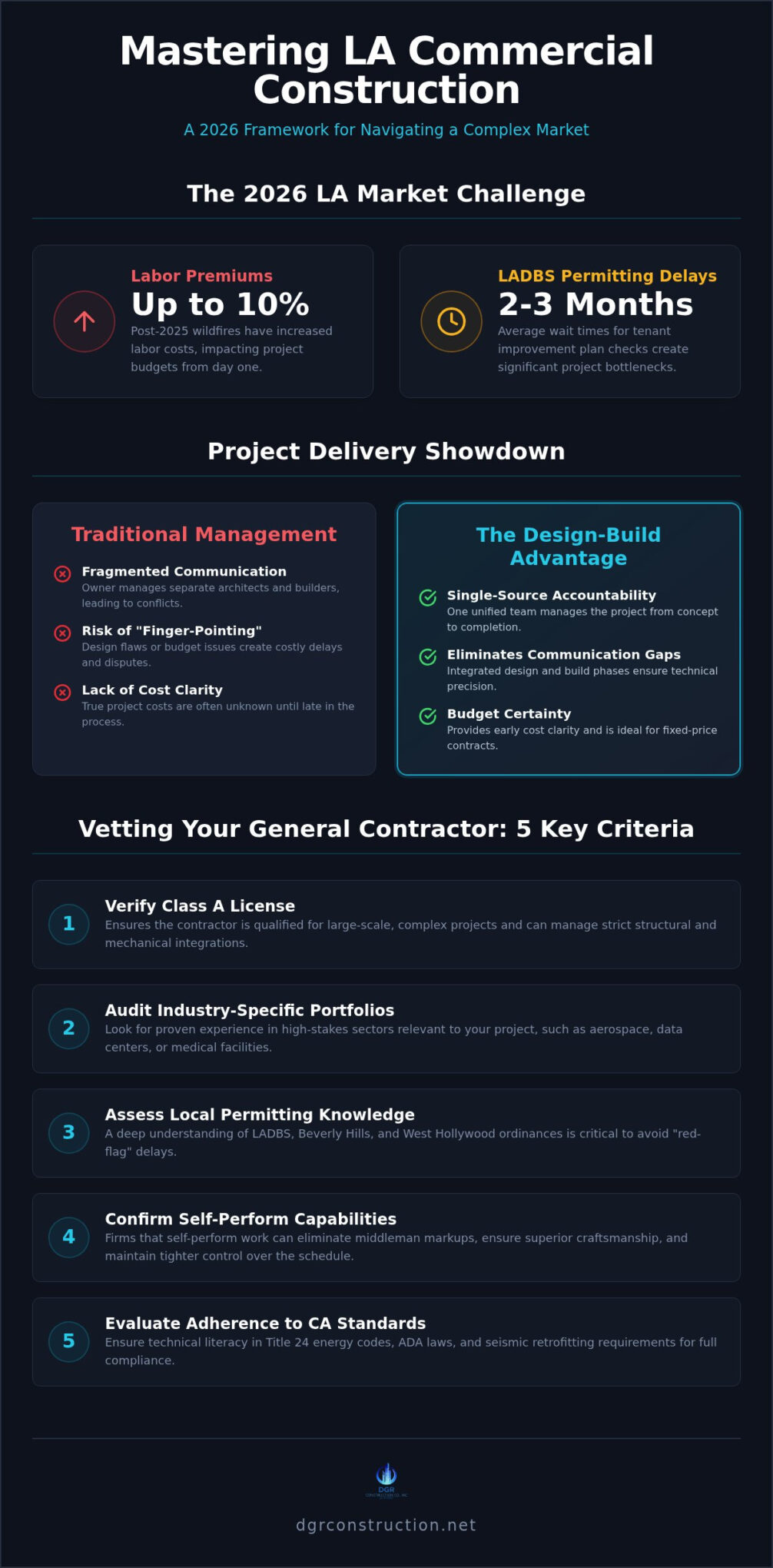
The Southern California market is currently defined by high demand and constrained resources. Following the 2025 wildfires, labor premiums of 5 to 10 percent have become the baseline for new projects. Managing these variables requires a sophisticated approach to Construction Management that prioritizes early cost clarity and technical oversight. A basic search for a “General Contractor Los Angeles” often returns results that lack the specialized experience required for high-stakes environments. Owners now need partners who understand the technical nuances of specific sectors like aerospace, data centers, or medical offices to avoid costly mid-project pivots.
Navigating LA County and DTLA Permitting
The Los Angeles Department of Building and Safety (LADBS) remains a significant bottleneck for developers. For full tenant improvements, plan check wait times currently average two to three months. In jurisdictions like Beverly Hills or West Hollywood, local ordinances add layers of complexity that can stall a project before the first hammer swings. Experienced commercial construction management los angeles specialists anticipate these “red-flag” delays by maintaining deep local knowledge and ensuring submittals are technically perfect on the first pass. This proactive coordination prevents the common cycle of revisions that exhausts budgets and delays occupancy.
Meeting California’s Strict Construction Standards
Building in 2026 requires strict adherence to the latest Title 24 energy standards. These mandates now require heat pump expansion for commercial HVAC, ASHRAE Guideline 36 controls, and electric-ready commercial kitchens. Beyond energy, seismic retrofitting remains a non-negotiable priority for high-rise environments and older industrial structures. Ensuring compliance requires a Class A licensed contractor who possesses the technical literacy to manage structural wall requirements and complex mechanical integrations. DGR Construction Co. leverages over 25 years of experience as a signatory to the Carpenters Union to ensure these technical standards aren’t just met, but are executed with the precision that large-scale builds demand.
Construction Management vs. Design-Build: Which Model Wins?
High-stakes sectors like aerospace and data center construction increasingly favor the design-build approach. These projects demand extreme precision and leave no room for communication gaps. By integrating the design and construction phases, technical requirements for sensitive laboratory environments or high-density server rooms are baked into the plan from day one. Regarding contracts, 2026 has seen a shift. While cost-plus contracts offer flexibility in a volatile material market, fixed-price contracts within a design-build framework provide the budget certainty that many institutional owners now require.
The Single Point of Responsibility
The primary friction in traditional projects is the potential for “finger-pointing” between the architectural team and the builders. If a design element is unbuildable or exceeds the budget, the owner typically bears the cost of the delay. Design-build eliminates this risk by establishing a unified project manager. This professional serves as the sole point of accountability, ensuring that the design remains tethered to the reality of the construction budget. For more on vetting these partners, see our guide on Choosing the Right Commercial General Contractors.
Speeding Up Occupancy with Integrated Delivery
Integrated delivery allows for a “fast-track” schedule where construction begins while final design details are still being refined. This overlap can save weeks on a project timeline. It is particularly effective for complex MEP (Mechanical, Electrical, and Plumbing) systems. By coordinating these structural elements early, the team avoids the collisions that typically occur during the build phase. This efficiency is why many owners now explore our design-build methodology as a way to mitigate the labor constraints currently facing the Southern California market.
Our approach at DGR Construction Co. extends beyond the structural shell. As a signatory to the Carpenters Union, we use our in-house expertise to manage everything from furniture coordination to the final clean-up. This ensures the transition from a construction site to a functional workplace is seamless and professional. We manage the entire experience to ensure it is frictionless, allowing you to focus on your operations while we handle the technical execution.
The Competitive Edge: Self-Perform Work and Union Labor
In the context of commercial construction management los angeles, the term “self-perform” refers to a general contractor’s ability to execute specific trades using their own skilled workforce. Many firms in Southern California operate strictly as brokers. They manage subcontractors but don’t employ the people actually performing the work. While this model has its place, it often introduces a middleman markup and creates a layer of insulation between the owner and the craftsmanship. A contractor who self-performs critical trades like drywall and T-bar ceilings offers a distinct advantage in both quality control and financial transparency.
Directly employing the labor force ensures that every detail aligns with the project’s technical standards. There is no ambiguity regarding who’s responsible for the finish. When the team on-site is accountable to the same leadership as the project manager, the result is a cleaner, more collaborative environment. This integration is particularly valuable for complex tenant improvements where the margin for error is slim and the schedule is aggressive. It allows for a level of oversight that pure management firms simply cannot match.
Why Union Signatory Status Matters in LA
DGR Construction Co. is signatory to the Carpenters Union, a commitment that guarantees a high level of technical proficiency. Union labor is synonymous with precision. For specialized projects like recording studios or aerospace facilities, the acoustic and structural requirements are unforgiving. Carpenters trained through the union apprenticeship programs possess the craftsmanship required to meet these rigorous specifications. This status also ensures strict adherence to safety protocols, contributing to a record of zero workplace accidents. It provides peace of mind for owners who can’t afford the liability or delays associated with substandard safety practices.
Cost Savings and Timeline Control
Control over the schedule is perhaps the most tangible benefit of the self-perform model. Following the 2025 wildfires, many subcontractors in the Los Angeles area are booked six to twelve months in advance. This scarcity often leads to “ghosting” or sudden price hikes. By managing an in-house crew, we eliminate the reliance on third-party availability. We can pivot schedules immediately. If a mechanical installation is completed ahead of time, our drywall team can mobilize the next day without the administrative friction of coordinating with an outside company.
This efficiency translates directly to cost savings. Beyond removing the subcontractor’s profit margin, direct labor management reduces administrative overhead. We utilize Procore software to provide real-time reporting on labor hours and project progress. This level of oversight ensures that every dollar is accounted for and that the project remains on a steady, logical path toward completion. It’s a disciplined approach that values your resources as much as the final physical product.
Evaluating a General Contractor Los Angeles: 5 Key Criteria
Selecting a partner for commercial construction management los angeles requires a disciplined vetting process that goes beyond a simple bid comparison. While the needs of a medical office differ from a residential expansion, the core requirement for a licensed, professional team remains; for example, coastalcontract.com provides a baseline of Class A quality for those exploring remodeling or additions. To protect your investment and ensure a frictionless experience, you must evaluate potential partners based on five distinct criteria. These markers of operational excellence separate the “quiet experts” from those who rely on high-pressure sales tactics.
- Industry-Specific Portfolio: Reviewing a general portfolio isn’t enough. You need to see evidence that the firm has built for your specific sector, whether it’s an aerospace facility or a complex tenant improvement.
- Verifiable Credentials: Ensure the firm holds a Class A license and carries substantial public liability insurance. These are non-negotiable markers of professional stability.
- Communication Cadence: Reliable partners provide weekly updates and daily field reports. This removes the “black box” of construction and keeps you informed of every milestone.
- Safety Records: A firm’s safety record is a direct reflection of their operational discipline. Look for zero-accident milestones and rigorous on-site protocols.
- Technology Stack: Modern management relies on real-time data tracking for RFIs, submittals, and as-builts. Without a digital core, projects are prone to human error and documentation gaps.
Leveraging Project Management Software
Transparency shouldn’t be a luxury. We utilize Procore software to centralize all project documentation, providing owners with daily peace of mind through real-time access to site photos and field reports. By digitizing the workflow, we eliminate the delays caused by paper-based communication and ensure that as-builts are updated in real-time. This level of technical oversight ensures that every stakeholder is looking at the same data. You can contact our team to see how our digital integration simplifies project oversight. For a deeper look at our protocols, review our 2026 Commercial Construction Safety Guide.
Industry-Specific Expertise: Aerospace to Healthcare
Building a retail storefront is vastly different from constructing a data center or a medical office. Specialized building requires more than general knowledge; it demands an understanding of precise environmental controls and structural tolerances. For instance, medical office construction must account for strict infection control and complex medical gas piping. High-end recording studios require advanced acoustic isolation that generalists often overlook. We’ve completed projects for high-profile clients like WME and OBB Media, proving our ability to manage the unique demands of media and entertainment spaces with precision and craftsmanship.
DGR Construction: Professional Management for Complex Projects
Danny founded DGR Construction Co. with a vision of bringing precision and professional stability to an often fragmented industry. For over 25 years, we have served as a primary point of accountability for owners navigating the complexities of the Southern California landscape. Our approach to commercial construction management los angeles is built on the foundation of our Class A license and our status as a signatory to the Carpenters Union. These aren’t just credentials; they are markers of a disciplined culture that values craftsmanship as much as the final budget. We don’t just build structures; we manage the entire experience to ensure it is frictionless and professional.
We prioritize a seamless, clean, and collaborative construction process. This means our job sites are organized, our communication is transparent, and our teams are fully integrated. Our success with high-profile clients like WME in Beverly Hills and OBB Media in West Hollywood illustrates our ability to manage the technical nuances of media and entertainment spaces. In these projects, we didn’t just meet the deadline; we ensured that the client’s best interests were protected through every phase of the design-build cycle. By utilizing Procore for real-time reporting, we maintain a level of transparency that gives owners daily peace of mind.
From 707 Wilshire to El Segundo: Our Local Impact
Managing high-rise renovations in the heart of DTLA, such as projects at 707 Wilshire, requires specialized logistical planning. We understand the constraints of working in occupied buildings where noise mitigation and vertical transportation are critical. Our impact extends to the aerospace hubs of El Segundo and Carson, where we provide the structural precision required for sensitive industrial facilities. This deep local rootedness ensures that we understand the specific nuances of each neighborhood’s building standards and permitting hurdles. For owners looking at regional expansion, we also offer a comparative guide to Industrial Design Build Orange County to assist in strategic planning.
Building Your Vision into Reality
Every project we undertake is a start-to-finish partnership. We provide a tailored approach to every detail, from the early MEP coordination to the furniture installation and the final clean. This comprehensive oversight is the reason why 146 happy clients have trusted us with their most critical assets. We take pride in the fact that much of our work comes from recurring projects, a testament to the reliability and stability we bring to the table. Our team is disciplined, meticulous, and results-driven, ensuring that your vision is realized without the stress typically associated with large-scale construction. Schedule your consultation at dgrconstruction.net to begin planning your next Los Angeles project with a partner committed to your success.
Securing Your Project’s Future in the Los Angeles Market
Navigating the 2026 Southern California landscape requires a partner who understands that precision and transparency are non-negotiable. By prioritizing integrated project delivery and leveraging the technical expertise of a union-signatory workforce, you can mitigate the risks of cost overruns and regulatory delays. Mastering commercial construction management los angeles is about more than just oversight; it is about establishing a singular point of accountability that protects your investment from the design phase to final occupancy.
DGR Construction Co. brings over 25 years of experience to every build. As a Certified Minority Contractor and a signatory to the Carpenters Union, we maintain an A+ BBB Rating and a record of zero workplace accidents. We manage the technical complexities so you don’t have to, ensuring your high-stakes project remains on a steady, logical path. Our approach values your time and resources as much as the final physical product.
Streamline your next LA project with DGR Construction and experience a partnership defined by craftsmanship and operational excellence. We look forward to building your vision into a reality that serves your business for years to come.
Frequently Asked Questions
What is the difference between a general contractor and a construction manager in Los Angeles?
A construction manager typically acts as the owner’s representative, focusing on oversight, budgeting, and coordination throughout the project lifecycle. In contrast, a general contractor is responsible for the physical build and day-to-day site management. Choosing a partner who offers comprehensive commercial construction management los angeles allows you to bridge this gap. This integrated approach ensures that the person managing the budget also understands the technical requirements of the construction phase.
How much does commercial construction management typically cost in Southern California?
Management fees in Southern California generally scale with project complexity and the scope of services provided. Factors such as the 10 percent labor premium currently seen in the LA market and extended LADBS permit wait times can influence the overall project budget. While we don’t provide fixed pricing without a consultation, we focus on value engineering to offset these market pressures. This approach ensures your capital is utilized efficiently across every technical trade.
What are the benefits of the Design-Build model for tenant improvements?
The Design-Build model offers single-source accountability, which eliminates the friction between architects and builders. For tenant improvements, this model can save weeks on a project timeline by allowing construction to begin while final design details are refined. It provides earlier cost clarity and reduces the risk of expensive change orders. This integrated delivery method is particularly effective for businesses that need to occupy their new space quickly to maintain operations.
Why should I hire a union-signatory contractor for my LA project?
Hiring a union-signatory contractor, such as a firm signatory to the Carpenters Union, ensures your project is handled by highly trained tradespeople. Union labor is synonymous with precision and craftsmanship, which is essential for complex commercial builds. This status also guarantees adherence to strict safety protocols, contributing to our record of zero workplace accidents. It provides a level of professional stability that is often missing in the non-union sector of the market.
How does DGR Construction handle project delays and budget overruns?
We mitigate delays and overruns through meticulous planning and the use of Procore software for real-time tracking. By self-performing critical trades like drywall and T-bar ceilings, we maintain direct control over the schedule and eliminate subcontractor-related bottlenecks. If a delay occurs, we pivot our in-house crews immediately to keep the project on a steady path. This hands-on management style ensures that we protect the owner’s best interests at every stage.
What specialized construction services do you offer for the aerospace industry?
Our aerospace construction services focus on the technical requirements of sensitive industrial facilities in areas like El Segundo and Carson. We manage the installation of advanced environmental controls, specialized structural reinforcements, and clean-room environments. With over 25 years of experience, we understand the rigorous standards required for aerospace operations. Our team ensures that every technical specification is met with the precision that high-stakes aerospace projects demand from their management partners.
How can I track the daily progress of my construction project?
Owners can track daily progress through our integrated project management software, Procore. We provide real-time access to field reports, site photos, and documentation logs, ensuring you have daily peace of mind. This digital core removes the black box of construction by providing a transparent view of every milestone. You can review labor hours and project updates from any device, allowing for a collaborative and informed relationship between the owner and the manager.
Do you handle permitting and architectural design as well as building?
Yes, our Design-Build approach includes the management of architectural design and the permitting process with the Los Angeles Department of Building and Safety. We navigate the complexities of LA County and DTLA permitting to expedite plan checks, which currently average two to three months. By coordinating these phases internally, we ensure that the design is buildable and remains within your budget. This start-to-finish partnership simplifies the entire experience for the project owner.


Pingback: Commercial General Contracting: 2026 Project Guide