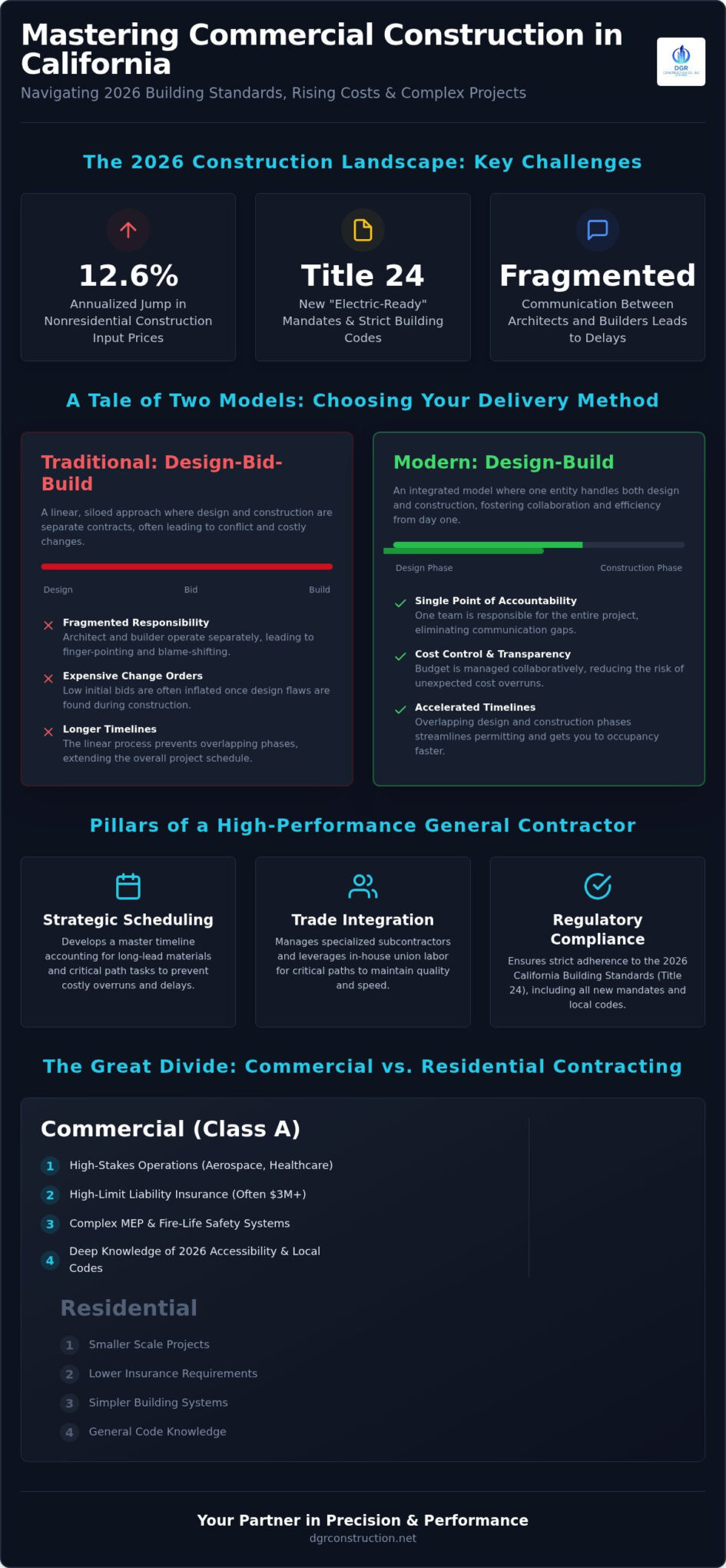
Nonresidential construction input prices jumped at a 12.6% annualized rate in early 2026, leaving many developers wondering if their original budgets are still worth the paper they’re printed on. You likely feel the weight of these rising costs alongside the anxiety of the new Title 24 “Electric-Ready” mandates and the frustration caused by fragmented communication between architects and builders. It’s a high-stakes environment where a single oversight can lead to months of delays. In this climate, the traditional approach to general contracting often fails to address the modern reality of California’s regulatory and economic landscape.
We understand that your primary goal is to move from a blueprint to a finished structure without the typical stressors of hidden fees or code-related setbacks. This guide helps you master the complexities of commercial construction by introducing a streamlined delivery model designed to save time and preserve your capital. We’ll provide a clear framework for evaluating contractor capabilities and a strategy to reduce project timelines. By the end of this article, you’ll have a roadmap to navigate the 2026 building standards with confidence, ensuring your next build is both efficient and professionally executed.
Key Takeaways
- Understand the critical role of a commercial general contractor as the primary point of accountability for your project’s timeline, budget, and safety standards.
- Discover why the design-build delivery model is the preferred method for complex 2026 builds to eliminate communication gaps and reduce overall project costs.
- Learn how specialized in-house union labor and integrated management software provide the real-time transparency necessary for modern general contracting projects.
- Identify the essential criteria for evaluating Class A licensed firms in Southern California to ensure strict compliance with the latest Title 24 building codes.
- Explore strategies to accelerate your path to occupancy by overlapping design and construction phases to streamline the permitting process in LA and Orange County.
What is General Contracting in Commercial Construction?
In the commercial sector, general contracting serves as the primary point of accountability for a project’s entire lifecycle. While many view a contractor simply as a builder, a sophisticated firm acts as the orchestrator of complex systems, legal requirements, and logistical hurdles. For high-stakes sectors like aerospace and healthcare, where precision is non-negotiable, the GC manages every detail from initial permit processing to the final coordination of specialized equipment. Understanding What is a General Contractor? involves recognizing their role as a strategic partner who mitigates risk and ensures that a massive capital investment translates into a functional, compliant asset. At DGR Construction Co., we position ourselves as the singular stabilizing force that manages these moving parts so the client doesn’t have to.
The Core Responsibilities of a Modern GC
A modern firm manages what’s known as the “Golden Triangle” of construction: scope, budget, and schedule. This requires a level of oversight that extends far beyond the job site. It involves coordinating specialized trades, professional engineering teams, and architectural consultants to ensure no detail is lost in transition. The responsibilities are comprehensive and include:
- Strategic Scheduling: Developing a master timeline that accounts for long-lead materials and critical path tasks to prevent costly overruns.
- Trade Integration: Managing specialized subcontractors while often utilizing in-house union labor for critical paths like drywall and T-bar to maintain speed.
- Regulatory Compliance: Ensuring strict adherence to the 2026 California Building Standards Code (Title 24), which includes the latest “Electric-Ready” mandates for commercial kitchens and mandatory battery storage systems.
Commercial vs. Residential Contracting: Key Differences
The gap between residential remodeling and commercial construction is vast. While those looking for home-scale upgrades can find out more about Kitchen Remodeling with Dragger’s Handyman Service, a Class A commercial contractor must handle a scale of operations that residential builders simply aren’t equipped for. This includes the necessity of high-limit liability insurance, often matching or exceeding $3M, to protect the client’s interests in high-value environments like data centers or medical offices.
The technical complexity of MEP (Mechanical, Electrical, and Plumbing) systems in a commercial build is also significantly higher. For instance, a commercial tenant improvement in Los Angeles requires a deep understanding of fire-life safety systems and updated 2026 accessibility requirements that prohibit dining table floor space from overlapping with accessible routes. Navigating these specific local nuances requires a partner with a long-standing local presence and a track record of reliability. This specialized focus ensures that the project moves through the permitting phase without the friction common in less experienced hands.
The Evolution of Delivery Models: Traditional GC vs. Design-Build
The landscape of 2026 requires more than just oversight; it requires total integration. Comparing various construction project delivery methods reveals a significant shift toward models that prioritize collaboration over competition. In a market where California construction pricing sits roughly 30% above the national midpoint, the delivery model you choose directly dictates your project’s financial viability. Traditional general contracting has historically relied on a linear progression, but modern demands for speed and budget control have accelerated the adoption of the design-build model.
Traditional Design-Bid-Build: The Costs of Fragmentation
The traditional “Design-Bid-Build” model creates a siloed environment where the architect and the builder operate under separate contracts. This fragmentation often leads to a cycle of finger-pointing when design intent clashes with field reality. You might face the “bid day” trap, where the lowest initial price is used as a placeholder, only to be inflated by expensive change orders once construction begins. This model often results in:
- Misaligned Expectations: Separate teams often have conflicting priorities regarding materials and construction methods.
- Administrative Overhead: Managing multiple contracts increases the burden on your internal team and complicates communication.
- Delayed Schedules: Construction cannot begin until the design is 100% complete, extending the path to occupancy by weeks or months.
The Design-Build Advantage for 2026
Design-build eliminates these silos by providing a single point of accountability. By integrating architectural design and engineering under one roof, we can start construction while the design is still being finalized. This “Speedy Service” model is essential when steel pipe prices have risen 12.5% and cement has climbed 7.7% year-over-year. Locking in procurement early saves months of potential delays and protects your budget from price volatility. For a deeper look at how this applies to specialized facilities, see our Industrial Design Build Orange County guide.
The ROI of this streamlined system isn’t just found in the final numbers; it’s found in the lack of friction throughout the process. A modern approach to general contracting should prioritize this single-source responsibility. When a single firm manages the entire experience, from the first sketch to the final clean, the risk of miscommunication evaporates. If you’re planning a complex build in 2026, choosing a partner who offers integrated design-build services is the most effective way to protect your investment and ensure a professional, frictionless result.
Key Pillars of a High-Performance General Contracting Firm
High performance in general contracting is defined by a firm’s ability to internalize risk and externalize transparency. It isn’t enough to simply manage a job site; a contractor must manage the entire professional experience. Safety serves as a primary example of this philosophy. A record of zero workplace accidents isn’t just a point of pride. It’s a significant financial asset that lowers insurance premiums and prevents the catastrophic delays associated with regulatory investigations. When you are Evaluating General Contracting Services, sophisticated clients look beyond the initial bid price to the systems that protect their long-term investment.
The Power of Self-Perform Labor
Relying solely on third-party subcontractors introduces variables that can jeopardize a project’s critical path. High-performance firms mitigate this risk by utilizing self-perform labor for essential trades. At DGR Construction Co., our in-house union drywall and T-bar teams allow us to maintain total control over both quality and speed. This internal workforce ensures that craftsmanship standards remain consistent across sensitive environments, such as aerospace facilities or medical offices. By reducing reliance on external schedules, we can compress timelines and eliminate the markup often associated with additional layers of subcontracting.
Technology-Driven Transparency with Procore
The technical complexity of 2026 builds, with their intricate “Electric-Ready” mandates and Title 24 requirements, demands a centralized communication hub. Procore provides this by centralizing RFIs, submittals, and daily reports into a single, accessible source of truth. This technology eliminates the frustration of fragmented communication that often occurs between architects and builders. Clients gain 24/7 access to project drawings and as-builts, ensuring they are never left in the dark regarding the status of their build.
We use “look-aheads” within the software to solve logistical bottlenecks before they manifest on the construction floor. This proactive approach is vital when material costs, such as the 12.6% jump in nonresidential inputs seen in early 2026, require precise procurement strategies. Real-time transparency ensures that every stakeholder is aligned from day one. This meticulous level of oversight makes high-stakes projects feel manageable, providing the stability and reassurance necessary for successful large-scale execution.
Evaluating General Contracting Services in Southern California
Selecting a partner for general contracting in Southern California requires a focused assessment of localized expertise. The regulatory environment in Los Angeles and Orange County is unique, characterized by high-density logistics and some of the nation’s most stringent building codes. A firm’s ability to navigate these specific friction points determines the project’s success. Whether you are planning a tenant improvement in a high-rise or a ground-up aerospace facility, the contractor must demonstrate a track record of managing the administrative and physical hurdles inherent to the region.
Local Compliance and Permitting Expertise
Navigating the 2026 California Building Standards Code (Title 24) is a primary challenge for any modern build. These standards, which went into effect on January 1, 2026, introduced complex “Electric-Ready” mandates and solar-plus-battery storage requirements for new commercial structures. A contractor without a deep understanding of these updates risks costly permit rejections and construction delays. For example, new accessibility requirements for restaurants now prohibit dining table floor space from overlapping with accessible routes, a detail that requires precision during the design-build phase.
Experience in high-traffic urban areas like Downtown Los Angeles (DTLA) is equally vital. Managing material deliveries and site safety in these environments requires meticulous planning to avoid municipal fines and logistical bottlenecks. Owners navigating these challenges can benefit from reviewing our comprehensive guide to commercial construction management Los Angeles projects demand in 2026, which covers permit timelines, labor premiums, and unified management strategies specific to the LA market. Use our Commercial General Contractor Orange County Checklist to vet your next partner against these specific local criteria.
Assessing Financial Stability and Insurance
Financial resilience is a non-negotiable trait in a volatile market. With nonresidential input prices rising at a 12.6% annualized rate in early 2026, you need a partner with the bonding capacity and insurance limits to protect your capital. A $3 million public liability and workers’ compensation policy serves as the industry baseline for professional commercial work. This level of coverage, paired with a Class A License (LIC: 1010921 B/C9), ensures the firm is qualified to handle the structural and engineering demands of sensitive sectors like healthcare or industrial manufacturing.
Reliability is further evidenced by an A+ BBB rating and a clean standing with the California Contractors State License Board (CSLB). Beyond licensing, union affiliation remains a critical asset for large-scale and public works projects. With several Southern California trade unions seeing wage increases in July 2026, a union-affiliated contractor provides the labor stability and highly skilled workforce necessary to meet prevailing wage requirements and aggressive timelines. If you’re ready to secure a partner who understands the nuances of the SoCal market, consult with DGR Construction Co. to ensure your project is managed with professional precision.
Streamlining Your Path to Occupancy with DGR Construction
DGR Construction Co. integrates the fundamental pillars of modern general contracting to eliminate the friction typically associated with large-scale builds. With over 26 years of experience in the Los Angeles and Orange County markets, we’ve refined a methodology that prioritizes project stability and client peace of mind. Our approach isn’t just about erecting structures; it’s about managing the entire experience so your path to occupancy is as direct and professional as possible. By acting as a singular, stabilizing force, we ensure that complex projects remain manageable and controlled from the first consultation to the final clean.
The DGR Process: From Concept to Completion
Every successful project begins with a rigorous feasibility analysis. We evaluate the technical and regulatory landscape of your specific site to identify potential hurdles before they impact the budget. Once the project moves into the design-build phase, our team merges architectural aesthetics with functional engineering. This integration ensures that the design remains grounded in construction reality, preventing the “bid day” surprises common in fragmented models.
The final build-out concludes with our “white glove” close-out package. This phase extends beyond structural completion to include customized furniture coordination and final occupancy logistics. We understand that a building isn’t finished until it’s ready for your team to move in and begin operations. This comprehensive oversight removes the stress of managing multiple vendors during the critical final weeks of a project.
Why Experience Matters in High-Tech Sectors
Technical precision is non-negotiable in sensitive environments. We’ve established a track record of success in 10,000+ SF build-outs for aerospace, entertainment, and medical clients. These high-stakes sectors require a partner who understands the nuances of cleanroom standards, specialized MEP systems, and rigorous compliance. Our “Speedy Service” model is particularly effective here; we begin construction on foundational elements while the final design details are still being polished. This overlapping schedule compresses timelines without compromising the meticulous standards required for advanced facilities.
Building a long-term partnership relies on consistent results and transparent communication. We utilize the tools and labor strategies discussed earlier to ensure that every milestone is met with precision. For a deeper look at our technical capabilities, you can learn how we managed technical precision in our guide to Aerospace Facility Construction in California. If you’re ready to move forward with a partner who values your resources as much as the final product, contact DGR Construction Co. for a professional consultation to discuss your 2026 project goals.
Securing Your 2026 Project Success
Navigating the complexities of California’s 2026 building standards requires more than just technical skill; it demands an integrated strategy that prioritizes transparency and speed. Moving away from fragmented communication toward a single-source design-build model is the most effective way to eliminate hidden fees and ensure strict compliance with new “Electric-Ready” and solar mandates. A sophisticated approach to general contracting transforms the construction process from a source of stress into a controlled, professional journey toward occupancy.
At DGR Construction Co., we provide the stability and precision necessary for high-stakes builds in the aerospace, medical, and data center sectors. Our status as a signatory to the Carpenters Union, combined with our A+ BBB rating and a record of zero workplace accidents, reflects a serious commitment to operational excellence. We don’t just build structures; we manage the entire experience to ensure it’s frictionless and results-driven. When you’re ready to protect your investment and streamline your next build, partner with DGR Construction for your next commercial build. We look forward to helping you turn your vision into a functional reality.
Frequently Asked Questions
What is the difference between a general contractor and a construction manager?
A general contractor is the primary point of accountability for the actual construction work, while a construction manager often acts as a consultant or representative for the owner. In general contracting, the firm holds the direct contracts with subcontractors and takes on the financial and operational risk of the build. This structure provides a clearer line of responsibility, ensuring that one entity is answerable for the project’s quality, safety, and final delivery.
How much does commercial tenant improvement construction cost per square foot in 2026?
Pricing for tenant improvements in Southern California is influenced by several factors, including the specific sector and the level of technical complexity required. While Southern California construction costs are roughly 30% above the national midpoint, the final cost per square foot depends on the scope of mechanical, electrical, and plumbing upgrades. Projects in high-tech industries like aerospace or healthcare often require specialized materials that impact the total investment more than standard office renovations.
Why is a Class A license important for my commercial project in California?
A Class A license is essential because it signifies that the contractor has the specialized engineering knowledge required for complex, high-stakes infrastructure. This qualification is particularly important for industrial facilities, data centers, and aerospace projects where structural integrity and technical precision are paramount. In California, holding a Class A license ensures the firm is legally and professionally equipped to manage the large-scale engineering demands that a standard building license might not cover.
Can a general contractor help with the design and permit phase?
Yes, a firm specializing in the design-build model can manage the entire journey from the initial concept through the permit phase. By integrating these services, the contractor handles the administrative burden of permit processing while simultaneously developing the construction plans. This proactive approach identifies potential code hurdles early, preventing the delays that typically occur when architects and builders work under separate contracts without a unified strategy.
What are the benefits of hiring a contractor with in-house union labor?
Utilizing in-house union labor, such as specialized drywall and T-bar teams, provides a significant advantage in both speed and craftsmanship. It allows the contractor to bypass the unpredictability of the third-party subcontractor market, ensuring that skilled tradespeople are available exactly when the schedule demands. This internal control leads to more consistent quality and helps maintain a record of reliability that is essential for complex commercial projects.
How do I ensure my construction project stays under budget?
To keep a project under budget, involve your contractor during the feasibility and design stages. This early collaboration allows for value engineering, where the team identifies cost-effective materials and methods before the plans are finalized. Choosing a delivery model with a single point of accountability also reduces the risk of the expensive change orders that frequently arise from miscommunication between separate design and construction teams.
What software should my general contractor be using for project management?
A high-performance firm should utilize industry-leading construction management software like Procore to centralize all project data. This technology provides 24/7 access to drawings, submittals, and daily reports, ensuring total transparency for the client. By using a digital platform for general contracting, the team can pre-emptively solve logistical bottlenecks and keep every stakeholder aligned through a single source of truth throughout the project’s lifecycle.
How long does a typical 10,000 square foot office build-out take?
The timeline for a 10,000 square foot build-out usually ranges from 12 to 20 weeks, depending on the specific tenant improvement requirements. Factors such as custom finishes, specialized MEP systems, and long-lead material procurement can influence the schedule. Using a streamlined delivery model can help compress this timeline by overlapping the design and construction phases, allowing work to begin on-site while final details are still being polished.